Category: History

  • Thomas Mann on Wagner, Nietzsche and Freud

    Thomas Mann on Wagner, Nietzsche, and Freud – Germanness as reflected in modernity

    When Thomas Mann speaks, people listen – not only because of the elegance of his language, but also because of his sharp insight into German culture. In his lecture on Richard Wagner on February 10, 1933, he ventured an interpretation that removed the composer from the sphere of nationalistic veneration and placed him in the vicinity of another authority that was just beginning to take effect: Sigmund Freud’s new ideas.

    Thomas Mann portrays Richard Wagner as an artist of a broken modernity, as a figure who does not rest in sublimity but is marked by inner conflicts. The excess, the pathos, the ecstatic exaggeration of his music appear to Mann as symptoms of a psychological struggle – an expression of the unconscious that Freud had made visible for the first time.

    In this interpretation, Wagner’s “Germanness” is not understood as a proud, flawless force, but as a spiritual fabric of greatness and illness, of creative vision and corrosive self-analysis. For Mann, Wagner is not a national saint, but the first great representative of a modern, self-questioning Germany.

    But Thomas Mann did not stop at psychoanalytic interpretation. He drew further parallels – to Friedrich Nietzsche, the philosopher who was initially ardently devoted to the “Master of Bayreuth” before turning away from him in a radical break. For Mann, this relationship was particularly revealing: Nietzsche recognized in Wagner’s intoxication, demonism, and excess the danger of exaggeration that could tip over into pathology.

    In Nice, where Mann lived for a time, he sensed the same tension between illness and creation that Nietzsche had experienced so vividly in the south. Nice, with its light and its vastness, became a contrasting image for both of them—a place of recovery and clarity, but also of painful self-observation. For Mann, Wagner embodied the abysmal German, while Nietzsche represented the critical, clarifying authority that rejected this legacy and at the same time transformed it creatively.

    But Thomas Mann himself was always reflected in this constellation. Like Wagner, he saw himself as an artist who drew inspiration from inner turmoil. The “bourgeois solidity” he embodied outwardly only partially concealed the abysses and ambivalences that nourished his work. From Nietzsche, he adopted the role of the self-analyst who recognizes weakness, critically penetrates it, and thereby overcomes it.

    In Nice, in the light of the Côte d’Azur, this self-interpretation became particularly clear to Mann. The south made him realize that Germanness was not only fate, but also a task: to reflect on it critically, to name its dangers, and to transform it from within. Wagner, Nietzsche, and Freud were not mere points of reference for him, but reflections of his own existence.

    This lecture on Wagner thus goes far beyond music. It proves to be a key text on Thomas Mann’s journey from defender of the “German essence” in Reflections of an Unpolitical Man to sharp critic who opposed National Socialism in exile. What began in Nice in reflections on Wagner and Nietzsche found its conclusion in a clear rejection of self-destructive Germanness.

    Thomas Mann’s interpretation of Wagner is a document of intellectual self-discovery: the linking of music, philosophy, and psychoanalysis into a triad of modernity—and at the same time the confession of a poet who recognized his own destiny in the mirror of Wagner and Nietzsche.
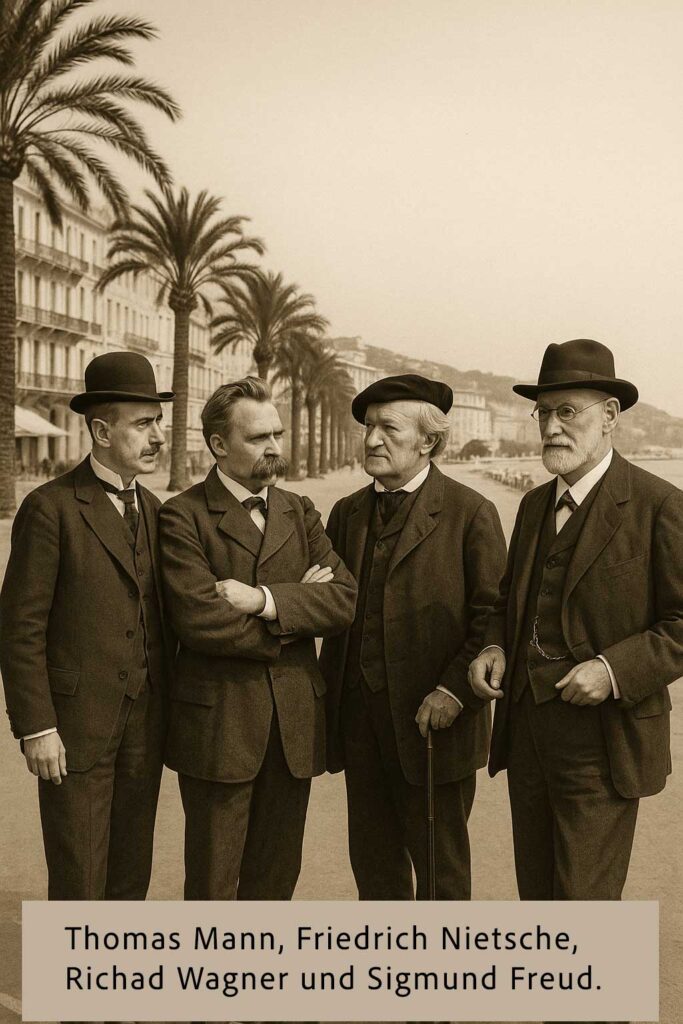
    Thomas Mann und Friedrich Nietzsche, Siegmund Freud und Richard Wagner
  • René Schickele – Zwischen Schwarzwald und Côte d’Azur

    René Schickele – Zwischen Schwarzwald und Côte d’Azur
    Ein Literat im Exil und seine Begegnungen mit der europäischen Bohème

    René Schickele, deutsch-französischer Schriftsteller, Publizist und überzeugter Europäer, verbrachte die letzten Jahre seines Lebens zwischen drei sehr unterschiedlichen, aber für ihn prägenden Orten: dem Kurort Badenweiler im Schwarzwald, dem pittoresken Sanary-sur-Mer in Südfrankreich und der Hafenstadt Nizza.

    Nach der Machtergreifung der Nationalsozialisten 1933 musste Schickele Deutschland verlassen. Badenweiler, wo er in den 1920er-Jahren zeitweise gelebt hatte und im Austausch mit anderen Intellektuellen stand, wurde für ihn zu einem Ort der Erinnerung – ein Rückzugsort, an den er später nur noch gedanklich zurückkehren konnte.

    Das eigentliche Zentrum seines Exils wurde jedoch Sanary-sur-Mer, ein kleines Fischerdorf in der Provence, das in den 1930er-Jahren zu einem Sammelpunkt deutschsprachiger Exilanten und europäischer Künstler wurde. Hier traf Schickele auf eine illustre Gesellschaft: Schriftsteller wie Thomas Mann, Lion Feuchtwanger und Franz Werfel suchten ebenso Schutz vor dem politischen Klima wie Künstlerinnen und Künstler der bildenden Kunst. Auch Erwin Piscator, der Theaterreformer, und Alma Mahler-Werfel gehörten zum Kreis. In den Cafés und an den Uferpromenaden Sanarys wurden politische Fragen ebenso intensiv diskutiert wie literarische Projekte – ein geistiger Freiraum, den die Exilierten dringend brauchten.

    Für Schickele war Sanary nicht nur ein Ort der Zuflucht, sondern auch ein Treffpunkt für den europäischen Dialog. In Gesprächen mit Feuchtwanger oder den Manns vertiefte er seine Vorstellung eines übernationalen, humanistischen Europas – ein Leitgedanke, der sich wie ein roter Faden durch sein Werk zog.

    Später zog es ihn weiter nach Nizza, wo er die milden Winter an der Côte d’Azur verbrachte. Hier verschlechterte sich jedoch sein Gesundheitszustand, und die politische Lage in Europa ließ ihm keine Ruhe. Trotz der bedrückenden Umstände arbeitete er weiter an Essays und Artikeln, in denen er vor den Gefahren des Nationalismus warnte.

    René Schickele starb 1940 in Vence bei Nizza. Sein Lebensweg zwischen Badenweiler, Sanary-sur-Mer und Nizza spiegelt nicht nur das Schicksal vieler europäischer Intellektueller im Exil wider, sondern steht auch für den Versuch, in Zeiten der Zerstörung eine geistige Heimat zu bewahren.

  • Against the worship of warmongering

    He grew up in the suburbs of Washington, D.C., where his family still lives today. But since returning from the war, he has been moving back and forth between Washington and the South. In 2011—seven years after returning from Iraq—he finally settled in Savannah because he was afraid that there were too many Arabs on the streets in Washington or Northern Virginia. He sensed them everywhere, felt constantly surrounded by them. His past as a notorious expert in body searches and interrogations in American prisons in Afghanistan and Iraq fuels his fear that he is now threatened with retaliation from every corner.

    His time as an interrogator, first at Bagram prison in Afghanistan and later, even more painfully, at Abu Ghraib—the most hellish place Damien Corsetti ever saw on earth—killed something inside him. “Abu Ghraib: If there ever was a bad place, it was that one. It was just death, fucking death. That place changed everyone who was there. Something cancerous was growing there.”

    Excerpt from “War at Any Cost” by James Risen.

    War at any cost, about greed, abuse of power, and the billion-dollar business of fighting terrorism.

  • Statutes and bureaucracy in 1851

    The Albrecht-Dürer-Verein would have risen to its zenith “if a narrow-minded adherence to bourgeois statutes, greed and envy had not always worked against free artistic development. It was recognised that these statutes were in part suitable for a local association, but by no means for a projected central art association. However, what was done to remedy the problem did not contribute to the prosperity of the whole, on the contrary, the promising bloom was destroyed; new statutes were created, some of which became even more impractical, even dangerous, and caused much confusion and annoyance. The promises made to the members could not be fulfilled, the lack of money for honorary expenses was claimed to be insufficient for such a large association, etc., without considering that the income is always in proportion to the growing number of members, and that on occasions where the honour and reputation of the association is at stake, buckling and saving can only bring harm.”

    Carl Alexander Heideloff

    Stairs to Radio Nice
  • Media Competence

    We do not want war

    The opposing camp bears the responsibility

    The leader of the enemy is a devil

    We are fighting for a good cause

    The enemy fights with unauthorized weapons

    The enemy commits atrocities on purpose, we only do so accidentally

    Our losses are small, those of the enemy are enormous

    Artists and intellectuals support our cause

    Our mission is sacred

    Anyone who doubts our reporting is a traitor.

    Anne Morelli

    Anne Morelli wrote the book Principes élémentaires de propagande de guerre in the style of Arthur Ponsonby’s classic work on propaganda research.

    It is interesting to observe how some journalists are unable to publish their research and work on any topic without judgment, but rather follow the narratives. It is then frightening to observe how people with diametrically opposed views are often very quickly insulted, downgraded and shunned as a result.

    None of this is actually new. What is new is the vehement claim and the sovereignty of interpretation and positioning of truth and lies (new German fake and hate speech) in the interests of those in power. The opposition and some citizens are quickly vilified. Since the Greeks and their invention of democracy 2500 years ago, it has been the task of the opposition to keep the rulers in check, as experience has shown that they are all too quick to pursue their own interests and bypass the actual sovereign in the clique.

    The words “populus”, ‘people’ and “sovereignty” are closely linked in the context of politics and philosophy. They refer to the source and nature of state power.

    “Populus” (Latin):

    Denotes the people as a totality of people who live in a certain area and are politically organized

    At school, know-it-alls were quickly frowned upon. Nowadays, adult know-it-alls have numerous tools to defame others, be it calling them Nazis or accusing them of hate speech.

Sign In

Register

Reset Password

Please enter your username or email address, you will receive a link to create a new password via email.