Dieser Podcast befasst sich mit dem Leben und dem intellektuellen Erbe von Georg Wilhelm Friedrich Hegel, wobei insbesondere seine prägenden Jahre im Tübinger Stift hervorgehoben werden. Zusammen mit seinen Weggefährten Hölderlin und Schelling entwickelte er dort in einer Atmosphäre aus strenger Disziplin und dem Enthusiasmus für die Französische Revolution die Grundlagen des Deutschen Idealismus. Die Texte beleuchten das Spannungsfeld seiner Philosophie, die einerseits als radikales Denken der Freiheit gefeiert wird, während sie andererseits aufgrund rassistischer Passagen und Vorwürfen des Totalitarismus in der modernen Forschung umstritten bleibt. Darüber hinaus dokumentieren Briefwechsel und historische Anekdoten seinen beruflichen Werdegang von Jena bis Berlin sowie seine lebenslange politische Haltung als Verteidiger bürgerlicher Rechte. Insgesamt zeichnen die Quellen das Bild eines komplexen Denkers, dessen Einfluss auf die politische Philosophie und Soziologie bis heute weltweit von zentraler Bedeutung ist.
Category: History
-
The Deconstruction of Deconstruction
On behalf of the French people, I would like to offer my apologies for having produced French theory (which, in turn, gave birth to the worst of all ideological crap: wokism).
We gave the world Descartes, Pascal, Tocqueville. And then, in the intellectual ruins of the post-’68 era, we gave the world Foucault, Derrida, Deleuze. Three brilliant men who, in the elegance of our language, forged the ideological weapon that is paralyzing the West today.
One must understand what they did. Foucault taught that there is no truth, that there are only power relations disguised as knowledge. That science, reason, justice, the medical institution, the school, the prison, sexuality—all are nothing but a staging of domination. Derrida taught that texts have no stable meaning, that every signifier slips, that every reading is a betrayal, that the author is dead and the reader reigns. Deleuze taught that one must prefer the rhizome to the tree, the nomad to the sedentary, desire to the law, becoming to being, difference to identity.
Taken in isolation, these are debatable theories. But when combined, exported, and popularized, they form a system. And this system is poison.
Because that is how it happened. These texts, unreadable in France, crossed the Atlantic. The departments at Yale, Berkeley, and Columbia absorbed them in the 1980s. There they found a breeding ground that did not exist here: American Puritanism, its racial guilt, its obsession with identity. French theory married this substrate, and the child of this union is called wokism.
Judith Butler reads Foucault and invents performative gender. Edward Said reads Foucault and invents academic postcolonialism. Kimberlé Crenshaw inherits the framework and invents intersectionality. At every turn, the matrix is French: there is no truth, there is only power, so every hierarchy is suspect, every institution oppressive, every norm violence, every identity constructed and therefore negotiable, every majority guilty.
Thus, three Parisian philosophers, who likely never imagined its practical consequences, have provided the code of exploitation for an entire generation of activists, university bureaucrats, HR professionals, journalists, and lawmakers. Thus, we have ended up with a civilization that no longer knows whether a woman is a woman, whether her own history deserves to be defended, whether merit exists, whether truth differs from opinion.
It’s bullshit for one simple reason, and we need to say so plainly. A civilization rests on three pillars: the belief that there is a truth accessible to reason, the belief that there is a good distinct from evil, the belief that there is a heritage that must be passed on. French theory has set out to destroy all three. Not out of malice. Out of intellectual play, out of a fascination with suspicion, out of hatred for the bourgeoisie that nurtured it. But the result is there. An entire generation has learned to deconstruct and never to build. An entire generation knows how to suspect and no longer how to admire. An entire generation sees power everywhere and beauty nowhere.
I apologize because we French bear a special responsibility. It is our language, our universities, our publishing houses, and our prestige that have given this nihilism its stylish packaging. Without the legitimacy of the Sorbonne and Vincennes, these ideas would never have crossed the ocean. We have exported doubt, just as others export weapons.
What is now being built in Silicon Valley, in the AI labs, in the startups, in the workshops, in all the places where people still make things instead of deconstructing them—that is the answer. A civilization is rebuilt by its builders, not by its commentators. By those who believe that truth exists and is worth dedicating oneself to. By those who embrace a hierarchy of the beautiful, the true, and the good, and are not ashamed to pass it on.
So: I apologize. And let’s get to work.
Brivael Le Pogam
in deutsch:
Version 1:
Heute dekonstruiere ich die Dekonstruktion. Die Dekonstruktion ist der effektivste jemals gegen eine Zivilisation erdachte geistige Virus. Sie wurde in Frankreich zwischen 1966 und 1980 von drei Männern hergestellt: Foucault, Derrida, Deleuze. Sie wurde in die USA exportiert, mit dem amerikanischen Rassismuspuritanismus hybridisiert und kam dreißig Jahre später unter dem Namen Wokismus zurück, um den gesamten Westen zu lähmen. So funktioniert sie, und deswegen muss man sie zerstören. Die These ist einfach. Jede Wahrheit ist nichts als ein verkleidetes Machtverhältnis. Jeder heilige Text, jedes Gesetz, jede Wissenschaft, jede Norm, jede Hierarchie, jede Identität, jede Institution verbirgt in Wirklichkeit eine Herrschaft. Dekonstruieren heißt, die Gewaltverhältnisse unter dem Anstrich des Wahren aufzuzeigen. Es heißt, die Maske herunterzureißen. Es heißt „entlarven“. So formuliert, wirkt es harmlos. Sogar nützlich. Wer mag nicht ein bisschen kritischen Geist? Die Falle ist hier. Die Dekonstruktion gibt sich als Methode aus. In Wirklichkeit ist sie eine Ontologie. Sie sagt nicht nur „fragen wir die Normen aus“, sie sagt „es gibt *nur* Machtverhältnisse“. Der Unterschied ist zivilisatorisch. Eine Gesellschaft, die ihre Normen befragt, bleibt stehen. Eine Gesellschaft, die glaubt, dass ihre Normen *nichts anderes* sind als Herrschaft, bricht zusammen. Weil sie nichts mehr verteidigen kann. Keine Grenze mehr, kein Gesetz mehr, keine Wissenschaft mehr, keine Sprache mehr, keine Geschichte mehr, keine Biologie mehr, keine Familie mehr. Alles wird verdächtig. Alles wird verhandelbar. Alles wird „konstruiert, also dekonstruierbar“. Das ist der erste Grund, warum es ein Virus ist. Es repliziert sich selbst. Sobald es injiziert ist, verwandelt es alles, was es berührt, in ein Ziel. Die Wissenschaft ist patriarchal, also dekonstruieren wir sie. Die Sprache ist kolonial, also erfinden wir sie neu. Die Meritokratie ist rassistisch, also schaffen wir sie ab. Das Geschlecht ist eine Konstruktion, also wählen wir es aus. Es gibt keinen Fels mehr. Alles ist Sand. Zweiter Grund. Das Virus ist *unwiderlegbar*. Wenn du eine Norm verteidigst, bist du der Unterdrücker. Wenn du leugnest, Unterdrücker zu sein, ist das der Beweis für dein unbewusstes Privileg. Wenn du Fakten zitierst, sind deine Fakten von der Macht kontaminiert, die sie produziert hat. Wenn du die Vernunft zitierst, ist die Vernunft selbst weiß, männlich, westlich. Es gibt keinen Ausweg. Das System ist so konzipiert, dass jede Einwirkung von vornherein unannehmbar ist. Das ist exakt die Struktur einer Sekte. Und das ist exakt das, was sich seit zwanzig Jahren in den Universitäten, Personalabteilungen, Medien, Verwaltungen, Aufsichtsräten eingenistet hat. Dritter Grund. Das Virus widerlegt sich selbst, zerstört sich aber nicht. Wenn jede Wahrheit Macht ist, dann ist der Satz „jede Wahrheit ist Macht“ selbst Macht, also wertlos. Logisch beißt sich die Dekonstruktion schon im ersten Satz in den Schwanz. Aber das ist ihr egal. Weil sie nie Kohärenz gesucht hat. Sie sucht politische Wirksamkeit. Und ihre politische Wirksamkeit ist enorm. Sie entwaffnet ihre Feinde und bewaffnet ihre Militanten. Sie lähmt den Verteidiger und befreit den Angreifer. Es ist eine perfekte asymmetrische Waffe. Vierter Grund. Das Virus produziert geminderte Menschen. Eine ganze Generation hat gelernt zu dekonstruieren und nie, zu bauen. Sie weiß zu misstrauen, nie zu bewundern. Sie sieht Macht überall und Schönheit nirgends. Sie kann tausend Seiten über den unterdrückerischen Charakter Shakespeares produzieren und null Zeilen schreiben, die in hundert Jahren lesenswert sind. Sie hat kritische Intelligenz mit kritischer Pose verwechselt. Sie ist von Konstruktion her steril. Ein Geist, der mit Dekonstruktion genährt wird, ist ein Geist, der nichts mehr aufbauen weiß. Fünfter Grund, der schwerwiegendste. Eine Zivilisation steht auf drei Säulen. Der Glaube, dass eine Wahrheit der Vernunft zugänglich ist. Der Glaube, dass ein Gut vom Bösen zu unterscheiden ist. Der Glaube, dass ein Erbe es verdient, weitergegeben zu werden. Die Dekonstruktion hat methodisch alle drei gesprengt. Nicht aus Bosheit. Aus intellektuellem Spiel, aus Faszination für das Misstrauen, aus Hass auf die Bourgeoisie, die ihre Propheten genährt hat. Aber das Ergebnis ist da. Eine Zivilisation, die nicht mehr an ihre Wahrheit, ihr Gut oder ihr Erbe glaubt, verteidigt sich nicht. Sie entschuldigt sich, während sie auf das Ende wartet. Das haben wir gemacht. Das muss man benennen. Die gute Nachricht ist, dass ein geistiges Virus nur überlebt, solange man ihm die Autorität der Rede einräumt. Es stirbt, sobald man aufhört, sein Spiel zu spielen. Sobald man ruhig wieder behauptet, dass es eine Wahrheit gibt, ein Schönes, ein Gutes, ein Erbe. Sobald man aufhört, den Dekonstrukteuren für den Bau zu gestatten. Sobald man wieder macht. Sobald man weitergibt. Sobald man schafft. Die Baumeister haben immer das letzte Wort gegenüber den Kommentatoren. Immer. Weil am Ende das Besteht bleibt, und nichts von dem, was dekonstruiert wurde. Also dekonstruiere ich heute die Dekonstruktion. Und morgen baue ich.
Brivael Le Pogam
Version 2:
Die Dekonstruktion der Dekokonstruktion
Ich möchte im Namen der Franzosen meine Entschuldigungen anbieten dafür, die Französische Theorie hervorgebracht zu haben (die wiederum die schlimmste aller ideologischen Scheiße geboren hat: den Wokismus). Wir haben der Welt Descartes, Pascal, Tocqueville geschenkt. Und dann, in den intellektuellen Trümmern des Nach-68, haben wir Foucault, Derrida, Deleuze geschenkt. Drei brillante Männer, die in der Eleganz unserer Sprache die ideologische Waffe geschmiedet haben, die heute den Westen lähmt. Man muss verstehen, was sie getan haben. Foucault hat gelehrt, dass es keine Wahrheit gibt, dass es nur Machtverhältnisse gibt, die als Wissen verkleidet sind. Dass die Wissenschaft, die Vernunft, die Gerechtigkeit, die medizinische Institution, die Schule, das Gefängnis, die Sexualität – alles nichts anderes ist als eine Inszenierung der Herrschaft. Derrida hat gelehrt, dass Texte keinen stabilen Sinn haben, dass jedes Signifikant gleitet, dass jede Lesart ein Verrat ist, dass der Autor tot ist und der Leser herrscht. Deleuze hat gelehrt, dass man das Rhizom dem Baum vorziehen muss, den Nomaden dem Sesshaften, das Begehren dem Gesetz, das Werden dem Sein, die Differenz der Identität. Isoliert genommen sind das diskutierbare Thesen. Kombiniert, exportiert, popularisiert, bilden sie ein System. Und dieses System ist ein Gift. Denn so ist es passiert. Diese Texte, in Frankreich unlesbar, haben den Atlantik überquert. Die Abteilungen von Yale, Berkeley, Columbia haben sie in den 80er Jahren aufgesogen. Dort fanden sie einen Nährboden, der bei uns nicht existierte: den amerikanischen Puritanismus, seine rassische Schuld, seine identitäre Obsession. Die Französische Theorie hat sich mit diesem Substrat vermählt, und das Kind dieser Ehe heißt Wokismus. Judith Butler liest Foucault und erfindet das performative Geschlecht. Edward Said liest Foucault und erfindet den akademischen Postkolonialismus. Kimberlé Crenshaw erbt den Rahmen und erfindet die Intersektionalität. Auf jedem Schritt ist die Matrix französisch: Es gibt keine Wahrheit, es gibt nur Macht, also ist jede Hierarchie verdächtig, jede Institution unterdrückend, jede Norm Gewalt, jede Identität konstruiert und daher verhandelbar, jede Mehrheit schuldig. So haben drei pariser Philosophen, die ihre praktischen Konsequenzen wahrscheinlich nie vorgestellt haben, den Exploitationscode für eine ganze Generation von Aktivisten, Universitätsbürokraten, Personalern, Journalisten, Gesetzgebern geliefert. So hat man eine Zivilisation bekommen, die nicht mehr weiß, ob eine Frau eine Frau ist, ob ihre eigene Geschichte es verdient, verteidigt zu werden, ob Verdienst existiert, ob Wahrheit sich von Meinung unterscheidet. Es ist Scheiße aus einem einfachen Grund, und man muss das ruhig sagen. Eine Zivilisation steht auf drei Säulen: dem Glauben, dass es eine der Vernunft zugängliche Wahrheit gibt, dem Glauben, dass es ein Gut gibt, das vom Bösen unterschieden ist, dem Glauben, dass es ein Erbe gibt, das weitergegeben werden muss. Die Französische Theorie hat sich vorgenommen, alle drei zu sprengen. Nicht aus Bosheit. Aus intellektuellem Spiel, aus Faszination für den Verdacht, aus Hass auf die Bourgeoisie, die sie genährt hat. Aber das Ergebnis ist da. Eine ganze Generation hat gelernt zu dekonstruieren und nie, zu bauen. Eine ganze Generation weiß zu verdächtigen und nicht mehr zu bewundern. Eine ganze Generation sieht Macht überall und Schönheit nirgends. Ich entschuldige mich, weil wir Franzosen eine besondere Verantwortung tragen. Es ist unsere Sprache, unsere Universitäten, unsere Verlage, unser Prestige, das diesem Nihilismus seinen schicken Verpackung gegeben hat. Ohne die Legitimität der Sorbonne und von Vincennes hätten diese Ideen nie den Ozean überquert. Wir haben den Zweifel exportiert, wie andere Waffen exportieren. Was jetzt in Silicon Valley gebaut wird, in den KI-Labors, in den Startups, in den Werkstätten, in all den Orten, wo Menschen noch Dinge herstellen, statt sie zu dekonstruieren, das ist die Antwort. Eine Zivilisation wird von den Baumeistern wiederaufgebaut, nicht von den Kommentatoren. Von denen, die glauben, dass Wahrheit existiert und es wert ist, sich ihr zu widmen. Von denen, die eine Hierarchie des Schönen, des Wahren, des Guten annehmen und keine Scham haben, sie weiterzugeben. Also: Entschuldigung. Und an die Arbeit.
Brivael Le Pogam
-
Card Game “Provence & Côte d’Azur”
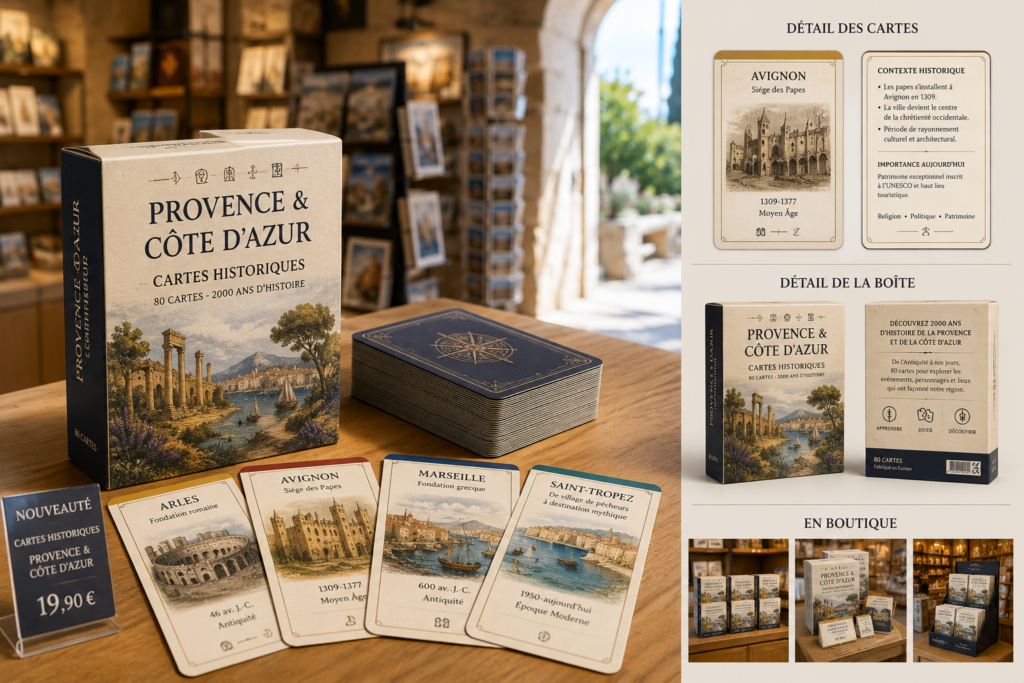
About the cards
Provence and the Côte d’Azur are more than just landscapes. They are the setting for empires, religious wars, artistic revolutions, and economic upheavals.
It was here that Napoleon Bonaparte marched back to Paris. It was here that Pablo Picasso’s colors and Vincent van Gogh’s art took shape. It was here, in Avignon, that popes reshaped the power structure of Europe.
But behind the beauty of the Riviera lies another story:
plague epidemics, pirates, secret smuggling routes, and forgotten fortresses.“PROVENCE AND THE CÔTE D’AZUR HISTORICA” brings this world to life as a strategic card game—playable, collectible, and historically immersive.
Not as a textbook.
But as a clash between history and play.
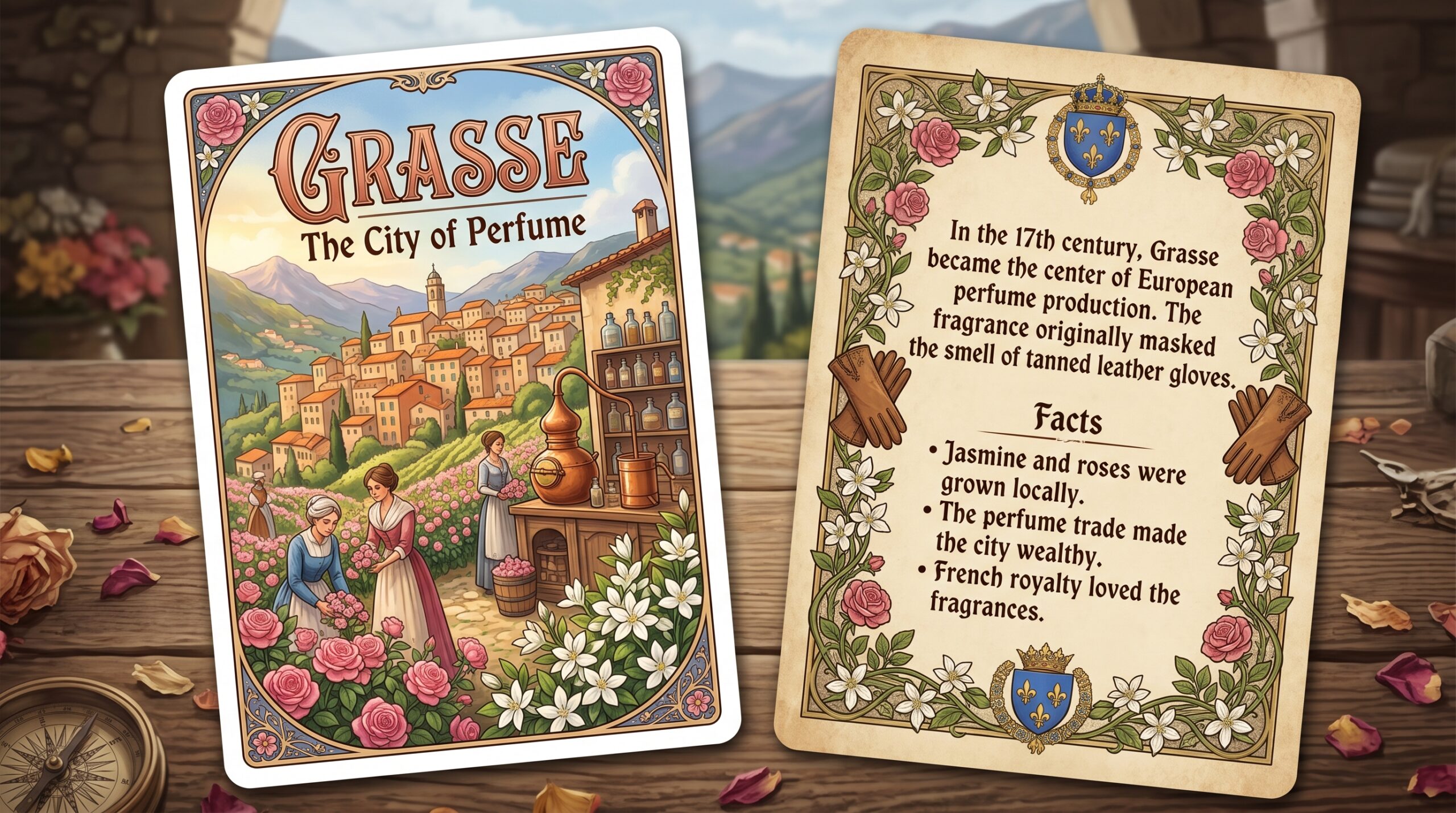
About Us
Grasse is a city in the Alpes-Maritimes department in southern France. It is considered the world capital of perfume and is located about 15 km north of Cannes on the slopes of the Côte d’Azur. It is known for its historic old town and its centuries-old tradition of perfume-making.
Key Facts
UNESCO Status: Intangible Cultural Heritage (2018, Art of Perfumery)
Region: Provence-Alpes-Côte d’Azur
Population: approx. 50,000 (2021)
Founded: in the Middle Ages
Economy: Perfume industry, tourism, agriculture
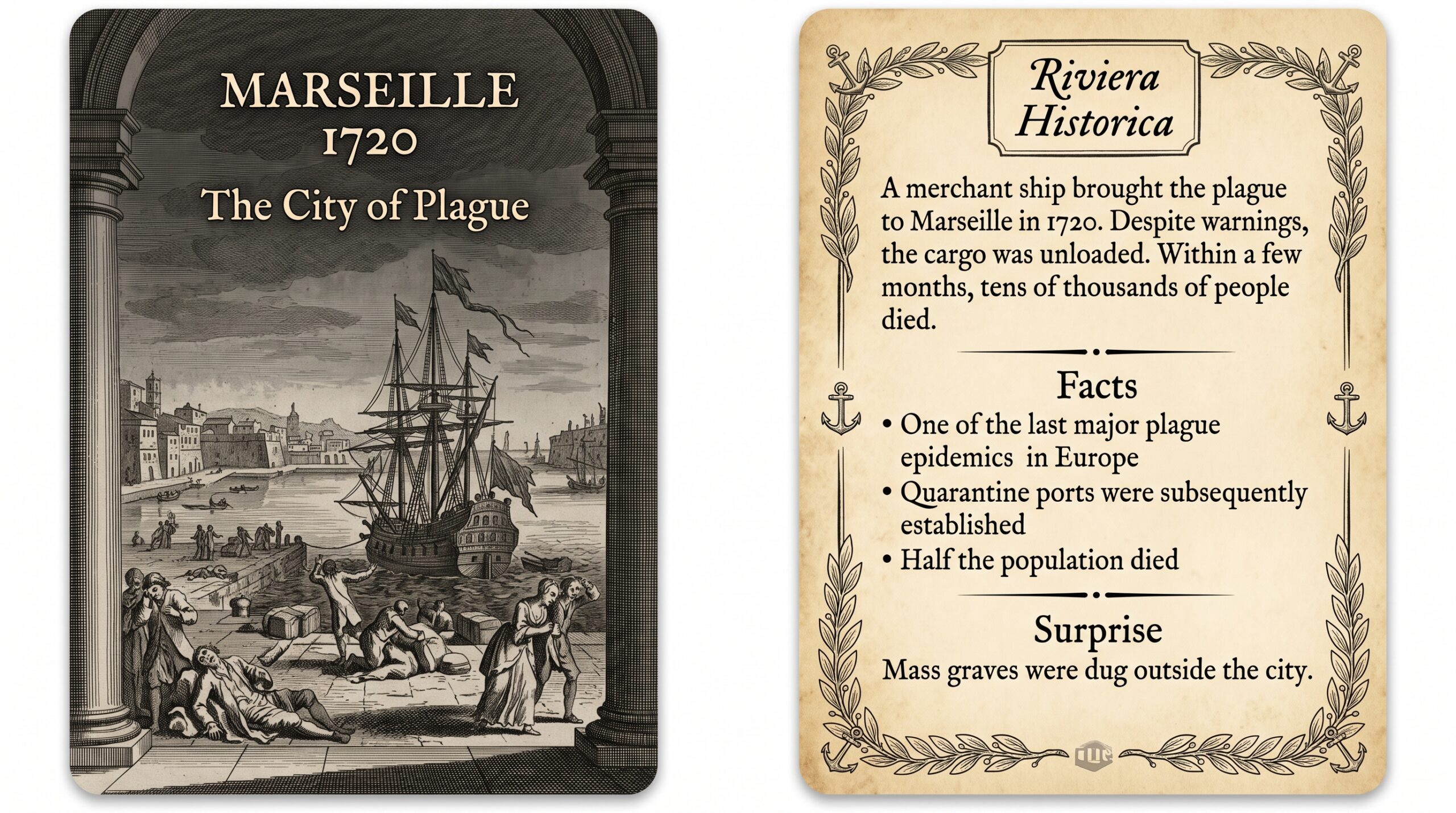
About Us
Marseille is a city in the Bouches-du-Rhône department in southern France. It is the second-largest city in France and the country’s oldest city, located on the Mediterranean coast in the Provence-Alpes-Côte d’Azur region. It is known for its historic Old Port, multicultural atmosphere, and important role as a major maritime hub.
Key Facts
UNESCO Status: Part of the “Marseille, European Capital of Culture” legacy (2013)
Region: Provence-Alpes-Côte d’Azur
Population: approx. 870,000 (2021)
Founded: around 600 BC by Greek settlers from Phocaea
Economy: Port and shipping industry, tourism, trade, culture, fisheries
Got questions?
Feel free to reach out.Kartenset: „Geschichte der Provence – 2000 Jahre im Süden Frankreichs“
Kategorie 1: Antike / Römerzeit (1–10)
- Gründung von Massalia (heutiges Marseille) durch Griechen (ca. 600 v. Chr.)
- Ausbau von Aquädukten in der Region Provence
- Bau des römischen Amphitheaters in Arles
- Gründung von Nemausus (heutiges Nîmes)
- Via Aurelia – römische Handelsstraße entlang der Küste
- Römische Weinproduktion in der Provence
- Triumphbogen von Orange
- Integration der Region in die römische Provinz Gallia Narbonensis
- Entwicklung von römischen Thermen in Aix
- Christianisierung der Städte im 4. Jahrhundert
Kategorie 2: Mittelalter (11–20)
- Gründung des Herzogtums Provence
- Bau der Festung von Les Baux-de-Provence
- Papsttum in Avignon (1309–1377)
- Bau des Papstpalasts in Avignon
- Pestepidemien im 14. Jahrhundert
- Handelsmacht Marseille im Mittelalter
- Kreuzzüge und Beteiligung provenzalischer Ritter
- Entwicklung romanischer Kirchenarchitektur
- Konflikte zwischen Provence und französischer Krone
- Aufstieg der Grafen von Provence
Kategorie 3: Renaissance & Frühe Neuzeit (21–30)
- Integration der Provence in das Königreich Frankreich (1481)
- Entwicklung von Aix als Verwaltungssitz
- Bau repräsentativer Stadtpaläste in Aix-en-Provence
- Seiden- und Textilhandel in Marseille
- Einfluss italienischer Renaissance auf Architektur
- Ausbau der Hafenwirtschaft
- Religionskriege in Südfrankreich
- Künstlerische Blüte in Aix
- Entwicklung lokaler Märkte (marchés provençaux)
- Einführung moderner Steuerverwaltung
Kategorie 4: Französische Revolution (31–40)
- Revolutionäre Unruhen in Marseille
- Bildung von lokalen Jakobiner-Clubs
- Abschaffung der Feudalrechte in der Provence
- Umbenennung von Kirchen und öffentlichen Plätzen
- Beteiligung provenzalischer Truppen an Revolutionskriegen
- Widerstand royalistischer Gruppen
- Hinrichtungen während der Terrorphase
- Neue Verwaltungsstruktur (Départements)
- Aufstieg der Nationalgarde in Südfrankreich
- Marseille als Zentrum revolutionärer Lieder („La Marseillaise“)
Kategorie 5: 19. Jahrhundert / Industrialisierung (41–50)
- Ausbau des Hafens von Marseille
- Eisenbahnverbindung Paris–Marseille
- Industrialisierung der Küstenregion
- Wachstum der Weinwirtschaft
- Urbanisierung von Aix und Marseille
- Kolonialhandel über Marseille
- Entwicklung der Lavendelindustrie
- Hafenarbeit und Migration
- Bau moderner Boulevards
- Erste touristische Reisen an die Côte d’Azur
Kategorie 6: Kunst & Kultur (51–60)
- Paul Cézanne in Aix-en-Provence
- Vincent van Gogh in Arles
- Entwicklung der provenzalischen Malerei
- Gründung von Kunstakademien in der Region
- Einfluss des Lichts der Provence auf Impressionismus
- Literatur von Frédéric Mistral (Provenzalische Sprache)
- Opern- und Theaterkultur in Marseille
- Entstehung lokaler Volksfeste
- Entwicklung der Lavendel-Ikonografie
- Künstlerkolonien in Südfrankreich
Kategorie 7: 20. Jahrhundert & Kriegszeit (61–70)
- Marseille im Ersten Weltkrieg als Hafen für Truppen
- Widerstand in der Provence im Zweiten Weltkrieg
- Besetzung Südfrankreichs durch Deutschland (1942)
- Résistance in den Alpen und Provence
- Befreiung von Marseille 1944
- Wiederaufbau nach dem Krieg
- Migration aus Nordafrika nach Marseille
- Wirtschaftlicher Aufschwung der Nachkriegszeit
- Entwicklung des Tourismus an der Côte d’Azur
- Filmindustrie in Cannes und Umgebung
Kategorie 8: Moderne Provence & Côte d’Azur (71–80)
- Entwicklung von Cannes als Filmstadt
- Internationalisierung von Marseille als Hafenmetropole
- Tourismusboom an der Riviera
- Gründung des Filmfestivals von Cannes
- Ausbau der Autobahnen und Flughäfen
- Schutz von Naturparks (Calanques)
- Luxustourismus in der Côte d’Azur
- Integration europäischer Kulturprojekte
- Wein- und Kulinarik-Tourismus
- Moderne Identität der Provence als Kultur- und Reiseziel
-
The French Era in the Rhineland and Prussia
Dieser Podcast von Klaus Kampe und Radio-Nice.Club dokumentiert die Ära der napoleonischen Herrschaft in Deutschland, wobei der Schwerpunkt auf der sogenannten „Franzosenzeit“ zwischen 1794 und 1815 liegt. Das Material beleuchtet den tiefgreifenden gesellschaftlichen Wandel im Rheinland, der durch die Einführung des Code Napoléon, die Säkularisation und moderne Verwaltungsstrukturen ausgelöst wurde. Ein weiterer zentraler Aspekt sind die militärischen Ereignisse von 1806, insbesondere der triumphale Einzug Napoleons in Berlin sowie die damit verbundenen preußischen Niederlagen. Augenzeugenberichte und Chroniken schildern eindringlich die Belastungen durch Plünderungen, Einquartierungen und die allgemeine Not der Zivilbevölkerung in Städten wie Templin. Insgesamt vermitteln die Texte ein facettenreiches Bild dieser Epoche, die zwischen modernem Aufbruch und der harten Realität einer fremden Militärbesatzung schwankte. Die Zusammenstellung verbindet dabei offizielle historische Einordnungen mit persönlichen Schicksalen und lokalen Anekdoten aus der Zeit des Zusammenbruchs des alten Preußens.
Wie erlebten die Bürger in Templin und Berlin die Besatzung?
Die Besatzungszeit nach 1806 wurde von den Bürgern in Berlin und Templin als eine Phase tiefer Verunsicherung, wirtschaftlicher Ausbeutung und massiver Belastungen durch Einquartierungen erlebt, wobei sich die städtische Atmosphäre in Berlin deutlich von der existenziellen Not in der kleineren Stadt Templin unterschied.
Erlebnisse in Berlin: Zwischen Prunk und Plünderung
In der preußischen Hauptstadt Berlin begann die Besatzung mit dem feierlichen Einzug Napoleons am 27. Oktober 1806.
- Widersprüchliche Eindrücke: Während offizielle französische Berichte von jubelnden Mengen sprachen, schilderten Augenzeugen die Stadt zunächst als „stille und düstere“ Kulisse mit geschlossenen Läden. Dennoch wandelte sich das Bild schnell; Berlin wirkte zeitweise wie ein „kleines Paris“, in dem das gesellschaftliche Leben trotz der Besatzung weiterging.
- Wirtschaftliche Ausbeutung: Die Bürger hatten enorme Lasten zu tragen. Berlin allein musste eine Kontribution von 10 Millionen Frank aufbringen. Hinzu kamen Zwangsanleihen, die Kosten für die Versorgung der Armee und die Bürokratie der Militärverwaltung.
- Kulturelle Begegnungen: Der Kammerdiener Tamanti, der Napoleon im Stadtschloss bediente, beschrieb den Kaiser als gebildeten und kultivierten Fürsten, was im Kontrast zu seinem Ruf als rücksichtsloser Ausbeuter stand. Aus dieser Zeit stammt auch die Berliner Warnung vor „Fisimatenten“: Eltern warnten ihre Töchter davor, der Einladung französischer Offiziere in deren Zelte („Visit ma tente“) zu folgen.
- Kunstraub: Ein bleibendes Symbol der Demütigung war der Abtransport der Quadriga vom Brandenburger Tor im Dezember 1806.
Erlebnisse in Templin: Existenzkampf und Ruin
In Templin war die Besatzung von weit chaotischeren und härteren Zuständen geprägt, da die kleine Stadt direkt an einer wichtigen Marschroute lag.
- Systematische Plünderungen: Bereits beim Einmarsch kam es zu massiven Raubzügen. Häuser, Mühlen und Keller wurden leergeräumt; die Soldaten stahlen Vieh, Bargeld, Wäsche und sogar Kupfergeräte [243–246]. Der Müller von Templin wurde stundenlang gemartert, als er sich den Soldaten entgegenstellte.
- Massive Einquartierung: Die Belastung war immens. In einem Zeitraum von nur vier Wochen zogen über 250.000 Soldaten durch die Stadt, die damals nur etwa 2.000 Einwohner hatte. In den Bürgerhäusern wurden oft 20 bis 120 Mann gleichzeitig untergebracht, was die Vorräte der Bewohner völlig erschöpfte.
- Zerstörung der Lebensgrundlagen: Um die hohen Kontributionen und die „Lagersteuer“ bezahlen zu können, sah sich die Stadt gezwungen, ihre Buchenwälder (das Buchholz und die Ahrensnestsche Heide) komplett abzuholzen und das Holz zu verkaufen.
- Hunger und Seuchen: Die Not gipfelte darin, dass Bürger Hunger litten und sich von Kartoffelschalen ernährten. In der Folge brachen Seuchen wie Ruhr, Scharlach und das „Nervenfieber“ aus. Die psychische Belastung war so hoch, dass Fälle von Wahnsinn und Suizid überliefert sind.
Ein bemerkenswertes Detail aus Templin ist die Tat des jüdischen Schulmeisters Jacob Abraham, der spontan 20 Carolinen aus eigener Tasche zahlte, um eine drohende Forderung der Franzosen an den Magistrat abzuwenden. Trotz der Härte blieb in Templin später der Spruch in Erinnerung, dass der Franzose als Feind „doch viel besser“ gewesen sei als der Russe (der 1813 kam) als Freund, da die französische Armee zumindest eine gewisse Manneszucht wahrte.Wie erlebten die Bürger in Templin und Berlin die Besatzung?
Die Besatzungszeit nach 1806 wurde von den Bürgern in Berlin und Templin als eine Phase tiefer Verunsicherung, wirtschaftlicher Ausbeutung und massiver Belastungen durch Einquartierungen erlebt, wobei sich die städtische Atmosphäre in Berlin deutlich von der existenziellen Not in der kleineren Stadt Templin unterschied.
Erlebnisse in Berlin: Zwischen Prunk und Plünderung
In der preußischen Hauptstadt Berlin begann die Besatzung mit dem feierlichen Einzug Napoleons am 27. Oktober 1806.
- Widersprüchliche Eindrücke: Während offizielle französische Berichte von jubelnden Mengen sprachen, schilderten Augenzeugen die Stadt zunächst als „stille und düstere“ Kulisse mit geschlossenen Läden. Dennoch wandelte sich das Bild schnell; Berlin wirkte zeitweise wie ein „kleines Paris“, in dem das gesellschaftliche Leben trotz der Besatzung weiterging.
- Wirtschaftliche Ausbeutung: Die Bürger hatten enorme Lasten zu tragen. Berlin allein musste eine Kontribution von 10 Millionen Frank aufbringen. Hinzu kamen Zwangsanleihen, die Kosten für die Versorgung der Armee und die Bürokratie der Militärverwaltung.
- Kulturelle Begegnungen: Der Kammerdiener Tamanti, der Napoleon im Stadtschloss bediente, beschrieb den Kaiser als gebildeten und kultivierten Fürsten, was im Kontrast zu seinem Ruf als rücksichtsloser Ausbeuter stand. Aus dieser Zeit stammt auch die Berliner Warnung vor „Fisimatenten“: Eltern warnten ihre Töchter davor, der Einladung französischer Offiziere in deren Zelte („Visit ma tente“) zu folgen.
- Kunstraub: Ein bleibendes Symbol der Demütigung war der Abtransport der Quadriga vom Brandenburger Tor im Dezember 1806.
Erlebnisse in Templin: Existenzkampf und Ruin
In Templin war die Besatzung von weit chaotischeren und härteren Zuständen geprägt, da die kleine Stadt direkt an einer wichtigen Marschroute lag.
- Systematische Plünderungen: Bereits beim Einmarsch kam es zu massiven Raubzügen. Häuser, Mühlen und Keller wurden leergeräumt; die Soldaten stahlen Vieh, Bargeld, Wäsche und sogar Kupfergeräte [243–246]. Der Müller von Templin wurde stundenlang gemartert, als er sich den Soldaten entgegenstellte.
- Massive Einquartierung: Die Belastung war immens. In einem Zeitraum von nur vier Wochen zogen über 250.000 Soldaten durch die Stadt, die damals nur etwa 2.000 Einwohner hatte. In den Bürgerhäusern wurden oft 20 bis 120 Mann gleichzeitig untergebracht, was die Vorräte der Bewohner völlig erschöpfte.
- Zerstörung der Lebensgrundlagen: Um die hohen Kontributionen und die „Lagersteuer“ bezahlen zu können, sah sich die Stadt gezwungen, ihre Buchenwälder (das Buchholz und die Ahrensnestsche Heide) komplett abzuholzen und das Holz zu verkaufen.
- Hunger und Seuchen: Die Not gipfelte darin, dass Bürger Hunger litten und sich von Kartoffelschalen ernährten. In der Folge brachen Seuchen wie Ruhr, Scharlach und das „Nervenfieber“ aus. Die psychische Belastung war so hoch, dass Fälle von Wahnsinn und Suizid überliefert sind.
Ein bemerkenswertes Detail aus Templin ist die Tat des jüdischen Schulmeisters Jacob Abraham, der spontan 20 Carolinen aus eigener Tasche zahlte, um eine drohende Forderung der Franzosen an den Magistrat abzuwenden. Trotz der Härte blieb in Templin später der Spruch in Erinnerung, dass der Franzose als Feind „doch viel besser“ gewesen sei als der Russe (der 1813 kam) als Freund, da die französische Armee zumindest eine gewisse Manneszucht wahrte.
KK
-
Sonne und Schatten: Deutsche Exilanten an der Côte d’Azur
Diese Quellen dokumentieren ein akademisches Kooperationsprojekt zwischen der Universität Leipzig und der Karls-Universität Prag, das sich der pragerdeutschen Literatur widmet. Im Zentrum stehen vergleichende Analysen zu Anna Seghers’ „Transit“ und Lenka Reinerovás „Die Schiffskarte“, wobei die autobiografischen Erfahrungen beider Autorinnen im französischen Exil beleuchtet werden. Die Texte untersuchen die Bedeutung von Cafés als lebensnotwendige Rückzugsorte sowie die existenzielle Notwendigkeit menschlicher Solidarität inmitten bürokratischer Willkür. Ein weiterer Fokus liegt auf der Identitätsproblematik der Protagonisten, die durch den Verlust ihrer Heimat und das maskenhafte Rollenspiel der Flucht geprägt sind. Zudem werden mythische und märchenhafte Motive analysiert, die das historische Zeitgeschehen der 1940er Jahre in einen überzeitlichen Kontext einordnen. Insgesamt bietet das Material eine tiefgreifende Synthese aus historischer Realität und literarischer Fiktion während der Zeit des Nationalsozialismus.
-
1960’s Garage Psych
1960’s Garage Psych from Pelham, New York (1967) Now available at MOJO BONE RECORDS
1960’s Garage from Los Angeles, California (1967) Later that year they morphed into the Strawberry Alarm Clock
1960’s Garage from Tampa, Florida (1967)
60’s Garage Psych from L.A. California
The Lemon Fog – Summer – 60’s Garage from Houston, Texas (1968)
The Music Machine – Dark White – 60’s Garage Psych from Los Angeles , CA (1969)
Regis Mull – I Saw Your Face – 60’s Garage Psych Pop from Pittsburgh, Pennsylvania (1967)
The Human Expression – Following Me – 1960’s Garage from Westminster/Tustin, California (1967)