Between Nice and Monaco, the village of รze rises like a defiant prayer in stone. Anyone climbing the steep path today can perhaps still sense the breath of centuries pastโthe crunch of boots on limestone, the distant thunder of cannons, the whispering of loyalties that changed with the wind like the flags on the battlements.
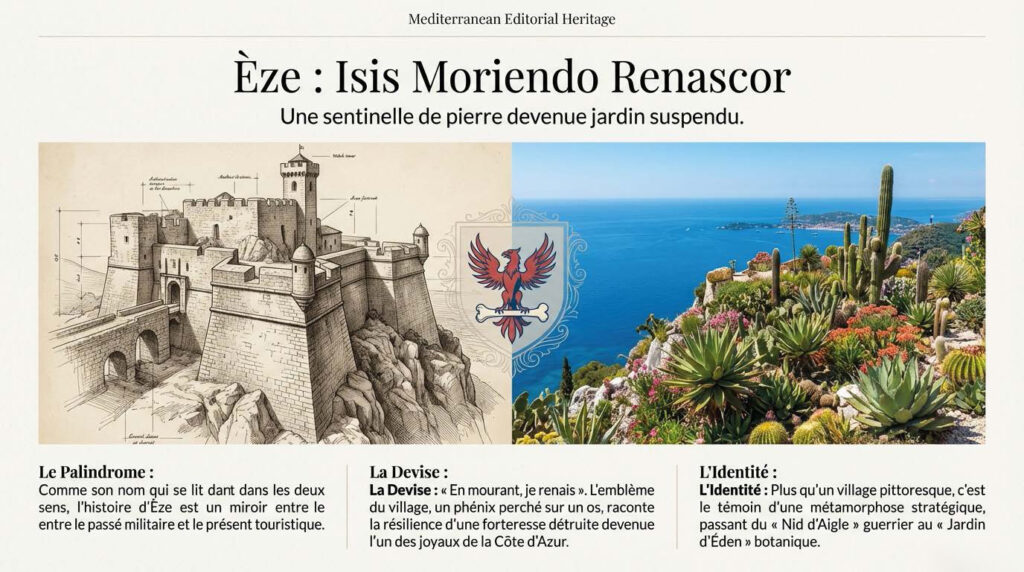
In the 14th and 15th centuries, this rocky nest belonged to the Duchy of Savoy, that idiosyncratic power between the Alps and the sea, which was neither entirely Italian nor entirely French, but a border kingdom โ tough, ambitious, distrustful. Savoy knew the value of heights. Whoever held the mountains held the roads. And whoever held the roads controlled trade, customs duties, rumors โ and destiny.
รze was not a pretty village for painters and flรขneurs, but a guard post. Fortification โ Savoy’s systematic policy of fortification โ turned the rock into a bastion. Rings of walls snaked around the summit like stone serpents; narrow gates, built so that no assault could easily break them, forced attackers into tight angles. A keep rose above the roofs, watchful like a stone eye over the Mediterranean. The houses themselves were part of the defense: densely built, with hardly any gaps, narrow alleys that resembled embrasures rather than streets. Those who fought here fought step by step.
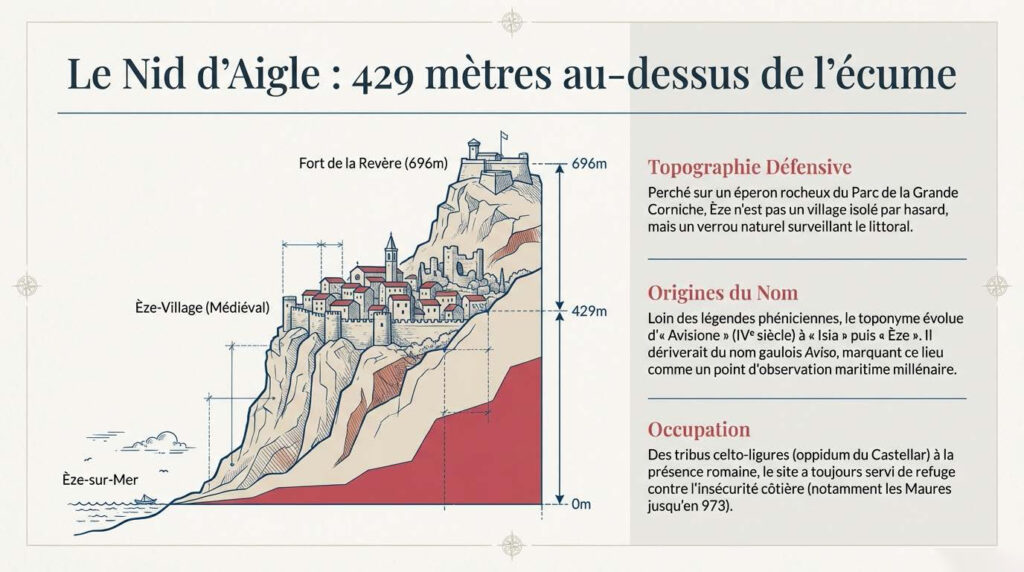
Savoy fortified not out of vanity, but out of necessity. The coast was contested. The Counts of Provence looked covetously upon the strategic heights. Later, the French crown pressed in, and from the east, the influence of the Italian powers grew. รze was a border post in a game whose rules were constantly changing.
The fighting rarely took the form of large, decisive battles. It came in the form of dawn raids, sieges that lasted for weeks, and betrayals behind half-open gates. According to chronicles from the region, a Savoyard garrison once held out for months while enemy troops cut off the water supply. They lived on supplies, salted fish, and whatever the cisterns yielded. Thirst was the invisible besieger.
But Savoy knew how to hold its ground. The dukes โ from Amadeus to their successors โ invested in stone rather than splendor. While cathedrals grew elsewhere, bastions grew here. The walls of รze were reinforced, towers raised, embrasures adapted to the new art of gunpowder. With the advent of artillery, the rock also changed: the ramparts had to be lower, thicker, and more resistant. War wrote its technical evolution into the limestone.
And yet the village was more than just a garrison. Between the alarm calls, everyday life revolved around olive oil, fishing, and pious processions. The people knew that they were living on a threshold. Their identity was not a fixed banner, but a fabric of dialects, alliances, and survival strategies. Sometimes they spoke of the Savoyard lord with loyalty, sometimes with cautious distance. For power, they had learned, is never final in border regions.
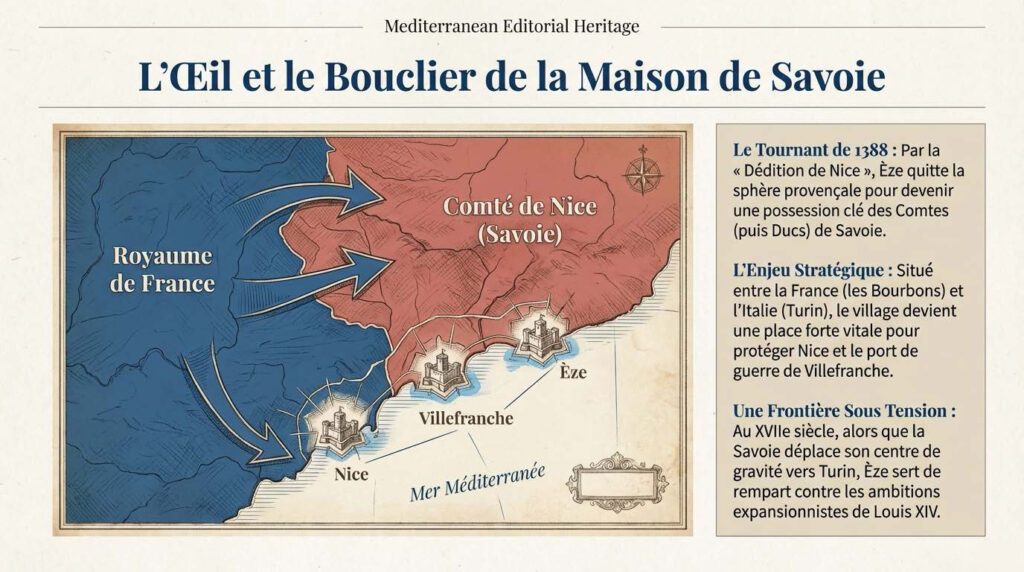
In the 16th century, when the great European conflicts reached the coast, รze once again became a pawn. Tensions between Savoy and France escalated, and the region around Nice was fought over several times. The walls of รze saw banners change, heard commands in different languages. Each party promised protection; each demanded loyalty.
It is said that after a particularly fierce battle, parts of the fortifications were severely damaged. But even in ruins, the place remained a symbol. The rock itself was the real fortress โ ancient, unyielding, indifferent to the changing rulers. Savoy may have ruled, France may have pressed, but the stone outlasted them all.
When you walk through รze today, between galleries and gardens, you can only see fragments of that defensibility. But in the narrowness of the alleys, in the abrupt drop of the cliffs, in the view down to the wide sea, that old logic still remains: whoever stands up here has gained time.
And perhaps that is the real story of Savoy in รzeโnot triumph or defeat, but the steadfast holding of a rock against the turmoil of the world.
in Deutsch:
Zwischen Nizza und Monaco erhebt sich, wie ein trotziges Gebet aus Stein, das Dorf รze. Wer heute den steilen Pfad hinaufsteigt, ahnt vielleicht noch den Atem der Jahrhunderte โ das Knirschen von Stiefeln auf Kalk, das ferne Donnern von Geschรผtzen, das Flรผstern von Loyalitรคten, die im Wind wechselten wie die Fahnen auf den Zinnen.
Im 14. und 15. Jahrhundert gehรถrte dieses felsige Nest zur Herzogtum Savoyen, jener eigenwilligen Macht zwischen Alpen und Meer, die weder ganz italienisch noch ganz franzรถsisch war, sondern ein Grenzreich โ zรคh, ehrgeizig, misstrauisch. Savoyen wusste um den Wert von Hรถhen. Wer die Berge hielt, hielt die Wege. Und wer die Wege hielt, kontrollierte den Handel, die Zรถlle, die Gerรผchte โ und das Schicksal.
รze war kein schmuckes Dorf fรผr Maler und Flaneure, sondern eine Wache. Die Fortesierung โ jene systematische Befestigungspolitik Savoyens โ machte aus dem Felsen eine Bastion. Mauerringe schlangen sich um den Gipfel wie steinerne Schlangen; schmale Tore, so gebaut, dass kein Sturmangriff sie leicht brechen konnte, zwangen Angreifer in enge Winkel. Ein Donjon erhob sich รผber die Dรคcher, wachsam wie ein steinernes Auge รผber dem Mittelmeer. Die Hรคuser selbst waren Teil der Verteidigung: dicht gebaut, kaum Zwischenrรคume, schmale Gassen, die eher Scharten als Straรen glichen. Wer hier kรคmpfte, kรคmpfte Schritt um Schritt.
Savoyen befestigte nicht aus Eitelkeit, sondern aus Not. Die Kรผste war umkรคmpft. Die Grafen von Provence blickten mit Begehrlichkeit auf die strategischen Hรถhen. Spรคter drรคngte die franzรถsische Krone, und von Osten her wuchs der Einfluss der italienischen Mรคchte. รze war Grenzposten in einem Spiel, dessen Regeln sich stรคndig รคnderten.
Die Kรคmpfe kamen selten als groรe, entscheidende Schlacht. Sie kamen als รberfรคlle im Morgengrauen, als Belagerungen, die Wochen dauerten, als Verrat hinter halb geรถffneten Toren. Einmal โ so berichten Chroniken aus der Region โ soll eine savoyische Garnison monatelang ausgeharrt haben, wรคhrend feindliche Truppen die Wasserzufuhr kappten. Man lebte von Vorrรคten, von gesalzenem Fisch, von dem, was die Zisternen hergaben. Der Durst war der unsichtbare Belagerer.
Doch Savoyen verstand es, seine Hรถhen zu halten. Die Herzรถge โ von Amadeus bis zu ihren Nachfolgern โ investierten in Stein statt in Pracht. Wรคhrend anderswo Kathedralen wuchsen, wuchsen hier Bastionen. Die Mauern von รze wurden verstรคrkt, Tรผrme erhรถht, Schieรscharten an die neue Kunst des Pulvers angepasst. Mit dem Aufkommen der Artillerie verรคnderte sich auch der Fels: niedriger, dicker, widerstandsfรคhiger mussten die Wรคlle sein. Der Krieg schrieb seine technische Evolution in den Kalkstein.
Und doch war das Dorf mehr als Garnison. Zwischen den Alarmrufen lebte ein Alltag aus Olivenรถl, Fischfang und frommen Prozessionen. Die Menschen wussten, dass sie auf einer Schwelle lebten. Ihre Identitรคt war kein festes Banner, sondern ein Gewebe aus Dialekten, Bรผndnissen, รberlebensstrategien. Mal sprach man vom savoyischen Herrn mit Loyalitรคt, mal mit vorsichtiger Distanz. Denn Macht, das hatte man gelernt, ist in Grenzregionen nie endgรผltig.
Im 16. Jahrhundert, als die groรen europรคischen Konflikte die Kรผste erreichten, wurde รze erneut zum Spielball. Die Spannungen zwischen Savoyen und Frankreich eskalierten, und die Region um Nizza wurde mehrfach umkรคmpft. Die Mauern von รze sahen Banner wechseln, hรถrten Befehle in verschiedenen Zungen. Jede Partei versprach Schutz; jede forderte Treue.
Es heiรt, dass nach einem besonders heftigen Gefecht Teile der Befestigung schwer beschรคdigt wurden. Doch selbst in Trรผmmern blieb der Ort Symbol. Der Fels selbst war die eigentliche Festung โ uralt, unbeugsam, gleichgรผltig gegenรผber den wechselnden Herren. Savoyen mochte herrschen, Frankreich mochte drรคngen, doch der Stein รผberdauerte sie alle.
Wenn man heute durch รze geht, zwischen Galerien und Gรคrten, sieht man nur noch Fragmente jener Wehrhaftigkeit. Doch in der Enge der Gassen, im abrupten Abbruch der Klippen, im Blick hinunter auf das weite Meer liegt noch immer jene alte Logik: Wer hier oben steht, hat Zeit gewonnen.
Und vielleicht ist das die eigentliche Geschichte Savoyens in รze โ nicht Triumph oder Niederlage, sondern das beharrliche Halten eines Felsens gegen die Unruhe der Welt.
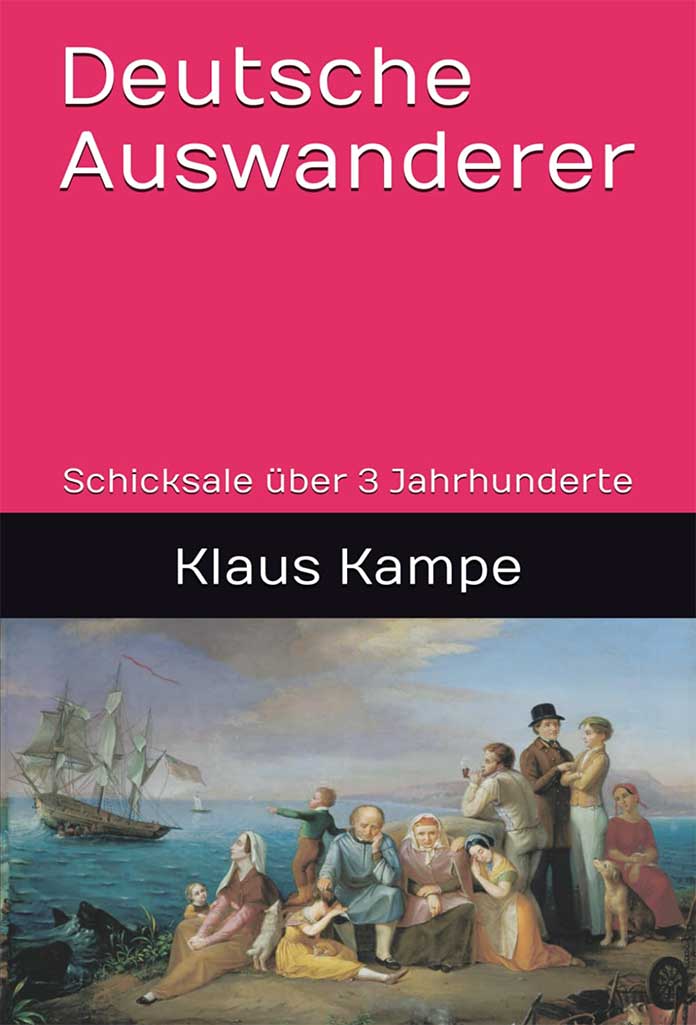
This theme documents three centuries of German emigration. Letters and diaries bring to life stories of people fleeing religious persecution, hunger, and the pursuit of freedom. The journey takes us from war-torn Europe to America and the Volga River.
Hier ein begleitendes Wort zum neuen Buch โZwischen Sehnsucht und Machtโ โWie Romantik und Idealismus die deutsche Geschichte prรคgten von Klaus Kampe. Es geht um eine Warnung vor den Auswรผchsen von Idealismus und Romantik in der heutigen Zeit. Das Buch stรผtzt sich auf historische und philosophische Analysen, die zeigen, wie die Sehnsucht nach einer โhรถheren Ordnungโ oder โWiederverzauberungโ der Welt in gefรคhrliche Irrationalitรคt oder Totalitarismus umschlagen kann.
Hier ist ein Entwurf:
Die Geschichte der deutschen Romantik lehrt uns, dass der Versuch, die Welt durch reine Poesie oder Idealismus zu heilen, oft mit einer gefรคhrlichen Realitรคtsferne einhergeht. Wenn das โromantische Subjektโ die Welt nur noch als Anlass fรผr seine eigene Produktivitรคt und Stimmung nutzt, droht eine politische Handlungsunfรคhigkeit oder eine bloรe Simulation von Wirksamkeit.
Besonders im Kontext moderner Groรprojekte wie dem Green Deal oder radikaler Umweltbewegungen besteht die Gefahr, dass die Vernunft in Unvernunft und Aufklรคrung in einen neuen Mythos umschlรคgt. Adorno und Horkheimer warnten in ihrer โDialektik der Aufklรคrungโ bereits davor, dass eine total verwaltete Welt keine wahre Freiheit schafft, sondern neue Formen der Unterwerfung, in denen der Einzelne zugunsten einer vermeintlich hรถheren kollektiven Notwendigkeit nichts mehr zรคhlt.
Kritische Punkte der Warnung:
โข Der รคsthetische Aristokratismus: Idealisten neigen dazu, ihre Visionen รผber die profanen Bedรผrfnisse der โMasseโ zu stellen, was zu einer Entfremdung von der sozialen Realitรคt fรผhrt.
โข Die โstรคhlerne Romantikโ der Planung: Carl Schmitt warnte vor den Paradiesen einer durchgeplanten Welt, die durch entfesselte Produktivkraft eine โSozialschrankeโ errichtet, die den Menschen nicht mehr erkennt, sondern ihn gewaltsam verรคndern will.
โข Verlust der Dezision (Entscheidungsfรคhigkeit): Romantiker verweilen oft im รคsthetischen โMรผรiggangโ und scheitern an der Notwendigkeit klarer politischer Unterscheidungen, was sie anfรคllig fรผr die Instrumentalisierung durch fremde Mรคchte macht.
โข Der โKrankheitskeimโ im Ideal: Wie Thomas Mann 1945 ausfรผhrte, trรคgt die Romantik oft einen Keim in sich, der die Hingabe an das Irrationale und eine weltfremde Tiefe รผber die demokratische Nรผchternheit stellt.
Man muss daher wachsam gegenรผber Bewegungen sein, die das Politische in โRausch und Mysteriumโ zurรผckverwandeln wollen. Eine Politik, die nur noch auf Gefรผhl, Erweckung und utopischem Schein basiert, verliert den Boden der rechtlichen und rationalen Normen und bereitet so den Weg fรผr eine neue Barbarei.
Es gilt, die Romantik als Korrektiv der Moderne zu nutzen, ohne sie zur Staatsideologie zu erheben, da sie sonst unweigerlich in der Katastrophe endet.
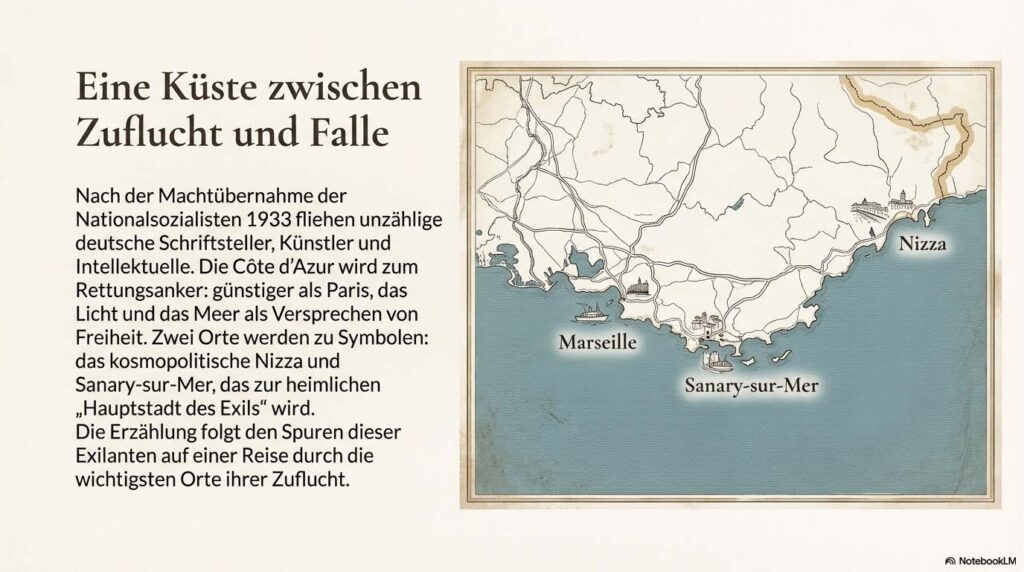
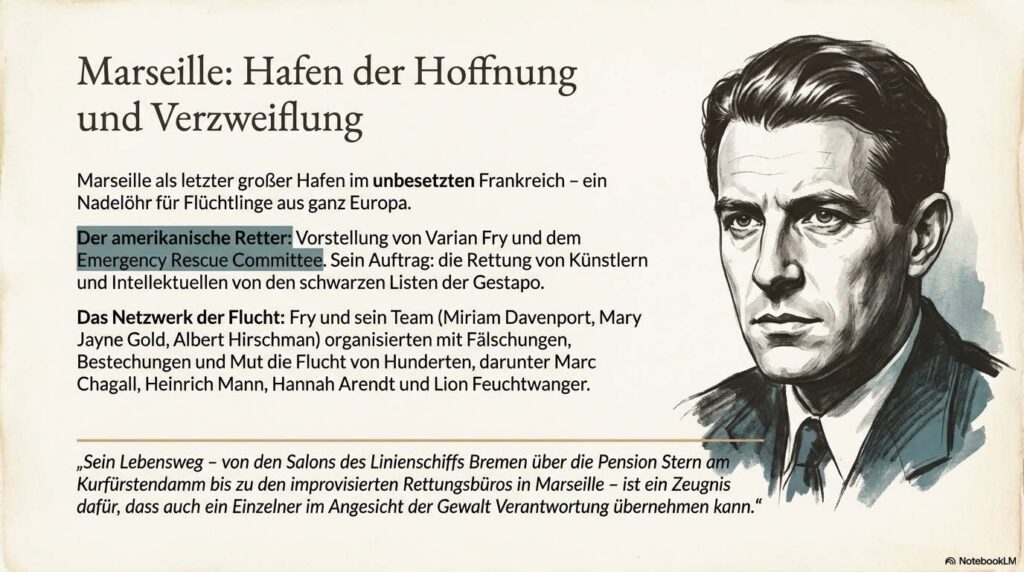
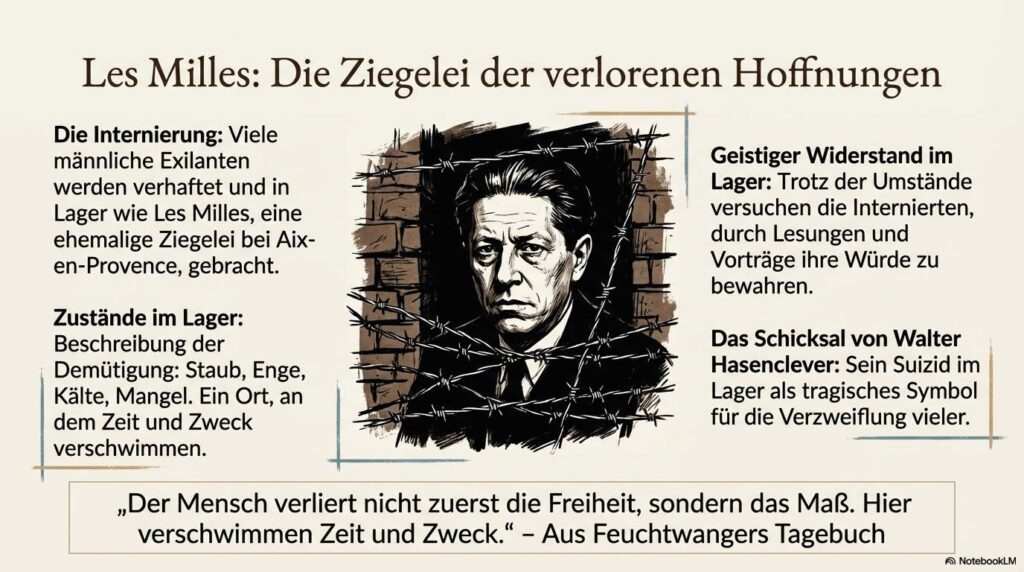
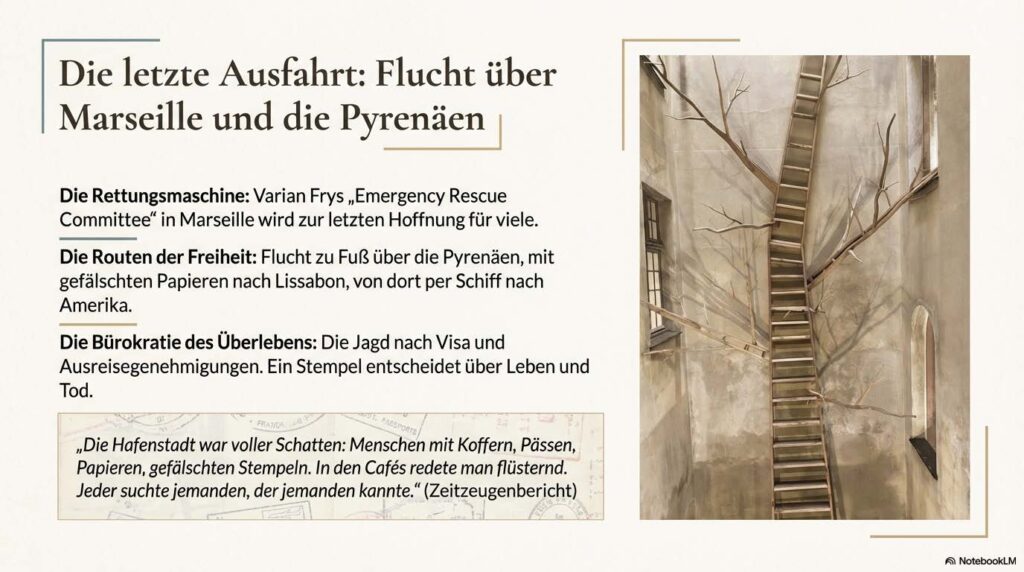
Podcast von Arcoplexus zum Buch “Deutsche Exilanten an der Cรดte d’Azur” von Klaus Kampe. Das Werk dokumentiert das bewegte Leben deutscher Exilanten an der Cรดte dโAzur wรคhrend der 1930er Jahre. Im Fokus stehen Zufluchtsorte wie Sanary-sur-Mer und Nizza, wo bedeutende Intellektuelle wie Thomas Mann, Lion Feuchtwanger und Hannah Arendt versuchten, ihre kulturelle Identitรคt gegen das NS-Regime zu verteidigen. Die Texte beleuchten zudem die mutigen Rettungsaktionen von Varian Fry in Marseille sowie die kรผnstlerische Arbeit des Fotografen Walter Bondy. Neben literarischen Analysen und historischen Fakten flieรen persรถnliche Anekdoten und fiktive Dialoge ein, die das Spannungsfeld zwischen mediterraner Idylle und existenzieller Bedrohung spรผrbar machen. Letztlich dient das Buch als Hommage an die schรถpferische Kraft einer Generation, die trotz Verfolgung und Internierung an Humanismus und Freiheit festhielt. Es verbindet dabei die historische Spurensuche mit dem kollektiven Gedรคchtnis einer verlorenen Welt. Zum Buch:
Ideologies are always prisons of thought based on ignorance rather than tolerance.
Using the example of
Whittaker Chambers: (Cold War Classics) โWitnessโ vs. Hannah Arendt: โVita activa or On Active Lifeโ two responses to the same experience.
Common starting point: break with ideology
Chambers experienced
communism as a belief system the break is existential, almost religious ideology = attempt to impose meaning on history
Arendt
analyzed ideology as a substitute for thinking Ideology = logic that overwhelms reality Totalitarianism arises when people stop judging
Commonality: Ideology is not โthinking wrong,โ but rather no longer thinking. The decisive difference: What follows from the break?
Here, the paths diverge radically. Chambers: Withdrawal from politics Central motif in Witness
Anthropology
Man is fallen
Power always corrupts
History tends toward evil
Response to totalitarianism: Asceticism, witness, sacrifice, refusal. Arendt: Return to politics Central motif in Vita activa
Freedom exists only where people act together.
Consequences:
Politics is irreplaceable.
No salvation, no ultimate goal.
Freedom arises between people, not in the soul.
Anthropology
Humans are capable of beginning (natality).
History is open.
Guilt and responsibility are political, not metaphysical.
Response to totalitarianism: Action, public discourse, judgment. The core conflict Question
Chambers
Arendt Where does salvation lie?
Outside the world
In the world Role of politics
Danger
Necessity Attitude toward history
Doom logic
Openness Antidote to ideology
Faith
Thinking Freedom
Internal
Public Why the New Right chooses Chambers โ and avoids Arendt Chambers is attractive because:
he creates meaning
clearly distributes guilt and blame
makes history readable as a struggle
charges politics with morality
perfect for Kulturkampf narratives. Arendt is uncomfortable because:
she promises no salvation
she critically examines all camps
she demands judgment, not loyalty
she desacralizes politics
bad for mobilization, good for freedom. Blรผcher as the silent key
Blรผcher would say between the two:
โThose who ask for meaning instead of responsibility are fleeing from freedom.โ
He shares the break with Chambers, but with Arendt the consequence:
no ideology
no doctrine of salvation
no ultimate order
Only action under uncertainty. Escalation (honest, not conciliatory)
Chambers helps us to leave totalitarianism behind. Arendt helps us to avoid falling back into it.
The New Right often stops at the first step.
How Arendt is systematically misunderstood today (e.g., โmass society = liberalismโ) The fundamental misunderstanding: Arendt = anti-liberalism? Claim (New Right, but also post-liberals):
Arendt showed that liberalism leads to mass society and thus to totalitarianism.
What Arendt actually says:
Mass society does not arise from too much freedom,
but from the disintegration of the world, bonds, and political action.
This can happen in liberal, authoritarian, or revolutionary systems.
For Arendt, liberalism is not the cause, but is often too weak to prevent totalitarianism. Misunderstanding: โMass society = multiculturalism/migrationโ Right-wing interpretation:
Mass = politically uprooted people
The decisive factor is lawlessness, not origin.
Nation states themselves have produced masses (e.g., stateless persons in the 1930s).
Ethnic homogeneity does not protect against totalitarianism โ it often accelerates it. Misunderstanding: Arendt legitimizes authoritarian order Right-wing appeal:
Order, authority, discipline as a bulwark against chaos
Arendt:
makes a strict distinction between:
authority (recognized, not enforced)
power (derived from collective action)
force (a substitute for power)
Authoritarian regimes destroy power; they do not stabilize it.
Those who confuse violence with order reproduce totalitarian logic. Misunderstanding: Arendt = cultural pessimism Simplified interpretation:
criticizes depoliticization, not modernity
Technology is not the problem,
but when it replaces human action
Equality is a prerequisite for politics, not its enemy
Arendt is not a cultural critic in the right-wing sense. Misunderstanding: โThe banality of evilโ = trivialization Frequent right-wing (and popular) misreading:
Eichmann was โjust a cog in the wheelโ
Guilt disappears in the system
Arendt means:
Eichmann was guilty,
but not demonic,
rather lacking in judgment
which is more dangerous than fanaticism
Evil does not become smaller, but closer.
This is uncomfortable for right-wing movements:
Guilt cannot be externalized.
Even โnormal patriotsโ can bear injustice.
Misunderstanding: Arendt as defender of โWestern values.โ Instrumentalization:
Arendt as key witness for โdefense of civilization.โ
The West vs. barbarism.
Arendt:
Rejects myths of civilization
Totalitarianism is modern, Western, rational
Not a โforeignโ disease
Those who use Arendt for cultural warfare have already lost. The blind spot of the New Right
The New Right adopts:
Arendt's diagnosis of fear
Her criticism of ideology
Her skepticism toward narratives of progress
It rejects:
Judgment against its own side
Plurality
Public sphere without compulsory loyalty
Arendt would say:
Ideology begins where thinking ends โ even on the right.
Misunderstanding: Liberals also misread Arendt
Not just the right. Liberal simplification:
Arendt = constitution, institutions, rule of law
Problem:
Arendt was skeptical of pure administrative liberalism
without a vibrant public sphere, institutions collapse
Bureaucracy is politically empty, not neutral
Arendt is anti-technocratic, not anti-liberal.
The New Right reads Arendt as a warning against freedom.
Liberals read her as a defender of order.
Both are wrong.
Arendt defends freedom as a practice. And that makes her dangerous to any camp logic. Hannah Arendt โ Carl Schmitt Why their proximity is assertedโand their opposition is concealed Why they are mentioned together at all
The New Right likes to claim:
โArendt and Schmitt both analyze the crisis of liberalism.โ
Formally, this is true:
both criticize liberal legalism
both do not see politics as administration
both reject optimism about progress
But: They draw opposite conclusions from this. The decisive contrast (one sentence)
Schmitt asks: Who decides in a state of emergency?
Arendt asks: How can people act together without a state of emergency?
Understanding of politics Carl Schmitt
Politics = friendโenemy distinction
The political is conflictual or not at all
Unity arises through demarcation
Homogeneity is a prerequisite for political order
Politics requires decision-making, if necessary against the law. Hannah Arendt
Politics = plural space of appearance
Politics arises between different parties
Conflict yes, but not existential
Homogeneity destroys politics
Politics needs publicity, not decision-making power. State of emergency vs. natality Schmitt
Sovereignty lies with those who decide on states of emergency.
Exceptions are the moment of truth in politics.
Law thrives on the breaking of law.
Order is always precarious, hence authoritarian safeguards. Arendt
Central concept: natality (the ability to begin)
Politics thrives on new beginnings, not on exceptions
A state of emergency is political failure
Freedom begins where violence ends. Power and violence (fundamental!) Schmitt
Power = decision-making power
Violence is a legitimate political means
Law is ultimately based on violence
Arendt
Power arises from joint action
Violence is a loss of power
Violence destroys legitimacy, even if it is effective
Here, any reconciliation is impossible. People, unity, homogeneity Schmitt
Democracy = identity of the rulers and the ruled
This presupposes homogeneity
Exclusion is democratically legitimate
Arendt
The people are not a substance
Political community arises through participation
Rights arise from belonging to the world, not from identity
Liberalism = danger of administration
Politics is replaced by bureaucracy
Public life becomes desolate
โ Solution: more politics, not less.
Same diagnosis โ opposite therapy. Why the New Right โSchmittizesโ Arendt
Typical strategy:
Arendt quotes on crisis, masses, ideology
combined with Schmitt's:
Decision
Sovereignty
Exception
Result: seemingly โhumane Schmittโ
This is intellectually dishonest:
Arendt undermines Schmitt's entire foundation
her concepts of power and freedom directly contradict him
The moral dividing line Schmitt
Law follows power
Guilt is secondary
Loyalty is decisive
Arendt
Guilt is personal
Thinking is a duty
Loyalty is never an excuse
Eichmann vs. State of Emergency.
Escalation Schmitt thinks about politics in terms of war. Arendt thinks about politics in terms of action. Schmitt needs enemies to create order. Arendt needs others to enable freedom.
Why this is crucial today
Those who equate Arendt with Schmitt:
legitimize states of emergency
moralize power
depoliticize responsibility
Arendt would be radical here:
The state of emergency is not the salvation of politics, but its end.
Carl Schmitt and the authoritarian left Basic idea: Schmitt’s core concepts
The central Schmittian concept:
Sovereignty = Who decides on the state of emergency Power concentrates when rules fail. The sovereign stands above the law in order to enforce order or transformation. Friendโenemy logic Politics is always conflict. Unity arises through demarcation. State decision โซ Moral or liberal principles Legal norms are secondary to effective power.
Why this is attractive to the authoritarian left a) State-centered solution to crises
Marxists, Leninists, or Stalinists seek instruments to enforce radical transformation.
Schmitt provides legitimation for executive power beyond liberal restrictions.
b) State of emergency as a political strategy
Revolution = โpermanent state of emergency.โ
Schmitt's theory allows for:
Emergency as a moment of political clarity.
Overriding the law as a legitimate means.
c) Friendโenemy logic for class struggle.
The left can interpret โbourgeoisie vs. proletariatโ as a political exceptional relationship.
Schmitt's concept becomes the legal or strategic basis for class politics.
d) Rejection of liberal civil society
Liberal institutions = obstacle to radical transformation.
Schmitt shows how law and democracy can be formal without real transformative power.
Tensions / limits
Schmitt is not a leftist; he defends the state and order, not revolution.
Schmitt's emphasis on national homogeneity clashes with internationalist leftist thinking.
Schmitt wants to limit the state of exception to sovereignty, not to permanent revolution.
Conclusion: Leftists selectively adopt, often only, the mechanism of power concentration, not his conservative philosophy of the state. Historical examples Actor
How Schmitt was received Leninism / Stalinism
Schmitt’s justification of exceptions as justification for the โdictatorship of the proletariatโ Italian left (Gramsci circle)
Schmitt’s friend-enemy logic for bloc formation in class struggle Neo-Marxists / Critical theory
Schmitt as an analytical tool: states of emergency, political decision-making mechanisms, but without normative approval Comparison: left vs. right Schmitt reception Feature
Right
Authoritarian left State of emergency
Protection of the nation, culture, order
Transformation, revolution, class rule Friendโenemy
Nation / identity
Classes, global enemies Legitimacy
Defense, preservation
Radical transformation Relationship to freedom
Secondary, often repressive
Secondary, often utopian
Schmitt is technically flexible because he describes mechanisms of power rather than defining them morally. That is why he works on both sides. The crucial point
Schmitt is attractive to any political movement that wants to transcend legal norms in favor of radical decisions.
Right: Nation, tradition, identity Left: Revolution, class rule, transformation Both ignore Schmitt’s normative concern that sovereignty is always bound to responsibility and concrete community.
Views on left-wing and right-wing ideology
in german:
Ansichten zur linken und rechten Ideologie
Ideologien sind immer Denkgefรคngnisse die auf Ignoranz basieren und nicht auf Toleranz.
am Beispiel von
Whittaker Chambers: (Cold War Classics) โWitnessโ
vs.
Hannah Arendt: โVita activa oder Vom tรคtigen Lebenโ
zwei Antworten auf dieselbe Erfahrung.
1Gemeinsamer Ausgangspunkt: Bruch mit der Ideologie
Chambers
erlebte den Kommunismus als Glaubenssystem
der Bruch ist existentiell, fast religiรถs
Ideologie = Versuch, der Geschichte einen Sinn aufzuzwingen
Arendt
analysierte Ideologie als Ersatz fรผr Denken
Ideologie = Logik, die Realitรคt รผberrollt
Totalitarismus entsteht, wenn Menschen aufhรถren zu urteilen
Gemeinsamkeit: Ideologie ist nicht โfalsch denkenโ, sondern nicht mehr denken.
Der entscheidende Unterschied: Was folgt aus dem Bruch?
Hier trennen sich die Wege radikal.
Chambers: Rรผckzug aus der Politik
Zentrales Motiv in Witness
Geschichte ist ein geistlicher Kampf, den der Mensch nicht gewinnen kann.
Konsequenzen:
Politik ist sekundรคr, fast gefรคhrlich
Erlรถsung liegt auรerhalb der politischen Welt
Christentum = letzte Wahrheit gegen geschichtsphilosophische Hybris
Anthropologie
Mensch ist gefallen
Macht korrumpiert immer
Geschichte tendiert zum Bรถsen
Antwort auf Totalitarismus: Askese, Zeugenschaft, Opfer, Verweigerung.
Arendt: Rรผckkehr in die Politik
Zentrales Motiv in Vita activa
Freiheit existiert nur dort, wo Menschen gemeinsam handeln.
Konsequenzen:
Politik ist unersetzlich
keine Erlรถsung, kein Endziel
Freiheit entsteht zwischen Menschen, nicht in der Seele
Anthropologie
Mensch ist anfangsfรคhig (Natalitรคt)
Geschichte ist offen
Schuld und Verantwortung sind politisch, nicht metaphysisch
Antwort auf Totalitarismus: Handeln, รffentlichkeit, Urteilskraft.
Der Kernkonflikt
Frage
Chambers
Arendt
Wo liegt das Heil?
Auรerhalb der Welt
In der Welt
Rolle der Politik
Gefahr
Notwendigkeit
Haltung zur Geschichte
Untergangslogik
Offenheit
Gegenmittel zur Ideologie
Glaube
Denken
Freiheit
innerlich
รถffentlich
Warum die Neue Rechte Chambers wรคhlt โ und Arendt meidet
Chambers ist attraktiv, weil:
er Sinn stiftet
Schuld und Opfer klar verteilt
Geschichte als Kampf lesbar macht
Politik moralisch auflรคdt
perfekt fรผr Kulturkampf-Narrative.
Arendt ist unbequem, weil:
sie keine Erlรถsung verspricht
sie alle Lager kritisch prรผft
sie Urteil verlangt, nicht Loyalitรคt
sie Politik entsakralisiert
schlecht fรผr Mobilisierung, gut fรผr Freiheit.
Blรผcher als stiller Schlรผssel
Blรผcher wรผrde zwischen beiden sagen:
โWer nach Sinn statt nach Verantwortung fragt, flieht vor Freiheit.โ
Er teilt mit Chambers den Bruch, aber mit Arendt die Konsequenz:
keine Ideologie
keine Heilslehre
keine letzte Ordnung
Nur Handeln unter Unsicherheit.
Zuspitzung (ehrlich, nicht versรถhnlich)
Chambers hilft, den Totalitarismus zu verlassen. Arendt hilft, danach nicht wieder hineinzugeraten.
Die Neue Rechte bleibt oft beim ersten Schritt stehen.
Wie Arendt heute systematisch missverstanden wird (z. B. โMassengesellschaft = Liberalismusโ)
Das Grundmissverstรคndnis: Arendt = Anti-Liberalismus?
Behauptung (Neue Rechte, aber auch Postliberale):
Arendt habe gezeigt, dass Liberalismus zur Massengesellschaft und damit zum Totalitarismus fรผhre.
Was Arendt tatsรคchlich sagt:
Massengesellschaft entsteht nicht aus zu viel Freiheit,
sondern aus Zerfall von Welt, Bindungen und politischem Handeln.
Das kann in liberalen, autoritรคren oder revolutionรคren Systemen passieren.
Liberalismus ist bei Arendt nicht Ursache, sondern oft zu schwach, um Totalitarismus zu verhindern.
Kurt and Theodor Wolff, the Berliner Tageblatt, โTen Years of Nice,โ and Alfred NeumannโFacets of a Liberal Public Sphere.
These men were primarily active in the late 19th and first half of the 20th century, with a focus on the period between the German Empire and the Weimar Republic. The history of the German press and intellectual world in the late 19th and early 20th centuries is hardly conceivable without the Berliner Tageblatt. As one of the most important liberal mass-circulation newspapers of the German Empire and the Weimar Republic, it was not only a news medium but also a forum for political debate, literary innovation, and European self-understanding. This environment attracted personalities such as Kurt and Theodor Wolff and authors such as Alfred Neumann, whose contributions exemplify the connection between journalism, literature, and political thought.
Theodor Wolff, long-time editor-in-chief of the Berliner Tageblatt, had a decisive influence on the newspaper. He understood journalism as a moral and political task. Under his leadership, the newspaper developed into a voice for liberalism, the rule of law, and understanding between European nations. Wolff’s editorials combined analytical acuity with linguistic elegance and made the Berliner Tageblatt a leading medium for the educated public. His work showed that political journalism could be more than mere reporting: it became intellectual intervention.
Kurt Wolff, although not directly part of the editorial team, represented a similar intellectual attitude. As one of the most important publishers of the 20th century, he promoted authors of literary modernism such as Franz Kafka, Georg Trakl, and Else Lasker-Schรผler. The proximity between the press and literature, as evidenced in the environment of the Berliner Tageblatt, points to a common cultural project: the renewal of language, thought, and social sensitivity. Kurt Wolff’s publishing work thus complemented Theodor Wolff’s journalistic work on a different, literary level.
One example of the Berliner Tageblatt’s European perspective is its review โTen Years of Nice.โ Such articles were typical of the paper: they combined current politics with historical reflection. The reference to Niceโas a venue for international conferences and diplomatic negotiationsโsymbolizes the paper’s interest in European power relations, peace agreements, and Germany’s role in international politics. Reviews of this kind served not only to inform readers, but also to educate them politically.
Alfred Neumann, who contributed to the intellectual milieu of the time as a journalist and writer, can also be placed in this context. His texts often combined political analysis with literary ambition, thus fitting in with the profile of the Berliner Tageblatt. Authors such as Neumann embodied the type of writing intellectual who mediated between feature pages, political commentary, and literary form.
In summary, it can be said that Kurt and Theodor Wolff, the Berliner Tageblatt, articles such as โTen Years in Nice,โ and authors such as Alfred Neumann were part of a shared cultural context. They represent an era in which journalism, literature, and politics were closely intertwined and in which liberal public discourse was understood as a central prerequisite for democratic culture. Looking back, it becomes clear how fragileโand at the same time how significantโthis tradition was.
These men were primarily active in the late 19th and first half of the 20th century, with a focus on the period between the German Empire and the Weimar Republic.
Theodor Wolff (1868โ1943)
Active approx. 1900โ1933
Editor-in-chief of the Berliner Tageblatt from 1906 to 1933
A defining figure of left-wing liberal journalism in the German Empire and the Weimar Republic
Had to go into exile from the Nazis in 1933
Kurt Wolff (1887โ1963)
Active from around 1910 until the 1950s
Most important publisher of literary modernism
Focus of his work: the 1910s and 1920s
Also emigrated after 1933 (USA)
Alfred Neumann (1895โ1952)
Active primarily in the 1920s and early 1930s
Journalist and writer of the Weimar Republic
Wrote political and literary texts
Emigration after 1933
Shared historical context
German Empire (1871โ1918)
First World War
Weimar Republic (1919โ1933)
End of their activities in Germany due to the National Socialists’ seizure of power
Overall, they belonged to Germany’s liberal intellectual public sphere between 1900 and 1933.