Rouge et Noir – A short story from Monaco
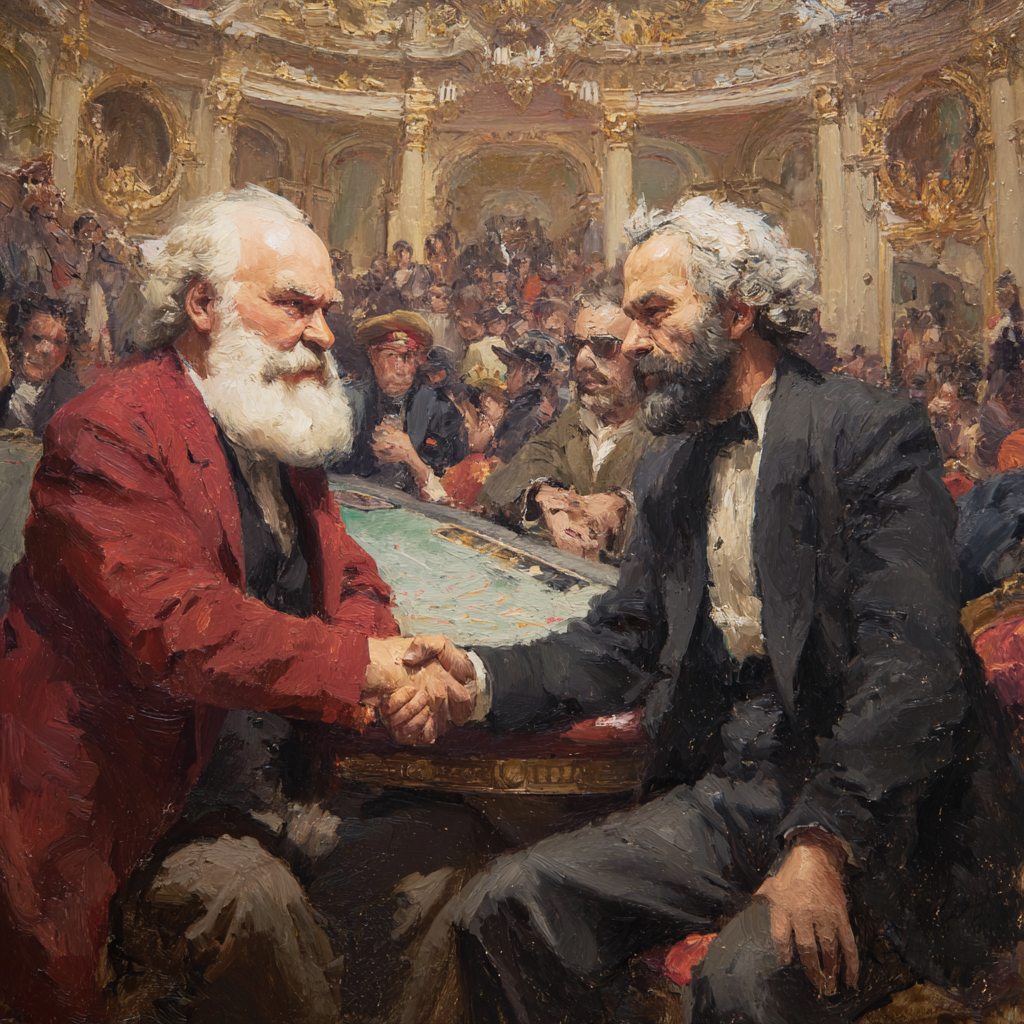
The night hung heavy over the principality when Karl Marx, marked by the dusty winds of Algiers, arrived in Monaco. His beard was tousled, his eyes glowed like coals, and yet he seemed weary from the battles of ideas. He had not sought the way to Monte Carlo, but here he was—on the threshold of the casino, where wealth and ruin were distributed at the tables of “Rouge et Noir.”
Inside, amid sparkling chandeliers and the clatter of chips, sat Leo Ferré, the anarchist, poet, and singer. He had just growled the words “Poète… vos papiers!” when he saw Marx. They did not know each other, but it was as if they had always been destined to meet.
“Monsieur Marx,” Ferré began mockingly, “here, where luck crumbles into cards and balls, you would search in vain for the proletariat. Only bourgeois and gamblers – the true rulers of the 20th century.”
Marx took off his coat, sat down, and glanced at the roulette wheel: “My dear Ferré, this house is the purest allegory of capital. The ball rolls, and the player believes in freedom. But in truth, the laws of probability are as inexorable as economics. The casino always wins.”
Ferré laughed harshly: “But it gives us illusion! People need dreams, not just analysis. Monaco—it has changed. From a poor rock with fishing nets to a realm of the rich. And yet: here, the longing for freedom creeps into every chanson.”
Another figure stepped out of the shadows: Guillaume Apollinaire, his forehead filled with poems, like others with wine. “You speak of illusion and freedom? I tell you, Monaco is a poem in which the words roulette ball and sea, betrayal and hope, are intertwined. You don’t have to dissect them – you have to sing them.”
The dialogue heated up, and the smoke from the cigars mingled with the spirit of the debates. Then Anthony Burgess entered the room, sharply dressed, a smile on his lips. He sat down as if he wanted to direct the scene. “Gentlemen, I wrote about violence and control, about societies that are like chessboards. But Monaco? It’s a laboratory. Here you can see how a microstate survives: through money laundering, through glamour, through the export of dreams. A dystopian microcosm.”
“Dystopia?” snorted Marcel Pagnol, the southern storyteller, who had just arrived. “I tell you: here, too, the people live, here, too, the kitchen smells of garlic and the sea. Behind the facades of the casino, children laugh, old women tell stories, and the fishermen—yes, they still exist—cast their nets. You can’t just see the glitz. You have to feel the heart of the Midi.”
The voices collided like balls on a roulette wheel. Marx railed against capitalism, Ferré sang verses of rebellion and love in a low voice, Apollinaire spoke in images, Burgess painted fears of the future, and Pagnol defended the everyday nature of humanity.
Finally, the croupier dropped the ball. It rolled, bounced, danced. All eyes were on the game, which suddenly became more than just a game. “Rouge!” cried the room, and indeed – the ball landed on red.
Marx stood up: “You see? It’s always a battle: red against black. And as long as people believe that happiness can be bought, history remains unfinished.”
Ferré reached for his cigarette, blew smoke into the chandelier, and whispered, “Or you sing against it, Karl. You sing so loud that even the walls of this casino shake.”
And outside, the Mediterranean Sea roared, indifferent as ever, while in Monaco the ball continued to roll—through the decades, through the voices of poets and rebels.
in deutsch:
Rouge et Noir – Eine Nouvelle aus Monaco
Die Nacht hing schwer über dem Fürstentum, als Karl Marx, vom staubigen Wind Algiers gezeichnet, in Monaco eintraf. Sein Bart war zerzaust, die Augen glühten wie Kohlen, und doch wirkte er zugleich müde von den Kämpfen der Ideen. Er hatte nicht den Weg nach Monte Carlo gesucht, aber er war hier – auf der Schwelle des Casinos, wo Reichtum und Ruin sich an den Tischen des „Rouge et Noir“ verteilten.
Drinnen, zwischen funkelnden Kronleuchtern und dem Lärm der Jetons, saß Leo Ferré, der Anarchist, Dichter und Sänger. Er hatte gerade die Worte „Poète… vos papiers!“ hingeknurrt, als er Marx erblickte. Sie kannten sich nicht, doch es war, als ob sie sich immer schon begegnen mussten.
„Monsieur Marx,“ begann Ferré spöttisch, „hier, wo das Glück in Karten und Kugeln zerfällt, würden Sie wohl das Proletariat vergeblich suchen. Nur Bourgeois und Spieler – die wahren Herrscher des 20. Jahrhunderts.“
Marx legte den Mantel ab, nahm Platz, und sein Blick streifte das Roulette: „Mein lieber Ferré, dieses Haus ist die reinste Allegorie des Kapitals. Die Kugel rollt, und der Spieler glaubt an die Freiheit. Doch in Wahrheit sind die Gesetze der Wahrscheinlichkeit so unerbittlich wie die Ökonomie. Das Casino gewinnt immer.“
Ferré lachte hart: „Aber es schenkt Illusion! Die Menschen brauchen Träume, nicht nur Analysen. Monaco – es hat sich gewandelt. Vom armseligen Felsen mit Fischernetzen zu einem Reich der Reichen. Und doch: hier schleicht sich die Sehnsucht nach Freiheit in jedes Chanson.“
Aus den Schatten trat eine weitere Gestalt: Guillaume Apollinaire, die Stirn mit Gedichten gefüllt, wie andere mit Wein. „Ihr sprecht von Illusion und Freiheit? Ich sage euch, Monaco ist ein Gedicht, in dem die Wörter Roulettekugel und Meer, Verrat und Hoffnung, sich ineinander verstricken. Man muss sie nicht zerlegen – man muss sie singen.“
Der Dialog erhitzte sich, und der Rauch der Zigarren mischte sich mit dem Geist der Debatten. Da betrat Anthony Burgess den Saal, scharf gekleidet, ein Lächeln auf den Lippen. Er setzte sich dazu, als wolle er Regie führen. „Meine Herren, ich schrieb von Gewalt und Kontrolle, von Gesellschaften, die wie Schachbretter sind. Aber Monaco? Es ist ein Labor. Hier zeigt sich, wie ein Zwergstaat überlebt: durch Geldwäsche, durch Glanz, durch den Export von Träumen. Ein dystopischer Mikrokosmos.“
„Dystopie?“ schnaubte Marcel Pagnol, der südliche Erzähler, eben eingetroffen. „Ich sage euch: Auch hier lebt das Volk, auch hier riecht die Küche nach Knoblauch und Meer. Hinter den Fassaden des Casinos lachen Kinder, alte Frauen erzählen Geschichten, und die Fischer – ja, es gibt sie noch – werfen ihre Netze. Man darf nicht nur den Glanz sehen. Man muss auch das Herz des Midi spüren.“
Die Stimmen prallten aufeinander wie Kugeln auf dem Roulette. Marx wetterte gegen den Kapitalismus, Ferré sang halblaut Verse von Aufruhr und Liebe, Apollinaire sprach in Bildern, Burgess malte Zukunftsängste, und Pagnol verteidigte die Alltäglichkeit des Menschlichen.
Schließlich ließ der Croupier die Kugel fallen. Sie rollte, sprang, tanzte. Alle Augen richteten sich auf das Spiel, das plötzlich mehr war als ein Spiel. „Rouge!“ rief der Saal, und tatsächlich – die Kugel fiel auf Rot.
Marx erhob sich: „Seht ihr? Es bleibt immer ein Kampf: Rot gegen Schwarz. Und solange die Menschen glauben, das Glück könne man kaufen, bleibt die Geschichte unvollendet.“
Ferré griff nach seiner Zigarette, blies den Rauch in den Kronleuchter und flüsterte: „Oder man singt gegen sie an, Karl. Man singt so laut, dass selbst die Mauern dieses Casinos beben.“
Und draußen rauschte das Mittelmeer, gleichgültig wie immer, während in Monaco die Kugel weiterrollte – durch die Jahrzehnte, durch die Stimmen der Dichter und Rebellen.
Rouge et Noir – Ein Disput in Monte Carlo
(Theater in Prosa, in vier Szenen)
Personen
- Karl Marx, Philosoph, vom Wüstenwind Algiers gezeichnet.
- Leo Ferré, anarchistischer Chansonnier, zynisch und glühend zugleich.
- Guillaume Apollinaire, Dichter, halb Geist, halb Mensch.
- Anthony Burgess, Schriftsteller, Beobachter der Moderne, ironisch.
- Marcel Pagnol, Erzähler des Südens, menschlich und warm.
- Croupier, stumm, aber Schicksal in Bewegung setzend.
Szene I – Ankunft
(Ein Saal des Casinos. Spiegel und Kronleuchter, das Klingen von Jetons. Marx tritt ein, schwer atmend, den Mantel über dem Arm. Er bleibt am Roulette stehen. Ferré sitzt bereits da, Zigarette in der Hand.)
Ferré: (spöttisch)
Monsieur Marx! Ein Revolutionär im Tempel des Spiels. Hier regiert nicht das Volk, hier regiert die Kugel.
Marx: (setzt sich, mit Blick auf das Roulette)
Gerade deswegen, mein Lieber. Hier zeigt sich das Kapital in seiner reinsten Form: Die Freiheit als Illusion, die Gesetze der Zahl als eiserne Notwendigkeit. Immer gewinnt das Haus.
Ferré: (lacht rau)
Aber das Haus nährt die Träume. Und ohne Träume, Karl, hungern die Menschen mehr als ohne Brot.
Szene II – Der Dichter
(Apollinaire tritt aus dem Halbdunkel, ein Glas in der Hand, als sei er aus den Versen selbst herabgestiegen.)
Apollinaire:
Ihr sprecht von Brot und Illusion? Ich sage euch: Monaco ist ein Gedicht aus Marmor und Meer. Das Roulette singt, die Jetons reimen. Zerlegt ihr den Reim, bleibt nur Staub.
Marx: (hart)
Poesie ist das Opium des Bürgertums, solange sie den Aufstand nicht nährt. Ihr verhüllt die Wahrheit in schönen Bildern.
Apollinaire:
Und doch träumt selbst der Revolutionär in Versen.
Ferré: (zischelt)
Ich bin der Beweis. Meine Chansons sind Poesie, aber sie brennen.
Szene III – Das Labor
(Burgess tritt ein, scharf gekleidet, lächelnd. Er bleibt stehen, als führe er Regie.)
Burgess:
Meine Herren, ihr träumt, ihr kämpft – und doch überseht ihr das Wesentliche: Monaco ist ein Labor. Ein Zwergstaat, der überlebt, indem er Kapital wäscht, Glanz verkauft, Dystopie im Miniaturformat.
Ferré: (bitter)
Und doch kann ein Lied diese Puppenstube erschüttern.
Burgess: (kalt)
Oder nur begleiten, wie Musik in einem Salon, während die Spieler verlieren.
(Pagnol tritt hinzu, die Wärme des Midi in der Stimme.)
Pagnol:
Ihr alle seht nur Fassaden. Ich sehe die Menschen: Fischer, Kinder, Mütter, Händler. Hinter dem Glanz lebt ein Alltag. Geschichten, die nach Meer riechen. Monaco ist nicht nur Roulette.
Marx: (schlägt mit der Faust auf den Tisch)
Gerade sie sind es, die man verschlingt! Ihr Leben nährt diesen Apparat, den ihr Alltag nicht schützen kann.
Szene IV – Entscheidung
(Der Croupier setzt die Kugel in Bewegung. Alle verstummen. Die Kugel rollt, springt, klackt. Jeder Blick folgt ihr.)
Marx: (erhebt sich)
Seht! Hier verdichtet sich Geschichte: Rot gegen Schwarz. Symbol des Kampfes, Allegorie der Welt.
(Die Kugel fällt auf Rot. Stille. Dann ein Aufatmen.)
Marx: (triumphierend)
Rot! Das Zeichen des Aufstands. Geschichte ist kein Spiel, aber sie kennt nur diesen Weg.
Ferré: (bläst Rauch in die Kronleuchter, leise)
Vielleicht, Karl. Aber ohne das Lied, ohne den Traum, bleibt selbst dein Rot stumm.
(Schweigen. Das Meer rauscht unsichtbar hinter den Spiegeln. Der Croupier sammelt die Jetons, ungerührt.)
Vorhang.