in german below:
Pierre Bonnard (1867–1947) ranks among the outstanding French painters of the late 19th and early 20th centuries. His work is characterized by a subtle interplay of light, color, and intimacy, which distinguishes him from the Impressionists and at the same time secures him a special position in the transition to modernism.
Born on October 3, 1867, in Fontenay-aux-Roses near Paris, Bonnard came from a middle-class family. He originally studied law, but was drawn to art from an early age. Together with artist friends such as Maurice Denis, Paul Sérusier, and Édouard Vuillard, he joined the artist group “Les Nabis,” which developed new forms of expression beyond the Impressionists after 1888. There he was given the nickname le Nabi très japonard, as he was strongly inspired by Japanese woodblock printing, which was in vogue in Europe around 1900.
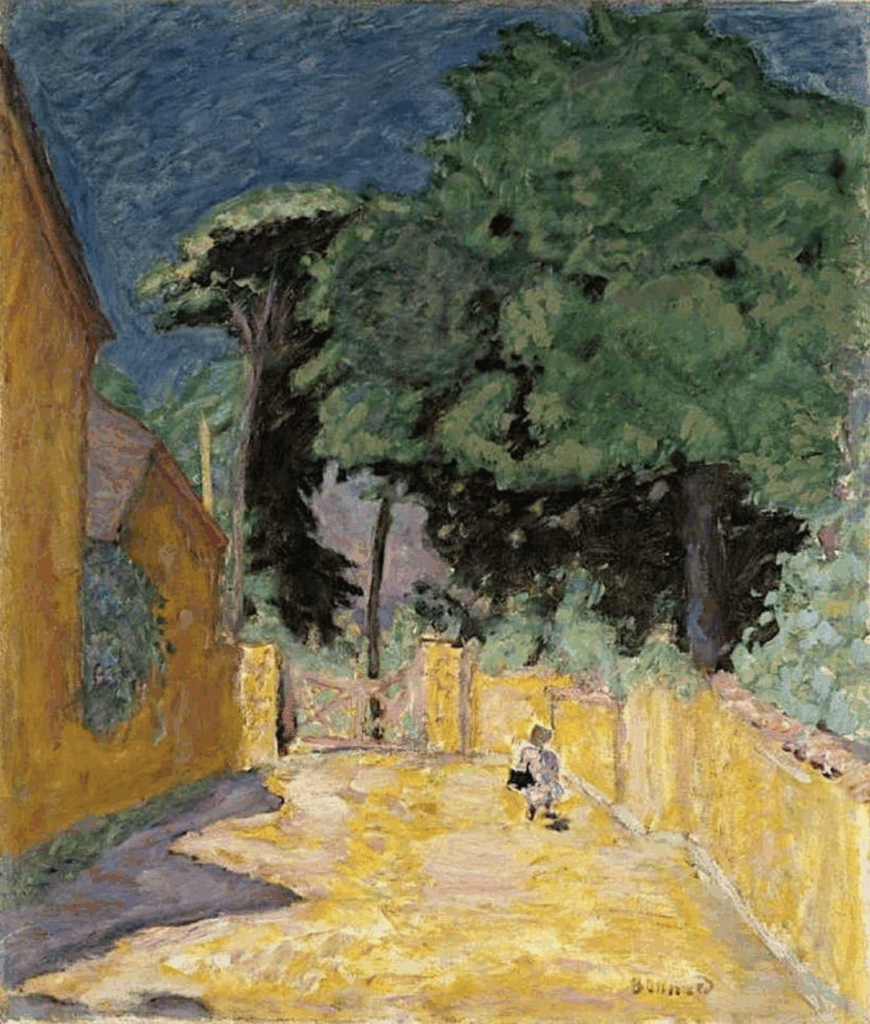
Bonnard was less interested in monumental historical themes than in everyday life: street scenes, garden scenes, interiors, and intimate moments. His partner and later wife, Marthe de Méligny, in particular, became his lifelong muse. She appears in numerous paintings, often in bathing or toilet scenes, reflecting Bonnard’s interest in intimacy, domesticity, and the depiction of light on skin and water.His painting technique differed from that of many of his contemporaries: Bonnard rarely worked directly in front of his subject. Instead, he sketched scenes, noted down colors, and later created the paintings in his studio from memory. This gave his pictures a dreamlike quality and an almost poetic blurriness, in which colors took precedence over form.
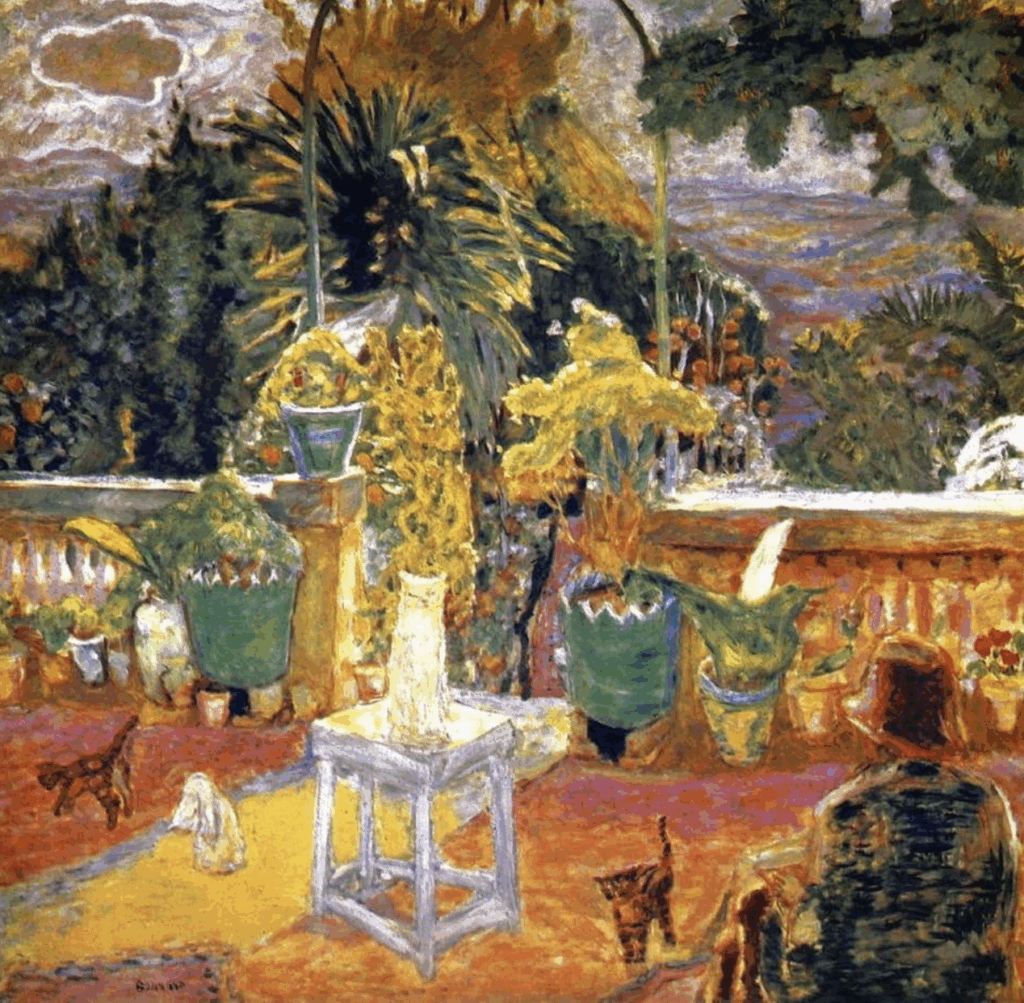
At the beginning of the 20th century, Bonnard increasingly withdrew from Parisian art life. After stays in Giverny and Vernon, he finally settled on the Côte d’Azur, in Le Cannet near Cannes. There he found inexhaustible motifs in his house and garden. His late works are filled with bright colors, Mediterranean light, and a deep tranquility that expresses his connection to nature.
Although Bonnard was appreciated during his lifetime, he stood in the shadow of artists such as Matisse and Picasso, who radically renewed modern painting. But today, Bonnard’s work is once again highly regarded: his ability to transform the intimate into the universal and his painterly sensibility are considered unique.
Pierre Bonnard died on January 23, 1947, in Le Cannet. His work left its mark on modern painting—not through loud provocations, but through quiet, lasting intensity.
in german:
Das Leben von Pierre Bonnard
Pierre Bonnard (1867–1947) zählt zu den herausragenden französischen Malern des späten 19. und frühen 20. Jahrhunderts. Sein Werk ist geprägt von einem subtilen Spiel aus Licht, Farbe und Intimität, das ihn von den Impressionisten unterscheidet und ihm zugleich eine Sonderstellung im Übergang zur Moderne sichert.
Geboren am 3. Oktober 1867 in Fontenay-aux-Roses bei Paris, stammte Bonnard aus einer bürgerlichen Familie. Ursprünglich studierte er Rechtswissenschaft, doch schon früh zog es ihn zur Kunst. Gemeinsam mit Künstlerfreunden wie Maurice Denis, Paul Sérusier und Édouard Vuillard schloss er sich der Künstlergruppe „Les Nabis“ an, die nach 1888 neue Ausdrucksformen jenseits der Impressionisten entwickelte. Dort erhielt er den Beinamen le Nabi très japonard, da er sich stark von der japanischen Farbholzschnittkunst inspirieren ließ, die in Europa um 1900 in Mode war.
Bonnard interessierte sich weniger für monumentale historische Themen als für das Alltägliche: Straßenszenen, Gartenbilder, Interieurs und intime Momente. Besonders seine Partnerin und spätere Ehefrau Marthe de Méligny wurde zu seiner lebenslangen Muse. Sie erscheint in zahlreichen Gemälden, oft in Bad- oder Toilettenszenen, was Bonnards Interesse an Intimität, Häuslichkeit und zugleich an der Darstellung von Licht auf Haut und Wasser spiegelt.
Sein malerisches Verfahren unterschied sich von vielen seiner Zeitgenossen: Bonnard arbeitete selten direkt vor dem Motiv. Stattdessen skizzierte er Szenen, notierte Farben und schuf die Gemälde später im Atelier aus dem Gedächtnis. Das verlieh seinen Bildern eine Traumhaftigkeit und eine beinahe poetische Unschärfe, in der Farben gegenüber der Form Vorrang erhielten.
Mit Beginn des 20. Jahrhunderts zog Bonnard sich zunehmend aus dem Pariser Kunstleben zurück. Nach Aufenthalten in Giverny und Vernon ließ er sich schließlich an der Côte d’Azur nieder, in Le Cannet bei Cannes. Dort fand er in seinem Haus und Garten unerschöpfliche Motive. Seine späten Werke sind erfüllt von leuchtenden Farben, mediterranem Licht und einer tiefen Ruhe, die seine Verbindung zur Natur ausdrückt.
Obwohl Bonnard zu Lebzeiten geschätzt wurde, stand er im Schatten von Künstlern wie Matisse und Picasso, die die moderne Malerei radikaler erneuerten. Doch gerade heute wird Bonnards Werk wieder hoch geschätzt: Seine Fähigkeit, das Intime ins Universelle zu überführen, und seine malerische Sensibilität gelten als einzigartig.
Pierre Bonnard starb am 23. Januar 1947 in Le Cannet. Sein Werk hinterließ Spuren in der modernen Malerei – nicht durch laute Provokationen, sondern durch leise, nachhaltige Intensität.
Quellen für Bilder von Pierre Bonnard
- Musée d’Orsay, Paris: umfangreiche Sammlung von Bonnards Arbeiten.
👉 Musée d’Orsay – Pierre Bonnard - Centre Pompidou, Paris: bedeutende Werke der Nabis und der Moderne.
👉 Centre Pompidou - The Metropolitan Museum of Art, New York (The Met Collection Online)
👉 Pierre Bonnard – Met Collection - Tate, London: besitzt mehrere Gemälde und Druckgrafiken.
👉 Pierre Bonnard – Tate - Art Institute of Chicago
👉 Pierre Bonnard – Art Institute of Chicago
Leave a Reply