Words like violence Break the silence Come crashing in Into my little world Painful to me Pierce right through me Can’t you understand? Oh, my little girl All I ever wanted All I ever needed Is here in my arms Words are very unnecessary They can only do harm Vows are spoken To be broken Feelings are intense Words are trivial Pleasures remain So does the pain Words are meaningless And forgettable All I ever wanted All I ever needed Is here in my arms Words are very unnecessary They can only do harm All I ever wanted All I ever needed Is here in my arms Words are very unnecessary They can only do harm All I ever wanted All I ever needed Is here in my arms Words are very unnecessary They can only do harm
Des mots comme la violence Brisent le silence Font irruption Dans mon petit monde Me font souffrir Me transpercent Ne comprends-tu pas ? Oh, ma petite fille Tout ce que j’ai toujours voulu Tout ce dont j’ai toujours eu besoin Est ici, dans mes bras Les mots sont inutiles Ils ne font que du mal Les promesses sont faites Pour être rompues Les sentiments sont intenses Les mots sont insignifiants Les plaisirs restent Tout comme la douleur Les mots sont dénués de sens Et oubliables Tout ce que j’ai toujours voulu Tout ce dont j’ai toujours eu besoin Est ici, dans mes bras Les mots sont vraiment inutiles Ils ne peuvent que faire du mal Tout ce que j’ai toujours voulu Tout ce dont j’ai toujours eu besoin Est ici, dans mes bras Les mots sont vraiment inutiles Ils ne peuvent que faire du mal Tout ce que j’ai toujours voulu Tout ce dont j’ai toujours eu besoin Est ici, dans mes bras Les mots sont vraiment inutiles Ils ne peuvent que faire du mal
Dieser Podcast von Arcoplexus befasst sich mit der Autorin Ines Sachs und ihrem Buch „Apéro um zwölf“, das ihren Umzug von Deutschland nach Südfrankreich humorvoll dokumentiert. Das Buch dient als praxisorientierter Ratgeber für Auswanderer und beleuchtet Themen wie administrative Hürden, die Bedeutung der Sprachintegration sowie soziale Rituale wie den französischen Apéro. Ergänzend dazu bieten die Texte Einblicke in Sachs’ beruflich geprägten Hintergrund als Projektmanagerin und ihre verschiedenen digitalen Kanäle zur Unterstützung von Frankophilen.
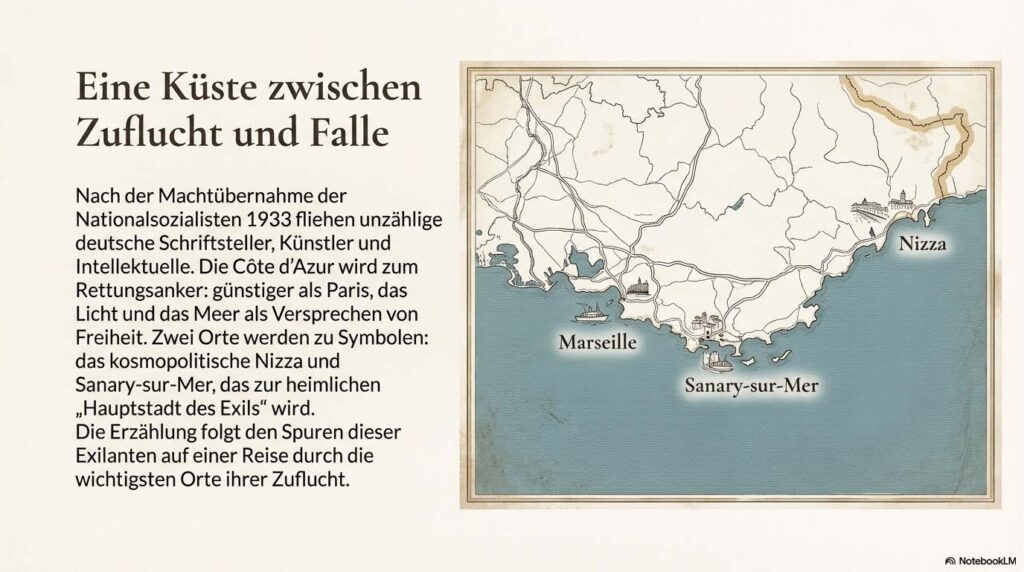
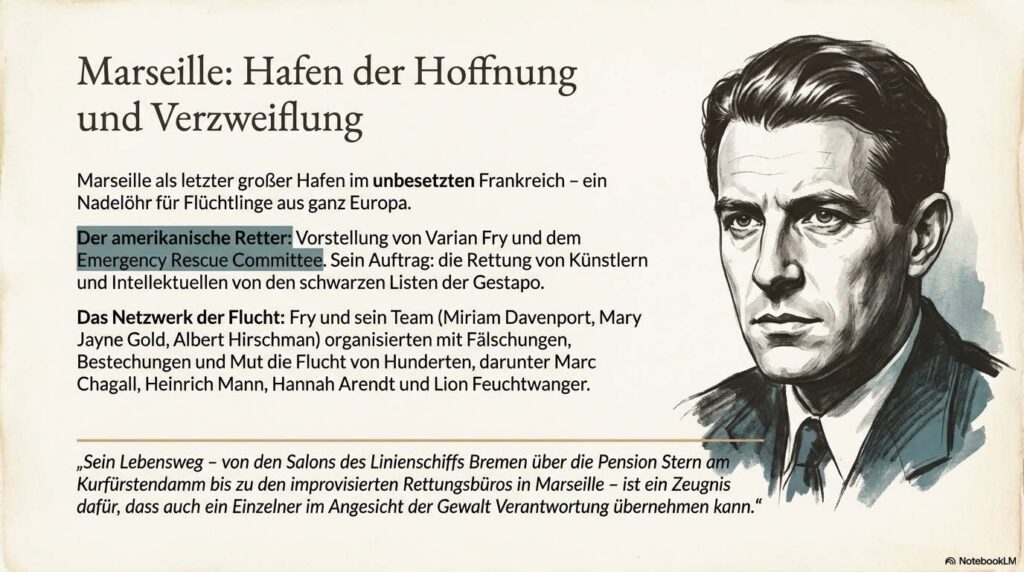
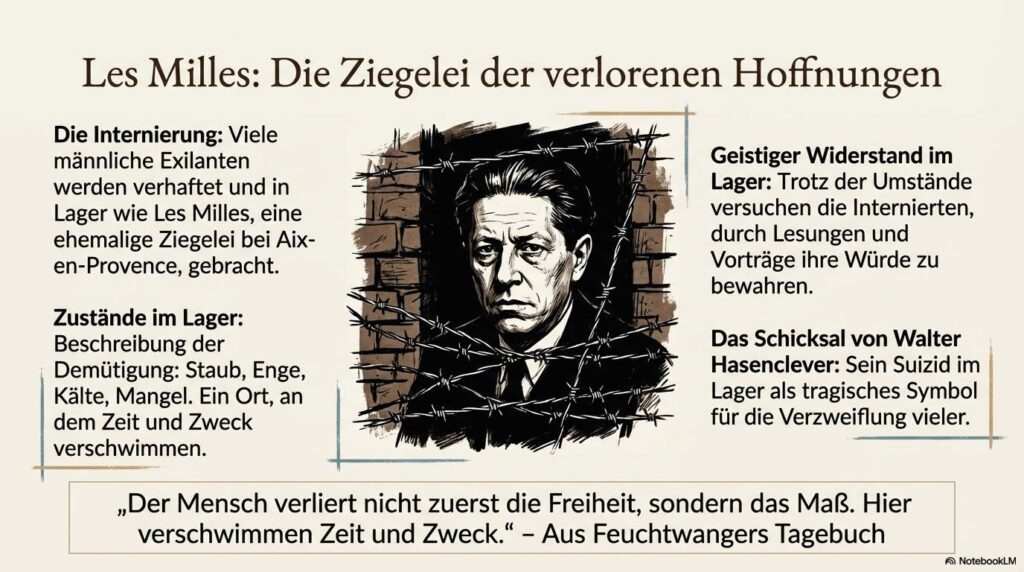
Podcast von Arcoplexus zum Buch “Deutsche Exilanten an der Côte d’Azur” von Klaus Kampe. Das Werk dokumentiert das bewegte Leben deutscher Exilanten an der Côte d’Azur während der 1930er Jahre. Im Fokus stehen Zufluchtsorte wie Sanary-sur-Mer und Nizza, wo bedeutende Intellektuelle wie Thomas Mann, Lion Feuchtwanger und Hannah Arendt versuchten, ihre kulturelle Identität gegen das NS-Regime zu verteidigen. Die Texte beleuchten zudem die mutigen Rettungsaktionen von Varian Fry in Marseille sowie die künstlerische Arbeit des Fotografen Walter Bondy. Neben literarischen Analysen und historischen Fakten fließen persönliche Anekdoten und fiktive Dialoge ein, die das Spannungsfeld zwischen mediterraner Idylle und existenzieller Bedrohung spürbar machen. Letztlich dient das Buch als Hommage an die schöpferische Kraft einer Generation, die trotz Verfolgung und Internierung an Humanismus und Freiheit festhielt. Es verbindet dabei die historische Spurensuche mit dem kollektiven Gedächtnis einer verlorenen Welt. Zum Buch:
Ideologies are always prisons of thought based on ignorance rather than tolerance.
Using the example of
Whittaker Chambers: (Cold War Classics) “Witness” vs. Hannah Arendt: “Vita activa or On Active Life” two responses to the same experience.
Common starting point: break with ideology
Chambers experienced
communism as a belief system the break is existential, almost religious ideology = attempt to impose meaning on history
Arendt
analyzed ideology as a substitute for thinking Ideology = logic that overwhelms reality Totalitarianism arises when people stop judging
Commonality: Ideology is not “thinking wrong,” but rather no longer thinking. The decisive difference: What follows from the break?
Here, the paths diverge radically. Chambers: Withdrawal from politics Central motif in Witness
Anthropology
Man is fallen
Power always corrupts
History tends toward evil
Response to totalitarianism: Asceticism, witness, sacrifice, refusal. Arendt: Return to politics Central motif in Vita activa
Freedom exists only where people act together.
Consequences:
Politics is irreplaceable.
No salvation, no ultimate goal.
Freedom arises between people, not in the soul.
Anthropology
Humans are capable of beginning (natality).
History is open.
Guilt and responsibility are political, not metaphysical.
Response to totalitarianism: Action, public discourse, judgment. The core conflict Question
Chambers
Arendt Where does salvation lie?
Outside the world
In the world Role of politics
Danger
Necessity Attitude toward history
Doom logic
Openness Antidote to ideology
Faith
Thinking Freedom
Internal
Public Why the New Right chooses Chambers – and avoids Arendt Chambers is attractive because:
he creates meaning
clearly distributes guilt and blame
makes history readable as a struggle
charges politics with morality
perfect for Kulturkampf narratives. Arendt is uncomfortable because:
she promises no salvation
she critically examines all camps
she demands judgment, not loyalty
she desacralizes politics
bad for mobilization, good for freedom. Blücher as the silent key
Blücher would say between the two:
“Those who ask for meaning instead of responsibility are fleeing from freedom.”
He shares the break with Chambers, but with Arendt the consequence:
no ideology
no doctrine of salvation
no ultimate order
Only action under uncertainty. Escalation (honest, not conciliatory)
Chambers helps us to leave totalitarianism behind. Arendt helps us to avoid falling back into it.
The New Right often stops at the first step.
How Arendt is systematically misunderstood today (e.g., “mass society = liberalism”) The fundamental misunderstanding: Arendt = anti-liberalism? Claim (New Right, but also post-liberals):
Arendt showed that liberalism leads to mass society and thus to totalitarianism.
What Arendt actually says:
Mass society does not arise from too much freedom,
but from the disintegration of the world, bonds, and political action.
This can happen in liberal, authoritarian, or revolutionary systems.
For Arendt, liberalism is not the cause, but is often too weak to prevent totalitarianism. Misunderstanding: “Mass society = multiculturalism/migration” Right-wing interpretation:
Mass = politically uprooted people
The decisive factor is lawlessness, not origin.
Nation states themselves have produced masses (e.g., stateless persons in the 1930s).
Ethnic homogeneity does not protect against totalitarianism – it often accelerates it. Misunderstanding: Arendt legitimizes authoritarian order Right-wing appeal:
Order, authority, discipline as a bulwark against chaos
Arendt:
makes a strict distinction between:
    authority (recognized, not enforced)
    power (derived from collective action)
    force (a substitute for power)
Authoritarian regimes destroy power; they do not stabilize it.
Those who confuse violence with order reproduce totalitarian logic. Misunderstanding: Arendt = cultural pessimism Simplified interpretation:
criticizes depoliticization, not modernity
Technology is not the problem,
but when it replaces human action
Equality is a prerequisite for politics, not its enemy
Arendt is not a cultural critic in the right-wing sense. Misunderstanding: “The banality of evil” = trivialization Frequent right-wing (and popular) misreading:
Eichmann was “just a cog in the wheel”
Guilt disappears in the system
Arendt means:
Eichmann was guilty,
but not demonic,
rather lacking in judgment
which is more dangerous than fanaticism
Evil does not become smaller, but closer.
This is uncomfortable for right-wing movements:
Guilt cannot be externalized.
Even “normal patriots” can bear injustice.
Misunderstanding: Arendt as defender of “Western values.” Instrumentalization:
Arendt as key witness for “defense of civilization.”
The West vs. barbarism.
Arendt:
Rejects myths of civilization
Totalitarianism is modern, Western, rational
Not a “foreign” disease
Those who use Arendt for cultural warfare have already lost. The blind spot of the New Right
The New Right adopts:
Arendt's diagnosis of fear
Her criticism of ideology
Her skepticism toward narratives of progress
It rejects:
Judgment against its own side
Plurality
Public sphere without compulsory loyalty
Arendt would say:
Ideology begins where thinking ends – even on the right.
Misunderstanding: Liberals also misread Arendt
Not just the right. Liberal simplification:
Arendt = constitution, institutions, rule of law
Problem:
Arendt was skeptical of pure administrative liberalism
without a vibrant public sphere, institutions collapse
Bureaucracy is politically empty, not neutral
Arendt is anti-technocratic, not anti-liberal.
Arendt is anti-technocratic, not anti-liberal.
The New Right reads Arendt as a warning against freedom.
Liberals read her as a defender of order.
Both are wrong.
Arendt defends freedom as a practice. And that makes her dangerous to any camp logic. Hannah Arendt ↔ Carl Schmitt Why their proximity is asserted—and their opposition is concealed Why they are mentioned together at all
The New Right likes to claim:
“Arendt and Schmitt both analyze the crisis of liberalism.”
Formally, this is true:
both criticize liberal legalism
both do not see politics as administration
both reject optimism about progress
But: They draw opposite conclusions from this. The decisive contrast (one sentence)
Schmitt asks: Who decides in a state of emergency?
Arendt asks: How can people act together without a state of emergency?
Understanding of politics Carl Schmitt
Politics = friend–enemy distinction
The political is conflictual or not at all
Unity arises through demarcation
Homogeneity is a prerequisite for political order
Politics requires decision-making, if necessary against the law. Hannah Arendt
Politics = plural space of appearance
Politics arises between different parties
Conflict yes, but not existential
Homogeneity destroys politics
Politics needs publicity, not decision-making power. State of emergency vs. natality Schmitt
Sovereignty lies with those who decide on states of emergency.
Exceptions are the moment of truth in politics.
Law thrives on the breaking of law.
Order is always precarious, hence authoritarian safeguards. Arendt
Central concept: natality (the ability to begin)
Politics thrives on new beginnings, not on exceptions
A state of emergency is political failure
Freedom begins where violence ends. Power and violence (fundamental!) Schmitt
Power = decision-making power
Violence is a legitimate political means
Law is ultimately based on violence
Arendt
Power arises from joint action
Violence is a loss of power
Violence destroys legitimacy, even if it is effective
Here, any reconciliation is impossible. People, unity, homogeneity Schmitt
Democracy = identity of the rulers and the ruled
This presupposes homogeneity
Exclusion is democratically legitimate
Arendt
The people are not a substance
Political community arises through participation
Rights arise from belonging to the world, not from identity
Liberalism = danger of administration
Politics is replaced by bureaucracy
Public life becomes desolate
→ Solution: more politics, not less.
Same diagnosis – opposite therapy. Why the New Right “Schmittizes” Arendt
Typical strategy:
Arendt quotes on crisis, masses, ideology
combined with Schmitt's:
    Decision
    Sovereignty
    Exception
Result: seemingly “humane Schmitt”
This is intellectually dishonest:
Arendt undermines Schmitt's entire foundation
her concepts of power and freedom directly contradict him
The moral dividing line Schmitt
Law follows power
Guilt is secondary
Loyalty is decisive
Arendt
Guilt is personal
Thinking is a duty
Loyalty is never an excuse
Eichmann vs. State of Emergency.
Escalation Schmitt thinks about politics in terms of war. Arendt thinks about politics in terms of action. Schmitt needs enemies to create order. Arendt needs others to enable freedom.
Why this is crucial today
Those who equate Arendt with Schmitt:
legitimize states of emergency
moralize power
depoliticize responsibility
Arendt would be radical here:
The state of emergency is not the salvation of politics, but its end.
Carl Schmitt and the authoritarian left Basic idea: Schmitt’s core concepts
The central Schmittian concept:
Sovereignty = Who decides on the state of emergency Power concentrates when rules fail. The sovereign stands above the law in order to enforce order or transformation. Friend–enemy logic Politics is always conflict. Unity arises through demarcation. State decision ≫ Moral or liberal principles Legal norms are secondary to effective power.
Why this is attractive to the authoritarian left a) State-centered solution to crises
Marxists, Leninists, or Stalinists seek instruments to enforce radical transformation.
Schmitt provides legitimation for executive power beyond liberal restrictions.
b) State of emergency as a political strategy
Revolution = “permanent state of emergency.”
Schmitt's theory allows for:
    Emergency as a moment of political clarity.
    Overriding the law as a legitimate means.
c) Friend–enemy logic for class struggle.
The left can interpret “bourgeoisie vs. proletariat” as a political exceptional relationship.
Schmitt's concept becomes the legal or strategic basis for class politics.
d) Rejection of liberal civil society
Liberal institutions = obstacle to radical transformation.
Schmitt shows how law and democracy can be formal without real transformative power.
Tensions / limits
Schmitt is not a leftist; he defends the state and order, not revolution.
Schmitt's emphasis on national homogeneity clashes with internationalist leftist thinking.
Schmitt wants to limit the state of exception to sovereignty, not to permanent revolution.
Conclusion: Leftists selectively adopt, often only, the mechanism of power concentration, not his conservative philosophy of the state. Historical examples Actor
How Schmitt was received Leninism / Stalinism
Schmitt’s justification of exceptions as justification for the “dictatorship of the proletariat” Italian left (Gramsci circle)
Schmitt’s friend-enemy logic for bloc formation in class struggle Neo-Marxists / Critical theory
Schmitt as an analytical tool: states of emergency, political decision-making mechanisms, but without normative approval Comparison: left vs. right Schmitt reception Feature
Right
Authoritarian left State of emergency
Protection of the nation, culture, order
Transformation, revolution, class rule Friend–enemy
Nation / identity
Classes, global enemies Legitimacy
Defense, preservation
Radical transformation Relationship to freedom
Secondary, often repressive
Secondary, often utopian
Schmitt is technically flexible because he describes mechanisms of power rather than defining them morally. That is why he works on both sides. The crucial point
Schmitt is attractive to any political movement that wants to transcend legal norms in favor of radical decisions.
Right: Nation, tradition, identity Left: Revolution, class rule, transformation Both ignore Schmitt’s normative concern that sovereignty is always bound to responsibility and concrete community.
Views on left-wing and right-wing ideology
in german:
Ansichten zur linken und rechten Ideologie
Ideologien sind immer Denkgefängnisse die auf Ignoranz basieren und nicht auf Toleranz.
am Beispiel von
Whittaker Chambers: (Cold War Classics) „Witness“
vs.
Hannah Arendt: „Vita activa oder Vom tätigen Leben“
zwei Antworten auf dieselbe Erfahrung.
1Gemeinsamer Ausgangspunkt: Bruch mit der Ideologie
Chambers
erlebte den Kommunismus als Glaubenssystem
der Bruch ist existentiell, fast religiös
Ideologie = Versuch, der Geschichte einen Sinn aufzuzwingen
Arendt
analysierte Ideologie als Ersatz für Denken
Ideologie = Logik, die Realität überrollt
Totalitarismus entsteht, wenn Menschen aufhören zu urteilen
Gemeinsamkeit: Ideologie ist nicht „falsch denken“, sondern nicht mehr denken.
Der entscheidende Unterschied: Was folgt aus dem Bruch?
Hier trennen sich die Wege radikal.
Chambers: Rückzug aus der Politik
Zentrales Motiv in Witness
Geschichte ist ein geistlicher Kampf, den der Mensch nicht gewinnen kann.
Konsequenzen:
Politik ist sekundär, fast gefährlich
Erlösung liegt außerhalb der politischen Welt
Christentum = letzte Wahrheit gegen geschichtsphilosophische Hybris
Anthropologie
Mensch ist gefallen
Macht korrumpiert immer
Geschichte tendiert zum Bösen
Antwort auf Totalitarismus: Askese, Zeugenschaft, Opfer, Verweigerung.
Arendt: Rückkehr in die Politik
Zentrales Motiv in Vita activa
Freiheit existiert nur dort, wo Menschen gemeinsam handeln.
Konsequenzen:
Politik ist unersetzlich
keine Erlösung, kein Endziel
Freiheit entsteht zwischen Menschen, nicht in der Seele
Anthropologie
Mensch ist anfangsfähig (Natalität)
Geschichte ist offen
Schuld und Verantwortung sind politisch, nicht metaphysisch
Antwort auf Totalitarismus: Handeln, Öffentlichkeit, Urteilskraft.
Der Kernkonflikt
Frage
Chambers
Arendt
Wo liegt das Heil?
Außerhalb der Welt
In der Welt
Rolle der Politik
Gefahr
Notwendigkeit
Haltung zur Geschichte
Untergangslogik
Offenheit
Gegenmittel zur Ideologie
Glaube
Denken
Freiheit
innerlich
öffentlich
Warum die Neue Rechte Chambers wählt – und Arendt meidet
Chambers ist attraktiv, weil:
er Sinn stiftet
Schuld und Opfer klar verteilt
Geschichte als Kampf lesbar macht
Politik moralisch auflädt
perfekt für Kulturkampf-Narrative.
Arendt ist unbequem, weil:
sie keine Erlösung verspricht
sie alle Lager kritisch prüft
sie Urteil verlangt, nicht Loyalität
sie Politik entsakralisiert
schlecht für Mobilisierung, gut für Freiheit.
Blücher als stiller Schlüssel
Blücher würde zwischen beiden sagen:
„Wer nach Sinn statt nach Verantwortung fragt, flieht vor Freiheit.“
Er teilt mit Chambers den Bruch, aber mit Arendt die Konsequenz:
keine Ideologie
keine Heilslehre
keine letzte Ordnung
Nur Handeln unter Unsicherheit.
Zuspitzung (ehrlich, nicht versöhnlich)
Chambers hilft, den Totalitarismus zu verlassen. Arendt hilft, danach nicht wieder hineinzugeraten.
Die Neue Rechte bleibt oft beim ersten Schritt stehen.
Wie Arendt heute systematisch missverstanden wird (z. B. „Massengesellschaft = Liberalismus“)
Das Grundmissverständnis: Arendt = Anti-Liberalismus?
Behauptung (Neue Rechte, aber auch Postliberale):
Arendt habe gezeigt, dass Liberalismus zur Massengesellschaft und damit zum Totalitarismus führe.
Was Arendt tatsächlich sagt:
Massengesellschaft entsteht nicht aus zu viel Freiheit,
sondern aus Zerfall von Welt, Bindungen und politischem Handeln.
Das kann in liberalen, autoritären oder revolutionären Systemen passieren.
Liberalismus ist bei Arendt nicht Ursache, sondern oft zu schwach, um Totalitarismus zu verhindern.
Some of you asked for a follow up on how things are going after moving (early military retiree) to France.
We are in Toulouse and we’ve explored some of our temporary neighborhood for a few days. We’re in an AirBnB until I find us a permanent rental. Speaking of…
To get a dossier facile completed, which is the French rental portfolio most landlords ask for (since they do not have the US-style credit scoring agencies here) I must translate all my documents to French. You can either pay to do this, or (like me) you can spend days doing this yourself on Canva. It’s painstaking work to reformat every dollar amount to euros and check that something hasn’t translated improperly. I’m actually taking a break from the salt mines to write this so I can be *somewhat* creative today. This is the point when reality hits and when people start to rethink their life choices. So far I’m not toe to toe with the ledge yet but my typing fingers are taking a beating.
Most French are very polite about the language barrier, but some are not. That’s just the nature of people *shrug*. Even if you start in French but try in English they may not want to switch to English, or may not be able to. It’s their country and their language, after all. I’m B1 level but of course, I do not know all the vocab words for everything, nor all the proper verbs. At the Christmas market last night, a vendor asked me in French if I wanted my pecan pie warmed up. Did I understand her? Absolutely not. Instead she popped it in the microwave and said something like, “I’m just going to warm it for her regardless” to her other vendor, and I’m thankful she did because it was so much better warm. Another customer service rockstar was the returns clerk at our closest Monoprix- he spoke really good English and made sure to help us out with buying a Christmas tree and pricing an expensive dragonfruit, all with a smile. The “Bonjour” is everything, EVERYTHING, when you enter a places or even sit down by someone in public, and “Merci pour votre patience” goes a long way with people when you’re trying to communicate but struggling, as well.
Everyone is dressed more stylishly than me, including the children and the homeless.
Another helpful tip is to DIGITALLY SCAN EVERYTHING before you leave. Scan all your paperwork, medical files, statements, records, bills, tax returns, pension certificates etc. unless you’re sure you’ll have both digital access or access to a printer/scanner when you move. I haven’t installed my VPN yet and I’m currently blocked from accessing a savings account statement online on their website (because now I have a french IP at the AirBnB) which I need for my Garantme guarantor file, which then FEEDS INTO the dossier facile, but I saved a digital copy before I left and can access that on my Google Drive. Only 9 years of military bureaucracy could have properly prepared me for dealing with this intense level of French paperwork. I am thriving.
I’m currently struggling with the laundry situation. The AirBnB has a very old, very tiny (in comparison to American) washer, and only a drying rack. No outdoor drying lines or windows with drying access (top floor, ceiling windows). I sent a silent prayer of thanks to my Depression-era grandmother who taught me how to dry clothes on a line and by a radiator, because otherwise I’d be sunk.
I’ve seen four sets of fake eyelashes, no BBL’s, no unrealistic plastic surgery/Botox treatments, and maybe 3 ladies with a full face of make up on since we landed in Paris and then flew to Toulouse. No one is contouring/wearing drag make up during the daytime. The younger girls wear more make up than we aged swamp witches. I am in my element. Just plucking my chin hairs makes me feel fully made up. I added eyebrows yesterday and immediately turned into Cindy Crawford. May do eyebrows/mascara tomorrow and become Ms. Universe, we’ll see. I really do love the lack of pressure to be “picture plastic perfect” here, though. Its a huge bonus.
So far, my daughter and I have managed Christmas shopping for each other, grocery shopping, land navigation, and getting 15k steps in every day just by walking to the places we need to get to. My body literally hurts from how out of shape I am and how much walking I have to do now that I don’t have a car. I’m so happy about it, though, since I moved here for the car-free life. I HATE driving, especially in California lol. I will adapt and overcome.
That is all for now. I did have a quintessentially French moment as I was shopping; I bought a sandwich and an Orangina and sat in a chair in the sidewalk and took my time eating it, while savoring the architecture and people-watching (pictured). Monday we may conquer the bus/public transportation, since there’s a tourism office nearby and they can explain how to buy fares. A la prochaine !
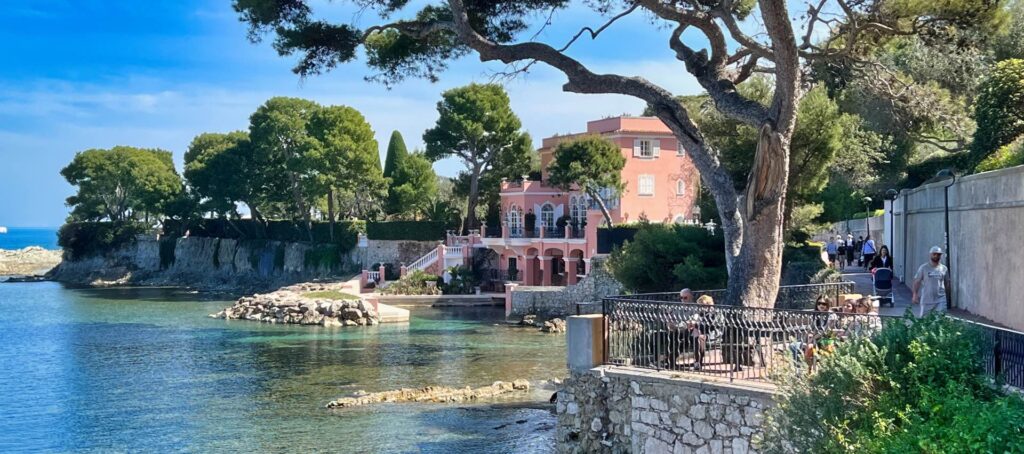
On the prestigious French Riviera, on the Saint-Jean-Cap-Ferrat peninsula, stands one of the most famous villa estates on the Côte d’Azur: the pink villa, now called La Fleur du Cap. This property is a fascinating example of late 19th-century luxury architecture, which over time has been home to a remarkable series of prominent residents and has become a setting for the social and cultural history of the Riviera.
Architecture and construction history
The villa was built in 1880 by Albert Bounin, the son of a Sardinian arms dealer and olive oil merchant from Nice. Bounin acquired several plots of land on the quiet headland of Cap Ferrat and had a picturesque estate built there, which he initially called L’Isoletta and which had a small private harbor. From the outset, the building captivated visitors with its location directly on the sea and its striking pink façade, which would later give it its name.
Later, his son Paul took over the estate, added an extra floor, and renamed the villa Lo Scoglietto (“the little rock”). During these early years, the house remained largely hidden from public view, but it soon became a notable destination for wealthy travelers on the Riviera.
Prominent residents in front of Niven
During the first decades of the 20th century, the villa changed owners and tenants several times:
In 1920, the Duchess of Marlborough, Consuelo Vanderbilt, one of the most prominent society figures of her time, lived there for a while.
In the 1950s, the villa was occupied by King Leopold III of Belgium shortly before his abdication.
The silent film and early sound film star Charlie Chaplin spent several weeks at the estate.
This series of famous guests shows how strongly the Riviera had become a refuge for aristocrats, movie stars, and wealthy travelers since the early 20th century—a trend that also had a strong influence on the image of the villa.
David Niven and the Riviera Era
Perhaps the most famous resident of the pink villa was British actor David Niven (1910–1983). Niven bought the villa in the late 1950s/early 1960s and made it his long-term home.
David Niven was one of the most charming and versatile actors of his generation. A Hollywood star, author, and former officer, he was considered an elegant gentleman with British charm. Niven was closely connected to the international celebrity scene on the Riviera: he was friends with Princess Grace Kelly and Prince Rainier of Monaco and was one of the well-known personalities who shaped the lifestyle of the Côte d’Azur in those years.
During this time, the pink villa was not only a private residence, but also a place for social gatherings. Niven also played a cinematic role as part of the estate: a scene from his film “Trail of the Pink Panther” (1982) was shot here — an ironic reference to the villa with its striking color and celebrity connections.
After his death in 1983, the small square in front of the villa was named Place David Niven — a lasting testament to the actor’s influence on local culture and the collective memory of Saint-Jean-Cap-Ferrat.
NAfterlife and restoration
Over the following decades, the property changed hands several times; since 1999, it has belonged to the parents of New Zealand billionaires Christopher and Richard Chandler, who had it extensively restored. Today, the villa is called La Fleur du Cap and is larger and better maintained than ever before — a monument to the glamorous era of the Riviera.
Conclusion
The pink villa in Cap Ferrat uniquely embodies the history of the Côte d’Azur: it is an expression of luxurious 19th-century architecture, a reflection of an aristocratic and cinematic society, and at the same time a place where the lives of prominent personalities such as David Niven have materialized. Its bright color and spectacular location above the sea make it a symbol of glamour, elegance, and the cultural appeal of the French Riviera to this day.