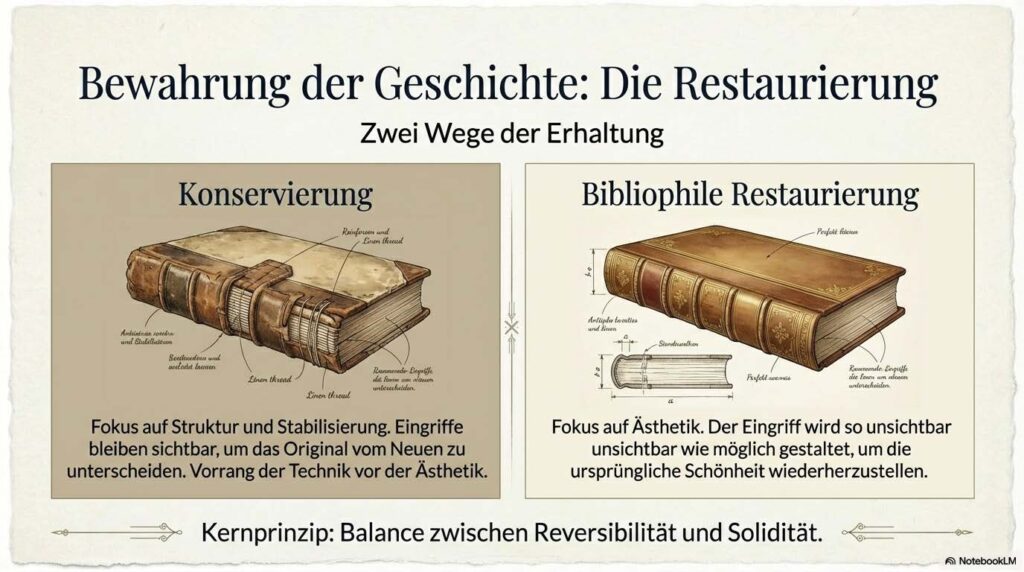
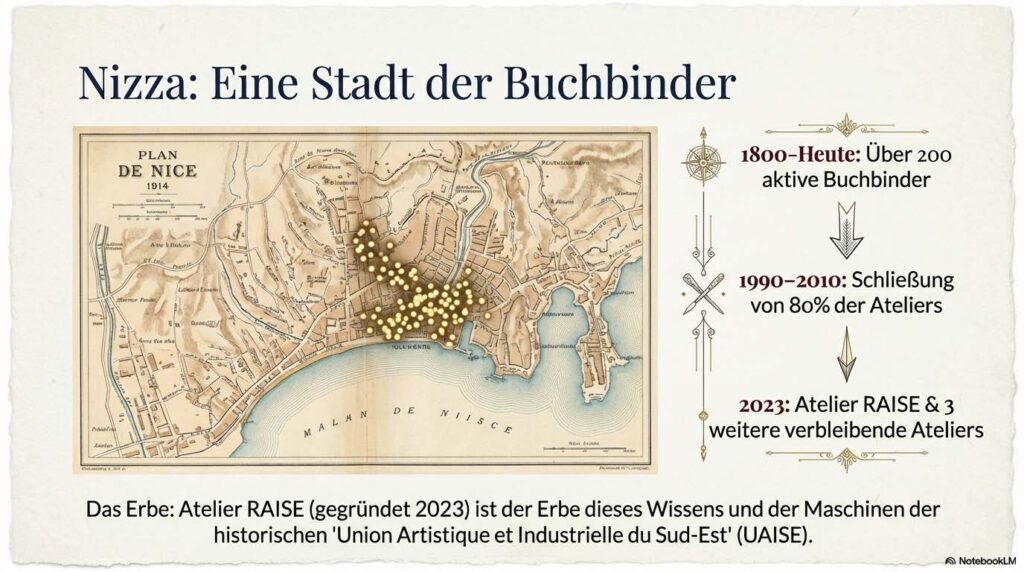
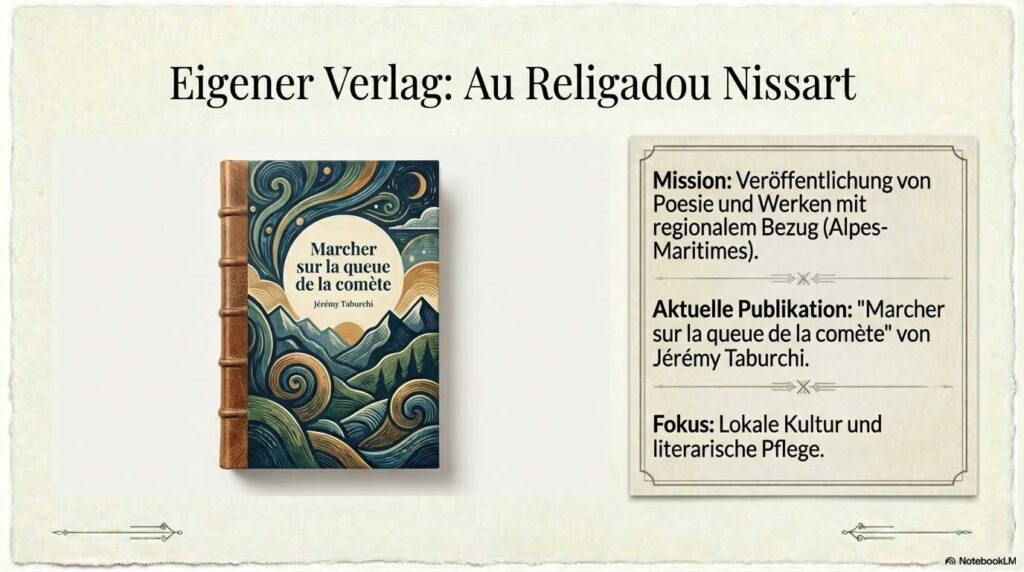
Das Atelier RAISE in Nizza, geführt von dem Experten Vincent Bottasso-Daideri, widmet sich der professionellen Buchbinderei und der Restaurierung historischer sowie moderner Werke. Die Quellen beschreiben ein breites Spektrum an Dienstleistungen, das von handwerklichen Fachkursen bis hin zur Gestaltung luxuriöser Künstlereditionen und humorvoller Kunstprojekte wie dem „Pass des Rosa Katzen-Landes“ reicht. Bottasso-Daideri ist zudem in der regionalen Kulturszene tief verwurzelt, unter anderem als Generalsekretär der Freunde des Kunstmuseums von Nizza und durch Kooperationen mit lokalen Künstlern wie Gérard Serée. Historische Rückblicke beleuchten die lange Tradition des Buchbinderhandwerks in der Region, während technische Erklärungen Einblicke in anspruchsvolle Verfahren wie die Vergoldung oder die Mosaik-Bindung geben. Das Atelier versteht sich somit als ein Zentrum für die Bewahrung des schriftlichen Kulturerbes und die Förderung zeitgenössischer Buchkunst.
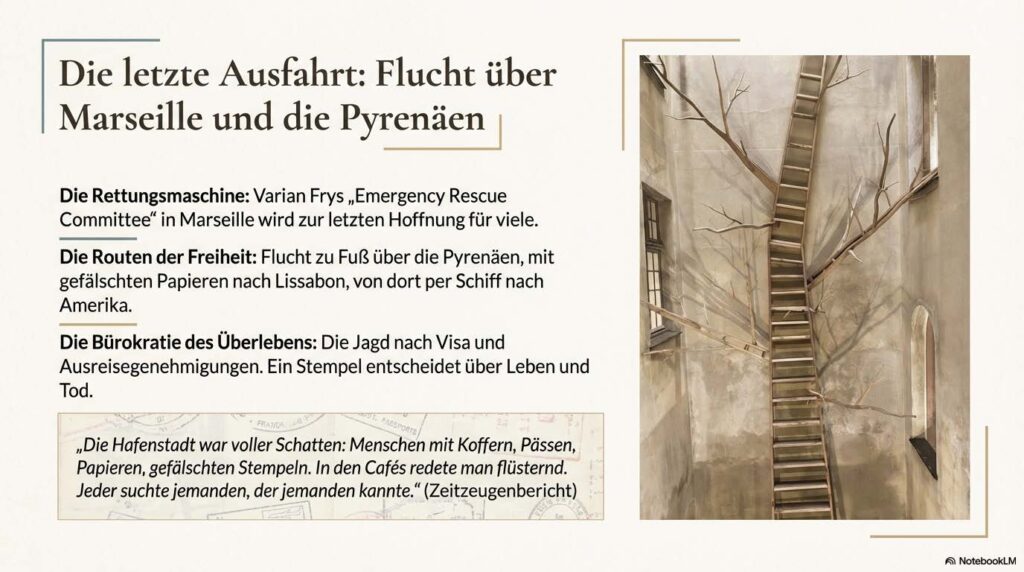
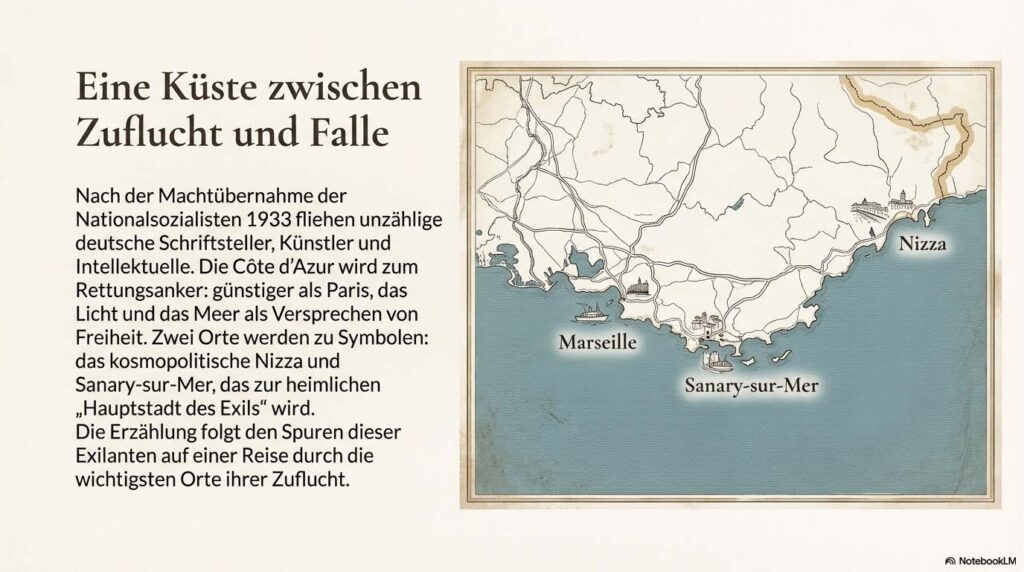
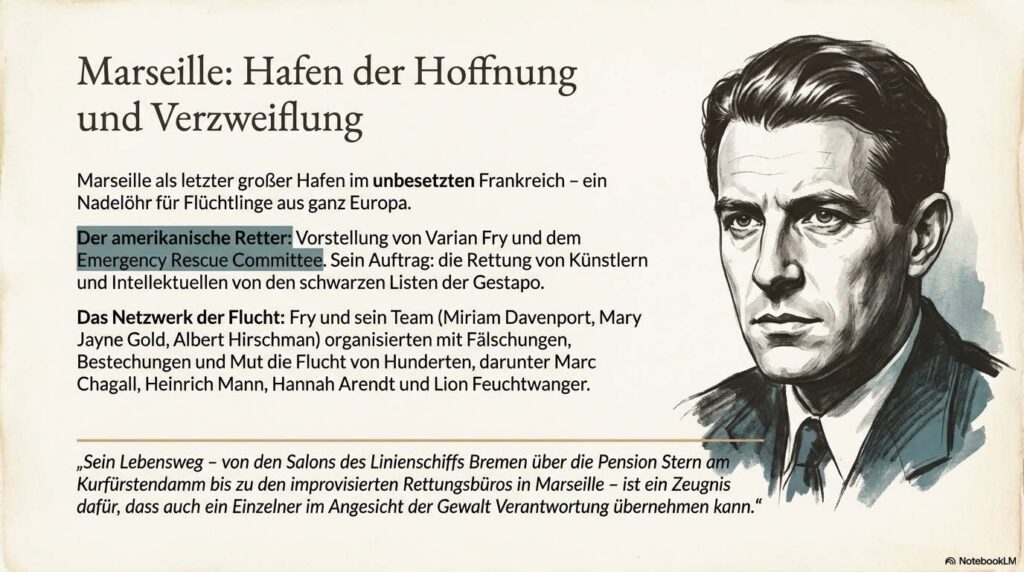
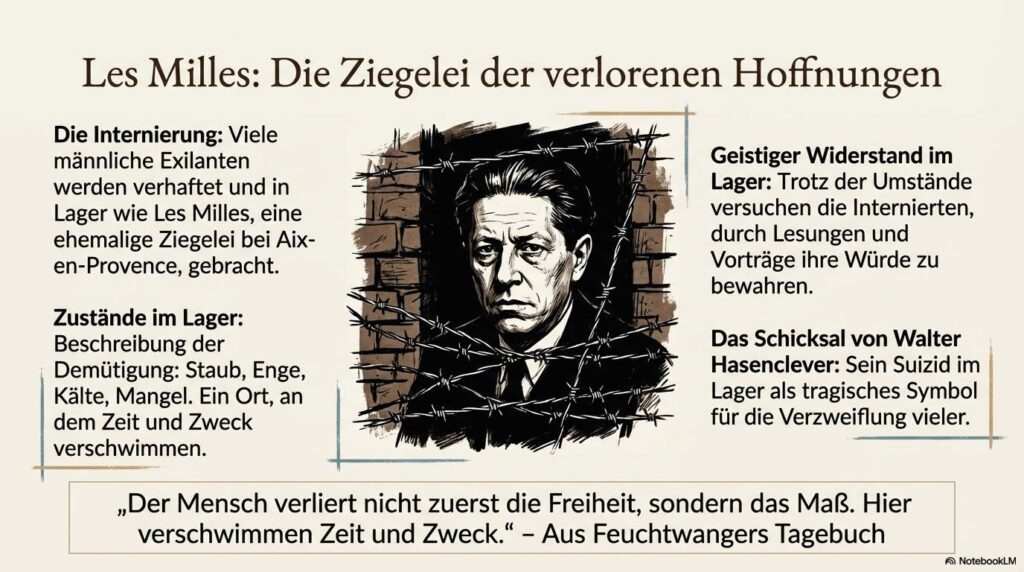
Podcast von Arcoplexus zum Buch “Deutsche Exilanten an der Côte d’Azur” von Klaus Kampe. Das Werk dokumentiert das bewegte Leben deutscher Exilanten an der Côte d’Azur während der 1930er Jahre. Im Fokus stehen Zufluchtsorte wie Sanary-sur-Mer und Nizza, wo bedeutende Intellektuelle wie Thomas Mann, Lion Feuchtwanger und Hannah Arendt versuchten, ihre kulturelle Identität gegen das NS-Regime zu verteidigen. Die Texte beleuchten zudem die mutigen Rettungsaktionen von Varian Fry in Marseille sowie die künstlerische Arbeit des Fotografen Walter Bondy. Neben literarischen Analysen und historischen Fakten fließen persönliche Anekdoten und fiktive Dialoge ein, die das Spannungsfeld zwischen mediterraner Idylle und existenzieller Bedrohung spürbar machen. Letztlich dient das Buch als Hommage an die schöpferische Kraft einer Generation, die trotz Verfolgung und Internierung an Humanismus und Freiheit festhielt. Es verbindet dabei die historische Spurensuche mit dem kollektiven Gedächtnis einer verlorenen Welt. Zum Buch:
Èze Village towers above the sparkling ribbon of the Mediterranean Sea like a silent witness to a complex past. Perched on a steep rocky outcrop on the French Riviera, the village uniquely combines traces of early Ligurian cultures, medieval power struggles, modern fortification policies, and the cultural trends of the Belle Époque. Its development is a prime example of the transformation of Mediterranean settlements from strategic strongholds to symbolic cultural landscapes.
1. The beginnings: Ligurian settlements and Roman spheres of influence
The earliest traces of human presence in the Èze area can be attributed to the Celto-Ligurian tribes who settled in the region around what is now Mont Bastide. The choice of location was motivated by both defensive and economic considerations: the extremely steep topography offered protection from attackers, while the proximity to the sea facilitated trade.
With Roman expansion in Provence, the entire coastal region was integrated into a systematic administrative and transportation system. Although Èze itself was not at the center of Roman urbanity, continuous settlement established itself along the coast, particularly in Èze-sur-Mer. The Roman presence also left behind agricultural techniques such as terraced farming and olive cultivation, which shaped the landscape until modern times.
Èze Village – Cactus Garden
2. Medieval consolidation: between Provence and Savoy
From the High Middle Ages onwards, Èze developed into a fortified village, which was ideal for military purposes due to its location at an altitude of 430 meters. From then on, its history was marked by territorial conflicts: Èze initially belonged to the County of Provence.
From the 14th century onwards, it fell under the rule of the House of Savoy. The conflict between Savoy and France in the 17th century led to multiple changes in strategy and ultimately to its integration into the Kingdom of France.
The medieval streets – now home to artists’ studios and boutiques – were originally designed for defensive purposes. The village functioned as a stone labyrinth intended to confuse attackers. The central fortress, the citadel of Èze, was repeatedly expanded, but fell victim to Louis XIV’s strategic order of destruction in 1706. Today’s platform with the “Jardin Exotique” is a relic of this military past.
3. Modern infrastructure: Fort Révère as part of national defense systems
In the 19th century, Èze once again became the focus of French military planning due to its geographical location. Fort Révère, located in the hinterland above the village, was built after 1870 as part of the so-called Séré de Rivières system – a network of modern fortifications of European significance, created in response to the Franco-Prussian War.
Fort Révère is characterized by: a polygonal layout with casemates, embrasures in all directions, massive walls made of stone and concrete, devices for communication with neighboring coastal and mountain forts.
Although Fort Révère was never involved in combat, it played a role in monitoring the coast and securing the Italian-French border. Today, as a restored monument, it offers one of the most impressive panoramic views of the Riviera and symbolizes an era of European rearmament that changed fundamentally with the First World War.
4. Château Balsan – Riviera romance and sophisticated
The advent of Riviera tourism in the 19th century marked the beginning of a new era for Èze. Château Balsan played a special role in this development. Industrialist Émile Balsan, who came from an influential textile family, acquired the estate and transformed it into a sophisticated retreat.
The château is remarkable for cultural and historical reasons: It was a frequent meeting place for the Parisian and international elite. Coco Chanel, who was closely associated with Émile Balsan in her early life, spent long periods here. It was in Èze that she made the transition from the world of aristocracy and bohemianism to her calling as a designer.
The subsequent conversion of the building into the exclusive Château de la Chèvre d’Or hotel marked another turning point: the Riviera became a luxury destination, while the historic buildings of Èze were integrated into tourist and cultural contexts.
5. Continuity and renewal: From an agricultural society to a cultural landscape
Until the early 20th century, Èze was still heavily agricultural: olive groves, vineyards, terraced farming, and sheep breeding dominated life. It was only with the expansion of modern transport infrastructure—roads, railways along the coast, and later the Corniche Routes—that the village underwent structural change.
The significant combination of historic buildings, an exceptional location, and romantic aesthetics led to Èze becoming a fixture for: artists and writers, botanists (especially because of the exotic garden), historians, and tourists from all over the world.
Today, Èze combines the preservation of its medieval identity with a mixture of arts and crafts, luxury hotels and natural landscape typical of the Côte d’Azur.
6. Concluding remarks
Èze Village is a prime example of the transformative power of historical sites. Its history encompasses: Ligurian origins, medieval power struggles, French and Savoyard territorial politics, modern fortification systems, the sophisticated culture of the Belle Époque and modern cultural tourism.
The Château Balsan and Fort Révère serve as striking anchor points: one embodies the aesthetic and social appeal of the Riviera, the other the strategic importance of the region in an era of geopolitical uncertainty.
Èze is thus not only a picturesque mountain village, but also a living archive of European history—a place where political, cultural, and landscape developments overlap in an extraordinary way.
A visit to Villa Kérylos on the French Riviera is like traveling back in time to the world of the ancient Greeks—but through the eyes of two passionate scholars of the early 20th century.
The visit—atmosphere and impressions
Upon entering the villa, you are greeted by a light-filled courtyard (peristyle) whose marble columns and water basins are immediately reminiscent of the architecture of classical Greek residences. The rooms are richly decorated with frescoes, mosaics, ornate furniture, and everyday objects—many of which were specially crafted based on ancient models, giving visitors the feeling of being in a living archaeology project.
From the open balcony, the view extends across the Mediterranean Sea to the Saint-Jean-Cap-Ferrat peninsula—a deliberate part of the concept: as in the homes of the ancient Greeks, the sea should always be present.
The owner: Théodore Reinach (1860–1928)
Théodore Reinach was a French scholar, historian, archaeologist, and politician.
He came from the famous Reinach family of bankers and artists, which belonged to France’s intellectual elite.
Reinach was deeply in love with Greek culture and philology. For him, Villa Kérylos was a life project—not as a replica, but as a creative reconstruction of a luxurious residence from the Greek Classical period (2nd–1st century BC).
He used the villa both as a vacation home and as a place of study and representation.
The architect: Emmanuel Pontremoli (1865–1956)
The architect Emmanuel Pontremoli was a graduate of the École des Beaux-Arts and later its director. He won the prestigious Prix de Rome in 1890 and spent years in Greece and the eastern Mediterranean.
These travels made him a specialist in Hellenistic architecture, which made him the ideal partner for Reinach’s vision. Pontremoli’s approach was extraordinary: he used modern building materials (concrete, iron), but designed each room according to ancient models, and integrated artisans, sculptors, and furniture designers who created new works specifically for the house based on archaeological models.
Historical background – Construction of the villa
Construction period: 1902–1908
Style: Hellenistic, inspired by the houses on Delos
Goal: An “ideal Greek house” – not a copy, but an authentic reinterpretation
Name: Kérylos means “tern,” a symbol of good luck in Greek mythology
After Reinach’s death in 1928, his family bequeathed the villa to the French Institute, which still manages it today.
Why it’s worth a visit
A tour of Villa Kérylos allows visitors to:
immerse themselves in the ancient world,
understand the interplay between science, art, and architecture around 1900,
and gain insight into the visions of two extraordinary personalities: a Hellenistic scholar and an architect influenced by Orientalism.
You leave the villa with the impression that you have visited not so much a museum as an ideal Greek house that – for a moment – is filled with life again.
A day at Villa Kérylos
The morning over Beaulieu-sur-Mer is still young as you walk along the narrow coastal road. The sea glistens in a milky blue, and the first rays of sunshine cast a silvery shimmer on the water’s surface. In the distance, you can see the simple, light silhouette of Villa Kérylos – a house that looks as if it has been blown straight from the spirit of antiquity to the coast of the Côte d’Azur.
Even the path leading there has something solemn about it. The bay lies calm, as if holding its breath, as you approach the entrance portal. As you cross the threshold, time suddenly seems to slow down.
In the first courtyard, a feeling of clarity envelops you. The sky above you is like a ceiling painting of pure color, and in the center murmurs a small water basin—the heartbeat of the house. The marble columns cast long shadows that fall across the antique-style mosaics. You feel the noise of the world quietly closing behind you and something else beginning: a silent conversation between you and the spirit of the past.
You wander through the rooms and notice the care that Théodore Reinach and Emmanuel Pontremoli have lavished on every detail. The Andron – once a place for conversations and banquets – welcomes you with cool walls decorated with mythological scenes. You imagine Reinach receiving guests here, scholars and artists immersed in passionate discussions about Greece, while outside the waves crash against the rocks.
In the bedroom, your gaze lingers on a golden border that shimmers in the sunlight. You feel as if this is less a room than a thought, artfully materialized. The bed is designed according to ancient models – simple yet sublime. You wonder if Reinach ever felt here that he was living in two worlds at once: the modern Riviera and ancient Greece.
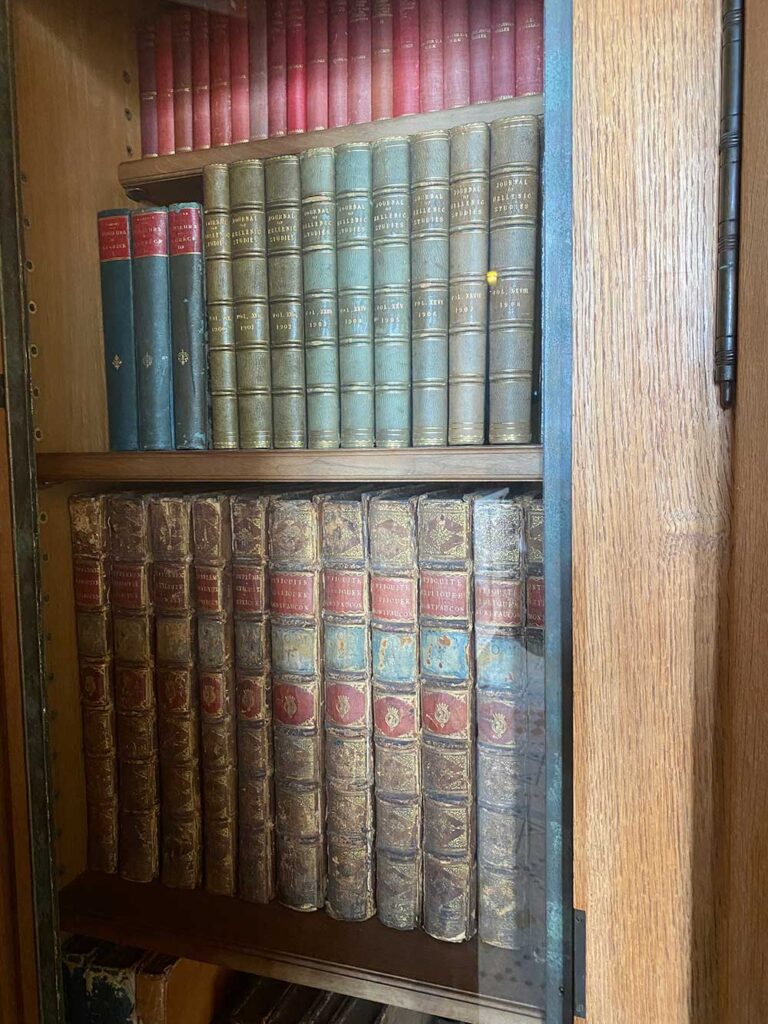
The library smells of old wood and a hint of the sea. The shelves—delicately crafted—stand as silent witnesses to his studies. Perhaps it was here that he immersed himself in his books while Pontremoli further refined the lines and proportions of the villa in his mind. Two men, united by a vision that came to fruition in these rooms: the dream of a house that does not copy the past, but embodies it.
When you finally reach the balcony, the view opens up to a Mediterranean panorama that seems almost unreal in its beauty. The sea lies like a calm cloth before you, and on the Saint-Jean-Cap-Ferrat peninsula, the villas glitter like scattered gems. A gentle breeze brushes your cheek, carrying the scent of salt and pine trees. You lean against the railing, and for a moment, the boundary between now and then seems to blur.
Perhaps this is the moment when you truly understand the villa: it is not a museum, but a conversation—between cultures, centuries, people. An ideal built with modern materials and an antique soul. A place that carries the longing not only to preserve beauty, but to live it.
When you leave the villa later and look back once more, it seems to float between the rocks and the sea. Elegant, timeless, a little mysterious. And you know that a part of you remains there, somewhere between the marble columns and the gentle splashing of the fountain, where antiquity came back to life for a moment.
Strophe I (Büchner) Friede den Hütten! – Krieg den Palästen! Hört ihr das Stöhnen der Erde, die Stimmen der Knechte? Das Blut rinnt in Furchen, doch die Herren speisen weiter. Reißt die Masken vom Antlitz, der Gerechtigkeit ihr kaltes, steinernes Gesicht! Refrain (beide, streitend) Gerechtigkeit! – ein Schwert, das rostet. Gerechtigkeit! – ein Feuer, das frisst. Zwischen Hütte und Palast, zwischen Kohlhaas und dem Fürst, wer hält das Maß? Wer bricht den Bann? Strophe II (Kleist) Höre, Büchner! Ich kenne den Mann, der Recht verlangte – Michael Kohlhaas, ein Händler von Pferden, so schlicht, so redlich – und doch in Brand gesetzt von Unrecht. Er griff zur Fackel, weil das Gericht schwieg. Sag mir, Georg, wo endet Recht, wo beginnt die Rache? Strophe III (Büchner, antwortend) Kleist, du siehst den Einzelnen brennen, doch ich höre das Volk schreien. Nicht ein Mann, ein Heer von Hungernden, nicht ein Pferd, tausend Seelen, und jeder Palast ein Kerker. Kohlhaas ist nicht der Einzelne – er ist die Saat, die im Zorn aufgeht. Bridge (Disput, wechselnd) Kleist: Recht ohne Gesetz ist Tyrannei. Büchner: Gesetz ohne Recht ist Gewalt. Kleist: Der Mensch darf nicht Richter im eigenen Streit sein! Büchner: Das Volk ist der Richter, wenn kein anderes Gericht mehr spricht. Refrain (beide, nun vereint im Streitgesang) Gerechtigkeit! – ein Schwert, das rostet. Gerechtigkeit! – ein Feuer, das frisst. Zwischen Hütte und Palast, zwischen Kohlhaas und dem Fürst, das Maß zerbricht – doch die Glut verlischt nicht. Outro (Büchner) Friede den Hütten! – Krieg den Palästen! Die Worte sind Pfeile, die Wahrheit ein Donner. Und im Streit der Dichter glüht ein einziger Ruf: Gerechtigkeit!
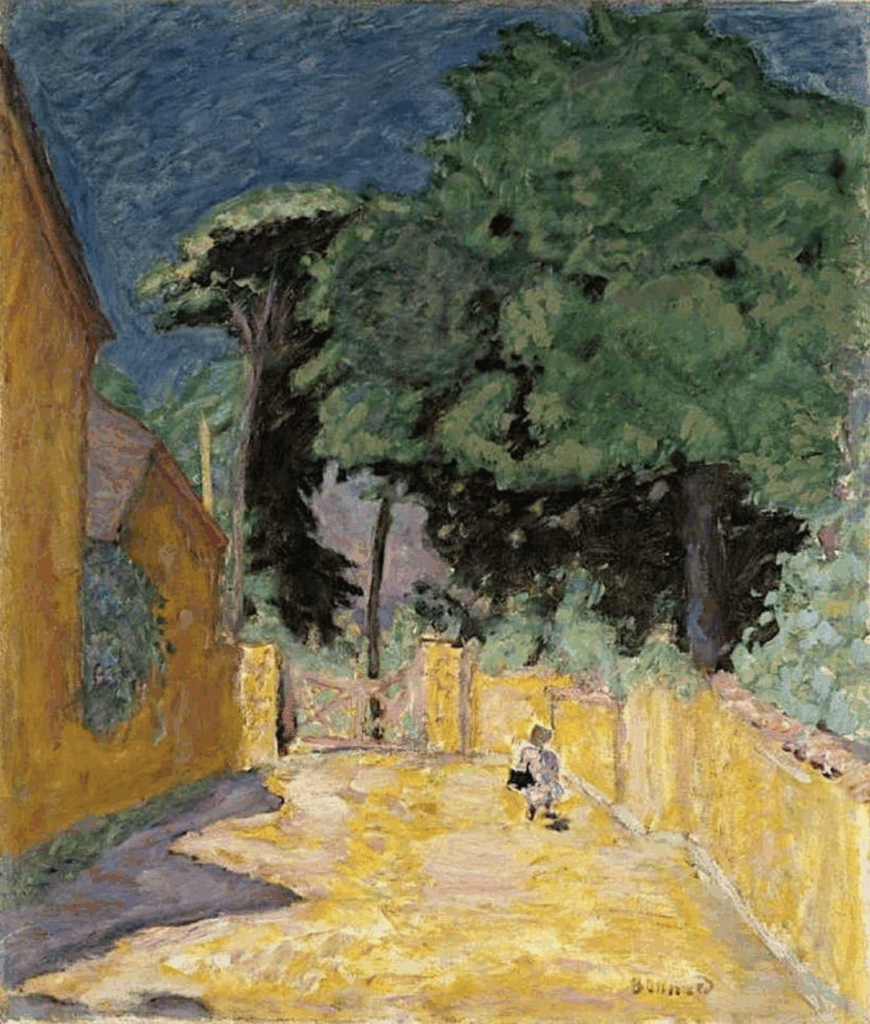
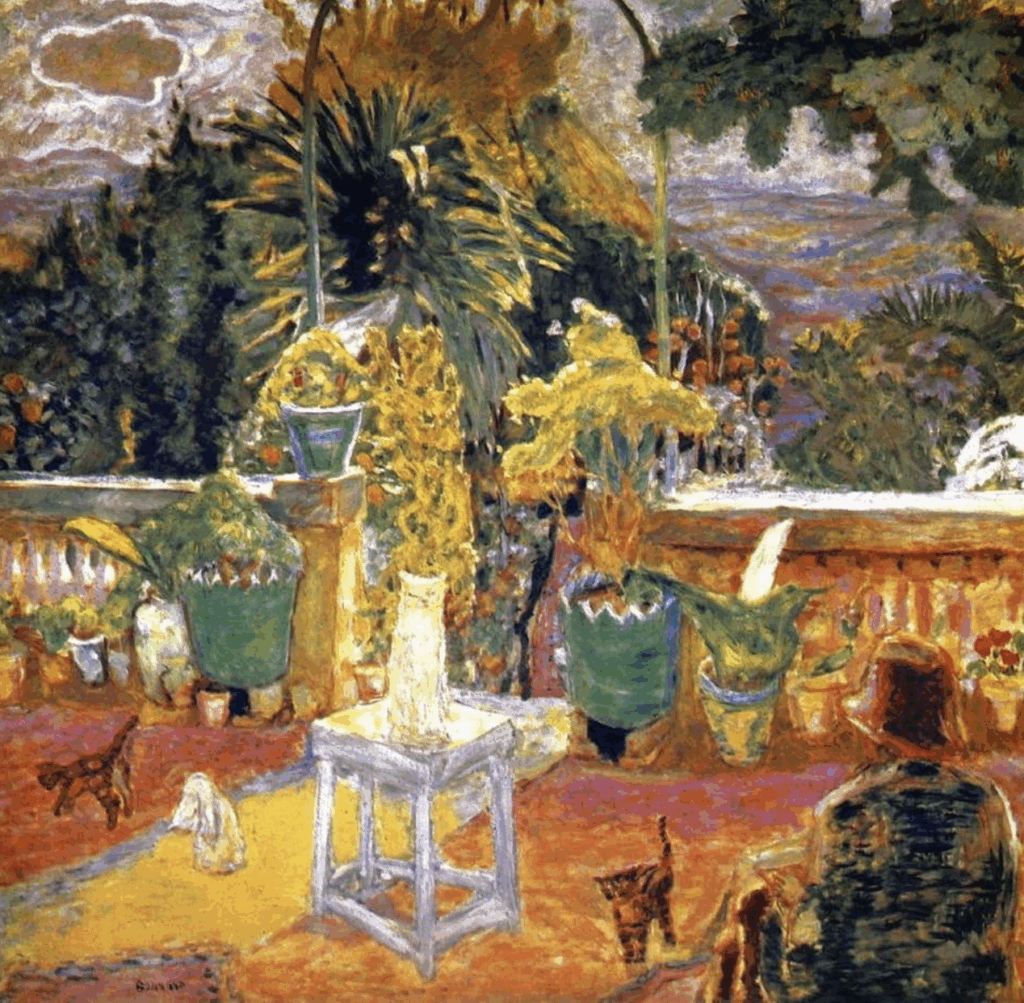
Pierre Bonnard (1867–1947) ranks among the outstanding French painters of the late 19th and early 20th centuries. His work is characterized by a subtle interplay of light, color, and intimacy, which distinguishes him from the Impressionists and at the same time secures him a special position in the transition to modernism.
Born on October 3, 1867, in Fontenay-aux-Roses near Paris, Bonnard came from a middle-class family. He originally studied law, but was drawn to art from an early age. Together with artist friends such as Maurice Denis, Paul Sérusier, and Édouard Vuillard, he joined the artist group “Les Nabis,” which developed new forms of expression beyond the Impressionists after 1888. There he was given the nickname le Nabi très japonard, as he was strongly inspired by Japanese woodblock printing, which was in vogue in Europe around 1900.
Bonnard was less interested in monumental historical themes than in everyday life: street scenes, garden scenes, interiors, and intimate moments. His partner and later wife, Marthe de Méligny, in particular, became his lifelong muse. She appears in numerous paintings, often in bathing or toilet scenes, reflecting Bonnard’s interest in intimacy, domesticity, and the depiction of light on skin and water.His painting technique differed from that of many of his contemporaries: Bonnard rarely worked directly in front of his subject. Instead, he sketched scenes, noted down colors, and later created the paintings in his studio from memory. This gave his pictures a dreamlike quality and an almost poetic blurriness, in which colors took precedence over form.
At the beginning of the 20th century, Bonnard increasingly withdrew from Parisian art life. After stays in Giverny and Vernon, he finally settled on the Côte d’Azur, in Le Cannet near Cannes. There he found inexhaustible motifs in his house and garden. His late works are filled with bright colors, Mediterranean light, and a deep tranquility that expresses his connection to nature.
Although Bonnard was appreciated during his lifetime, he stood in the shadow of artists such as Matisse and Picasso, who radically renewed modern painting. But today, Bonnard’s work is once again highly regarded: his ability to transform the intimate into the universal and his painterly sensibility are considered unique.
Pierre Bonnard died on January 23, 1947, in Le Cannet. His work left its mark on modern painting—not through loud provocations, but through quiet, lasting intensity.
in german:
Das Leben von Pierre Bonnard
Pierre Bonnard (1867–1947) zählt zu den herausragenden französischen Malern des späten 19. und frühen 20. Jahrhunderts. Sein Werk ist geprägt von einem subtilen Spiel aus Licht, Farbe und Intimität, das ihn von den Impressionisten unterscheidet und ihm zugleich eine Sonderstellung im Übergang zur Moderne sichert.
Geboren am 3. Oktober 1867 in Fontenay-aux-Roses bei Paris, stammte Bonnard aus einer bürgerlichen Familie. Ursprünglich studierte er Rechtswissenschaft, doch schon früh zog es ihn zur Kunst. Gemeinsam mit Künstlerfreunden wie Maurice Denis, Paul Sérusier und Édouard Vuillard schloss er sich der Künstlergruppe „Les Nabis“ an, die nach 1888 neue Ausdrucksformen jenseits der Impressionisten entwickelte. Dort erhielt er den Beinamen le Nabi très japonard, da er sich stark von der japanischen Farbholzschnittkunst inspirieren ließ, die in Europa um 1900 in Mode war.
Bonnard interessierte sich weniger für monumentale historische Themen als für das Alltägliche: Straßenszenen, Gartenbilder, Interieurs und intime Momente. Besonders seine Partnerin und spätere Ehefrau Marthe de Méligny wurde zu seiner lebenslangen Muse. Sie erscheint in zahlreichen Gemälden, oft in Bad- oder Toilettenszenen, was Bonnards Interesse an Intimität, Häuslichkeit und zugleich an der Darstellung von Licht auf Haut und Wasser spiegelt.
Sein malerisches Verfahren unterschied sich von vielen seiner Zeitgenossen: Bonnard arbeitete selten direkt vor dem Motiv. Stattdessen skizzierte er Szenen, notierte Farben und schuf die Gemälde später im Atelier aus dem Gedächtnis. Das verlieh seinen Bildern eine Traumhaftigkeit und eine beinahe poetische Unschärfe, in der Farben gegenüber der Form Vorrang erhielten.
Mit Beginn des 20. Jahrhunderts zog Bonnard sich zunehmend aus dem Pariser Kunstleben zurück. Nach Aufenthalten in Giverny und Vernon ließ er sich schließlich an der Côte d’Azur nieder, in Le Cannet bei Cannes. Dort fand er in seinem Haus und Garten unerschöpfliche Motive. Seine späten Werke sind erfüllt von leuchtenden Farben, mediterranem Licht und einer tiefen Ruhe, die seine Verbindung zur Natur ausdrückt.
Obwohl Bonnard zu Lebzeiten geschätzt wurde, stand er im Schatten von Künstlern wie Matisse und Picasso, die die moderne Malerei radikaler erneuerten. Doch gerade heute wird Bonnards Werk wieder hoch geschätzt: Seine Fähigkeit, das Intime ins Universelle zu überführen, und seine malerische Sensibilität gelten als einzigartig.
Pierre Bonnard starb am 23. Januar 1947 in Le Cannet. Sein Werk hinterließ Spuren in der modernen Malerei – nicht durch laute Provokationen, sondern durch leise, nachhaltige Intensität.