These sources deal with the fifth studio album by the rock band Genesis and its cultural and political context. The focus is on the title “Selling England by the Pound”, which plays on the British currency and units of weight to criticise the sell-out of English identity and increasing Americanisation. The texts provide a detailed analysis of the opening track “Dancing with the Moonlit Knight”, which, through its blend of Arthurian legend and modern critique of consumerism, is regarded as a commentary on social decline. In addition, Peter Gabriel’s theatrical live performances and the band’s musical development within the progressive rock genre are examined. Finally, the documents contain references to cultural institutions in Berlin that focus on surrealist art and avant-garde projects.
Category: Art
-
The Art of Seal Carving in Japan
The Art of Stamps in Japan – Travel Culture, Graphic Design, and Memories Japan has a unique form of visual travel culture: stamp collecting. What at first glance appears to be a simple souvenir is actually a distinct art form that blends graphic design, tourism marketing, and cultural tradition. Particularly well-known are the so-called eki-bengoshi, or station stamps, which travelers in Japan have been collecting for nearly a century.

Their designs tell stories about places, landscapes, temples, and local identity—and turn a journey into a visual chronicle.
Origins of the Japanese stamp tradition
The modern tradition of collecting travel stamps has two roots.
- Religious pilgrimage stamps (Goshuin)
For centuries, pilgrims have received so-called Goshuin—calligraphic stamps in red ink—at Buddhist temples and Shinto shrines. They serve as proof of a visit and are collected in special books. - Station Stamps (Eki Stamps)
The first station stamp was introduced in Fukui in 1931. The idea was to encourage travelers to collect commemorative stamps along the way and thus visit more places.
Today, there are thousands of such stamps—at train stations, airports, museums, tourist attractions, and even in department stores.
Typical Design of Japanese Travel Stamps
Japanese stamps have their own graphic language:
- mostly circular composition
- place name in Kanji script
- local symbols or landmarks
- often vermilion color (traditional temple red)
- combination of illustration and characters
The stamp is thus a kind of graphic “emblem” of the respective location.
Many designs are even based on kamon, the traditional Japanese family crests.
Examples of Japanese stamps
1. Train station stamps
Train stations are among the most common places for collecting stamps.
Typical motifs::
- famous local buildings
- local specialties
- mascots or historical figures
Examples:
- Tokyo Station
A stamp featuring the kanji 東 (“East”) and Tokyo Tower. - Ryōgoku Station
Depiction of a sumo wrestler – a symbol of the neighborhood’s traditional sumo wrestling. - Enoshima Station
Depiction of the coastline and a surfing mascot.
These stamps are usually free and are available on small tables next to the ticket counters.
2. Stamps from Tourist Attractions
Tourist attractions also have their own stamps.
Typical motifs:
- historical buildings
- landscapesn
- cultural symbols
Examples:
- Aizu-Wakamatsu Castle
Aizu-Wakamatsu Castle - Stamp featuring the castle and the legendary red cow figure Akabeko.
- Jigokudani Monkey Park
Stamp featuring the famous snow monkeys.
These stamps combine tourism with the region’s visual identity.
3. Airport Stamps
Airports also participate in this stamp-collecting culture.
Example:
- Narita International Airport
Stempel zeigen häufig Flugzeuge, Terminalgebäude oder das Wahrzeichen der Region.
Airport stamps are particularly popular among international travelers.
4. Temple and Shrine Stamps
Religious stamps are a particularly artistic variation.
Example:
- Kongobu-ji
Stamps featuring calligraphic characters, temple seals, and the date.
These goshuin are often handwritten by monks and therefore possess an almost calligraphic quality.
Stamp rallies – collecting as a game
Japanese railway companies regularly organize so-called stamp rallies.
In these events, travelers receive:
- a collection card
- several stamp stations
- small prizes upon completing the collection
These events combine travel with playful exploration of the cities.
Comparison with Europe
Stamp culture also exists in Europe—though in a different form.
Aspect Japan Europe Prevalence very widespread (train stations, museums, temples) rare Design artistic graphic illustrations mostly simple text stamps Tradition religious pilgrimage stamps for centuries more of a modern tourist practice Collecting culture socially accepted hobby more of a niche interest Accessibility mostly freely accessible often only at tourist offices Examples in Europe
- Pilgrimage stamps on the Camino de Santiago
- Museum and visitor center stamps
- Special stamps from post offices
The European variants, however, are often functional—less graphically elaborate.
Cultural significance
Japanese stamp art reflects three cultural principles:
1. Culture of remembrance
Travel is understood as a collection of visual moments.2. Local identity
Each stamp is a graphic portrait of a city.3. Democratic art
Unlike museum exhibits, these mini-prints are freely accessible and available to every traveler.This creates a kind of graphic atlas of Japan that exists not in a museum, but in thousands of small notebooks.
Conclusion
While stamps in Europe mostly serve administrative functions, Japan has developed them into a distinct art form. The small round prints combine graphic design, local culture, and the travel experience—and turn every trip into a personal art archive.
by Klaus Kampe
- Religious pilgrimage stamps (Goshuin)
-
When the Riviera was still an artists’ paradise
Today, the Côte d’Azur is synonymous with yachts, film festivals, and luxury resorts. Places like Saint-Tropez, Cannes, and Antibes are among the most glamorous destinations in Europe. But long before movie stars and oligarchs filled the harbors, the Riviera was a retreat for painters—a quiet laboratory of modernism.
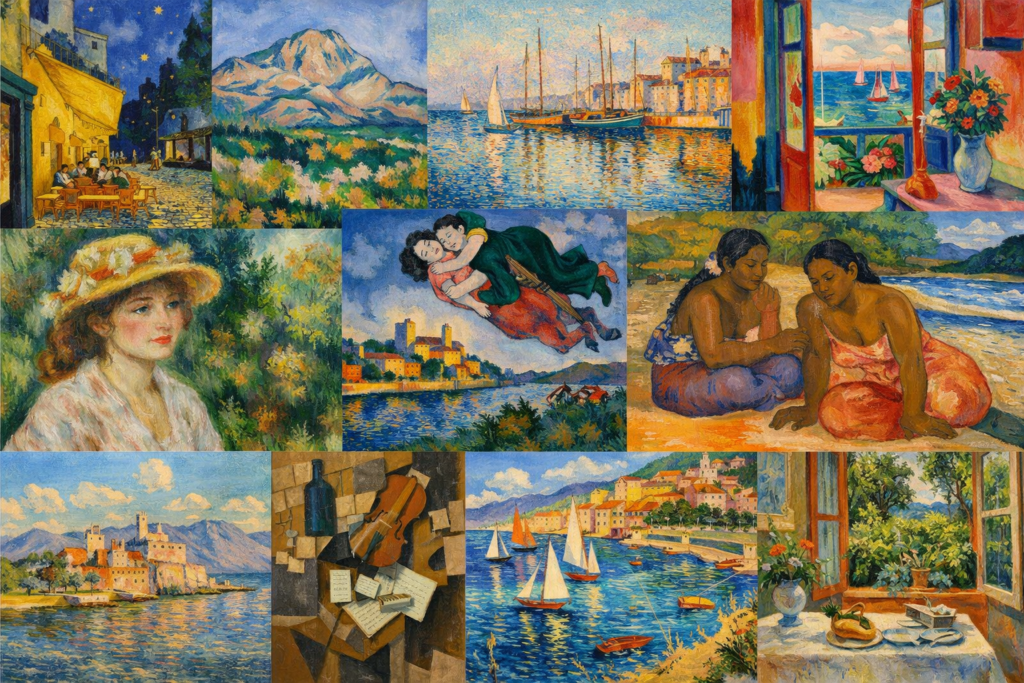
In the late 19th century, the coast between Italy and Marseille was still a relatively quiet region of fishing villages, olive groves, and small port towns. The railway line along the Mediterranean coast, built in the 1860s, made the landscape easily accessible to travelers and artists for the first time.
With these new connections, a cultural movement began that would change the history of art.
The discovery of the south
Among the first painters to be attracted by the Mediterranean light were Impressionists such as Claude Monet and Pierre-Auguste Renoir.
They were looking for new motifs beyond the gray boulevards of Paris. The Riviera offered them something they could hardly find in the north: clear air, intense colors, and a light that bathed the landscape in sharp contrasts.
Renoir eventually settled permanently in Cagnes-sur-Mer. His house, surrounded by old olive trees, became a quiet open-air studio.
Other artists also began to discover the region—not as a fashionable vacation destination, but as a place of artistic freedom.
Van Gogh and the search for the south
For Vincent van Gogh, the south was almost a mythological place. When he arrived in Arles in 1888, he believed he could establish a new artistic community here—an “atelier of the south.”
Arles seemed to him like a European version of Japan: bright light, clear colors, simple landscapes.
In less than two years, he created some of his most famous works there. The sunflowers, the starry night over the Rhône, and the yellow houses of the city became icons of modern painting.
But Van Gogh’s vision of an artists’ collective failed. His mental crisis and famous quarrel with Paul Gauguin meant that the dream of the studio of the south never became reality.
And yet the idea remained: the South as a place for a new art.
Cézanne and the architecture of the landscape
While Van Gogh painted the South as an emotional experience, Paul Cézanne viewed his native landscape with almost scientific concentration.
Living in Aix-en-Provence, he repeatedly hiked to a mountain that would later become world-famous: Montagne Sainte-Victoire.
Cézanne painted it dozens of times. But he didn’t just want to depict the appearance of the mountain; he wanted to make its structure visible. He broke down houses, trees, and hills into geometric shapes.
This seemingly simple idea became the foundation of modern art.
Later artists such as Georges Braque and Pablo Picasso developed Cubism from it.
Artists’ colonies by the sea
At the turn of the century, the Riviera slowly began to transform into an international artists’ landscape.
In 1892, the Neo-Impressionist Paul Signac discovered the small port of Saint-Tropez. Enthused by the light and colors of the sea, he bought a house there.
His studio soon became a meeting place for artists. Signac worked with the technique of pointillism – tiny dots of color that combine from a distance to form luminous landscapes.
In his paintings, the port of Saint-Tropez appeared as a shimmering mosaic of blue, yellow, and orange.
The explosion of color
In 1905, another decisive moment in art history occurred.
Two young painters, Henri Matisse and André Derain, were working together in the small Catalan port of Collioure.
The two decided to radically repaint the landscape. They used pure, unmixed colors – violet shadows, green skies, red trees.
When these paintings were exhibited at the Paris Autumn Salon, critics reacted with shock. One mockingly called the artists “les fauves” – the wild beasts.
But it was precisely this “wildness” that made the movement famous.
A quiet retreat
Not all artists were looking for revolutionary manifestos. Some found peace and quiet on the Riviera.
Pierre Bonnard lived for many years in Le Cannet above Cannes. His paintings depict intimate scenes: a laid table, a bathroom, a garden in the afternoon light.
Marc Chagall also moved to the medieval village of Saint-Paul-de-Vence after the Second World War. It was there that he created his poetic paintings full of floating figures and bright colors.
From artists’ paradise to myth
Over the course of the 20th century, the Riviera underwent fundamental changes. Tourism boomed, large hotels were built, and later film festivals, marinas, and luxury villas followed.
The landscape remained the same, but its significance shifted.
Where painters once sought new forms and colors, visitors now came in search of sun and glamour.
Nevertheless, some of the old atmosphere has been preserved. In the alleys of Arles, in the hills of Aix, or in the quiet streets of Saint-Paul-de-Vence, you can still sense why this region once attracted artists from all over Europe.
Because before the Riviera became the stage for the international jet set, it was one thing above all else:
a place where modern art was born.
Heute ist die Côte d’Azur ein Synonym für Yachten, Filmfestivals und Luxusresorts. Orte wie Saint-Tropez, Cannes oder Antibes gehören zu den glamourösesten Destinationen Europas. Doch lange bevor Filmstars und Oligarchen die Häfen füllten, war die Riviera ein Rückzugsort für Maler – ein stilles Labor der Moderne.
Im späten 19. Jahrhundert war die Küste zwischen Italien und Marseille noch eine vergleichsweise ruhige Region aus Fischerdörfern, Olivenhainen und kleinen Hafenstädten. Die Eisenbahnlinie entlang der Mittelmeerküste, die in den 1860er Jahren gebaut wurde, machte die Landschaft erstmals für Reisende und Künstler leicht erreichbar.
Mit den neuen Verbindungen begann eine kulturelle Bewegung, die die Kunstgeschichte verändern sollte.
Die Entdeckung des Südens
Zu den ersten Malern, die sich vom mediterranen Licht angezogen fühlten, gehörten Impressionisten wie Claude Monet und Pierre-Auguste Renoir.
Sie suchten nach neuen Motiven jenseits der grauen Pariser Boulevards. Die Riviera bot ihnen etwas, das sie im Norden kaum fanden: klare Luft, intensive Farben und ein Licht, das die Landschaft in scharfe Kontraste tauchte.
Renoir ließ sich schließlich dauerhaft in Cagnes-sur-Mer nieder. Sein Haus inmitten alter Olivenbäume wurde zu einem stillen Atelier unter freiem Himmel.
Auch andere Künstler begannen, die Region zu entdecken – nicht als mondäne Ferienlandschaft, sondern als Ort künstlerischer Freiheit.
Van Gogh und die Suche nach dem Süden
Für Vincent van Gogh war der Süden fast ein mythologischer Ort. Als er 1888 nach Arles kam, glaubte er, hier eine neue künstlerische Gemeinschaft gründen zu können – ein „Atelier des Südens“.
Arles erschien ihm wie eine europäische Version Japans: grelles Licht, klare Farben, einfache Landschaften.
In weniger als zwei Jahren schuf er dort einige seiner berühmtesten Werke. Die Sonnenblumen, die Sternennacht über der Rhône oder die gelben Häuser der Stadt wurden zu Ikonen der modernen Malerei.
Doch Van Goghs Vision eines Künstlerkollektivs scheiterte. Seine psychische Krise und der berühmte Streit mit Paul Gauguin führten dazu, dass der Traum vom Atelier des Südens nie Wirklichkeit wurde.
Und doch blieb die Idee bestehen: Der Süden als Ort einer neuen Kunst.
Cézanne und die Architektur der Landschaft
Während Van Gogh den Süden als emotionales Erlebnis malte, betrachtete Paul Cézanne seine Heimatlandschaft mit fast wissenschaftlicher Konzentration.
In Aix-en-Provence lebend, wanderte er immer wieder zu einem Berg, der später weltberühmt werden sollte: der Montagne Sainte-Victoire.
Cézanne malte ihn dutzende Male. Doch er wollte nicht nur die Erscheinung des Berges darstellen, sondern seine Struktur sichtbar machen. Häuser, Bäume und Hügel zerlegte er in geometrische Formen.
Diese scheinbar einfache Idee wurde zum Fundament der modernen Kunst.
Spätere Künstler wie Georges Braque und Pablo Picasso entwickelten daraus den Kubismus.
Künstlerkolonien am Meer
Um die Jahrhundertwende begann sich die Riviera langsam in eine internationale Künstlerlandschaft zu verwandeln.
Der Neoimpressionist Paul Signac entdeckte 1892 den kleinen Hafen von Saint-Tropez. Begeistert vom Licht und den Farben des Meeres kaufte er dort ein Haus.
Sein Atelier wurde bald zu einem Treffpunkt für Künstler. Signac arbeitete mit der Technik des Pointillismus – winzige Farbpunkte, die sich aus der Entfernung zu leuchtenden Landschaften verbinden.
Der Hafen von Saint-Tropez erschien in seinen Bildern wie ein flimmerndes Mosaik aus Blau, Gelb und Orange.
Die Explosion der Farbe
1905 ereignete sich ein weiterer entscheidender Moment der Kunstgeschichte.
Im kleinen katalanischen Hafen Collioure arbeiteten zwei junge Maler zusammen: Henri Matisse und André Derain.
Die beiden beschlossen, die Landschaft radikal neu zu malen. Sie verwendeten reine, ungemischte Farben – violette Schatten, grüne Himmel, rote Bäume.
Als diese Bilder im Pariser Herbstsalon ausgestellt wurden, reagierten Kritiker schockiert. Einer nannte die Künstler spöttisch „les fauves“ – die wilden Tiere.
Doch genau diese „Wildheit“ machte die Bewegung berühmt.
Ein stiller Rückzugsort
Nicht alle Künstler suchten nach revolutionären Manifesten. Manche fanden an der Riviera vor allem Ruhe.
So lebte Pierre Bonnard viele Jahre in Le Cannet oberhalb von Cannes. Seine Bilder zeigen intime Szenen: einen gedeckten Tisch, ein Badezimmer, einen Garten im Nachmittaglicht.
Auch Marc Chagall zog nach dem Zweiten Weltkrieg in das mittelalterliche Dorf Saint-Paul-de-Vence. Dort entstanden seine poetischen Bilder voller schwebender Figuren und leuchtender Farben.
Vom Künstlerparadies zum Mythos
Im Laufe des 20. Jahrhunderts veränderte sich die Riviera grundlegend. Der Tourismus boomte, große Hotels entstanden, später folgten Filmfestivals, Yachthäfen und Luxusvillen.
Die Landschaft blieb zwar dieselbe – doch ihre Bedeutung verschob sich.
Wo einst Maler nach neuen Formen und Farben suchten, kamen nun Besucher auf der Suche nach Sonne und Glamour.
Dennoch hat sich ein Teil der alten Atmosphäre erhalten. In den Gassen von Arles, in den Hügeln von Aix oder in den stillen Straßen von Saint-Paul-de-Vence kann man noch immer erahnen, warum diese Region einst Künstler aus ganz Europa anzog.
Denn bevor die Riviera zur Bühne des internationalen Jetsets wurde, war sie vor allem eines:
Ein Ort, an dem die moderne Kunst geboren wurde.
Heute ist die Côte d’Azur ein Synonym für Yachten, Filmfestivals und Luxusresorts. Orte wie Saint-Tropez, Cannes oder Antibes gehören zu den glamourösesten Destinationen Europas. Doch lange bevor Filmstars und Oligarchen die Häfen füllten, war die Riviera ein Rückzugsort für Maler – ein stilles Labor der Moderne.
Im späten 19. Jahrhundert war die Küste zwischen Italien und Marseille noch eine vergleichsweise ruhige Region aus Fischerdörfern, Olivenhainen und kleinen Hafenstädten. Die Eisenbahnlinie entlang der Mittelmeerküste, die in den 1860er Jahren gebaut wurde, machte die Landschaft erstmals für Reisende und Künstler leicht erreichbar.
Mit den neuen Verbindungen begann eine kulturelle Bewegung, die die Kunstgeschichte verändern sollte.
Die Côte d’Azur und Südfrankreich wurden im späten 19. und frühen 20. Jahrhundert zu einem einzigartigen Magneten für Künstler. Das Licht, die Farben des Meeres und die besondere Atmosphäre zwischen Mittelmeer und Hügeln wirkten wie ein Labor der Moderne. Maler aus unterschiedlichen Strömungen – Impressionismus, Fauvismus, Postimpressionismus und frühe Moderne – fanden hier neue Ausdrucksformen. Zu den bedeutendsten gehören André Derain, Henri Matisse, Pierre-Auguste Renoir, Raoul Dufy, Georges Braque, Marc Chagall, Paul Signac, Pierre Bonnard, Claude Monet, Paul Gauguin, Paul Cézanne und Vincent van Gogh. Ihre Werke markieren den Übergang von der klassischen Landschaftsmalerei zur radikalen Bildsprache der Moderne.
Das Licht des Südens – Wie die Moderne entstand
Bereits im 19. Jahrhundert zog das außergewöhnliche Licht des Mittelmeerraums Künstler an. Die klaren Farben, das intensive Blau des Himmels und die scharfen Schatten unterschieden sich stark vom diffusen Licht Nordfrankreichs oder der Pariser Ateliers.
Der Impressionist Claude Monet suchte in seinen Landschaften genau diese flüchtigen Momente des Lichts. Seine Malweise löste die festen Konturen auf und verwandelte die Natur in vibrierende Farbflächen. Monet bereitete damit den Boden für eine neue Generation von Künstlern.
Auch Pierre-Auguste Renoir zog es später an die Riviera. In seinem Haus in Cagnes-sur-Mer entstanden spätimpressionistische Bilder voller Wärme und mediterraner Helligkeit. Seine Figuren wirken weicher, ruhiger und fast zeitlos – als hätte das Licht des Südens auch die Malerei selbst beruhigt.
Cézanne und van Gogh – Die Revolution der Form
Eine entscheidende Brücke zwischen Impressionismus und Moderne bildet Paul Cézanne aus Aix-en-Provence. Während Monet die flüchtige Erscheinung der Natur malte, suchte Cézanne nach ihrer inneren Struktur. Berge, Bäume und Häuser zerlegte er in geometrische Formen. Besonders seine Darstellungen der Montagne Sainte-Victoire wurden zu einem Schlüsselwerk der modernen Malerei.
Auch Vincent van Gogh erlebte im Süden Frankreichs eine künstlerische Explosion. Während seiner Zeit in Arles malte er Sonnenblumen, Sternennächte und glühende Landschaften mit einer Intensität, die weit über den Impressionismus hinausging. Farbe wurde bei ihm zum Ausdruck innerer Emotionen.
Die Explosion der Farbe – Fauvismus
Zu Beginn des 20. Jahrhunderts radikalisierte eine neue Künstlergeneration den Umgang mit Farbe. Die sogenannten „Fauves“ („wilde Tiere“) verwendeten reine, ungemischte Farbtöne.
Im Sommer 1905 arbeiteten Henri Matisse und André Derain im kleinen Hafen von Collioure. Dort entstanden Landschaften mit grellen Orangen, intensiven Grüntönen und violetten Schatten. Farbe wurde nicht mehr zur Beschreibung der Natur verwendet – sie wurde selbst zum Ausdrucksmittel.
Diese Befreiung der Farbe prägte auch den Maler Raoul Dufy. Seine Bilder zeigen Segelboote, Strände und Städte der Riviera mit leichten,
by Klaus Kampe
-
Die Kunst der Buchbinderei in Nizza
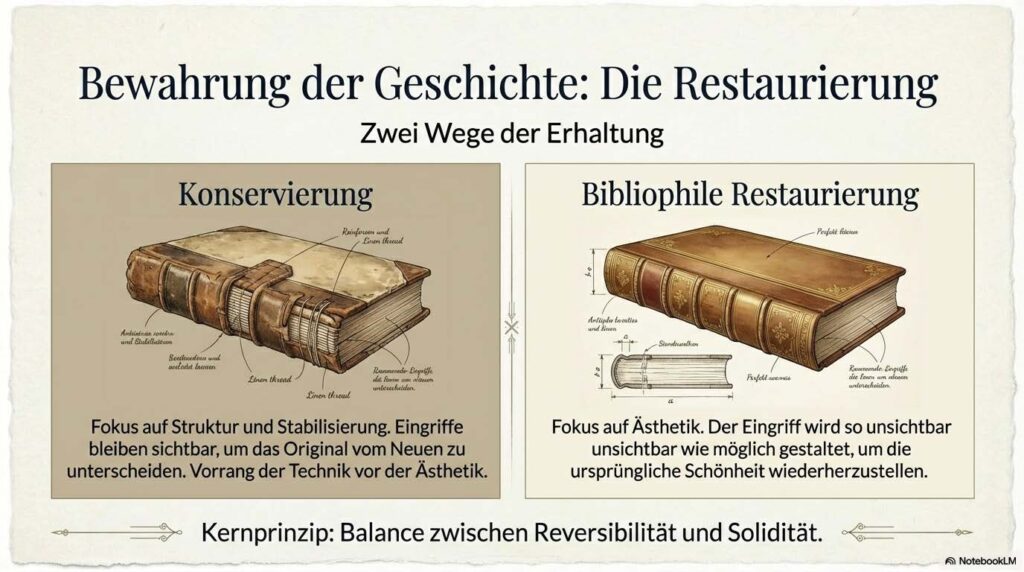
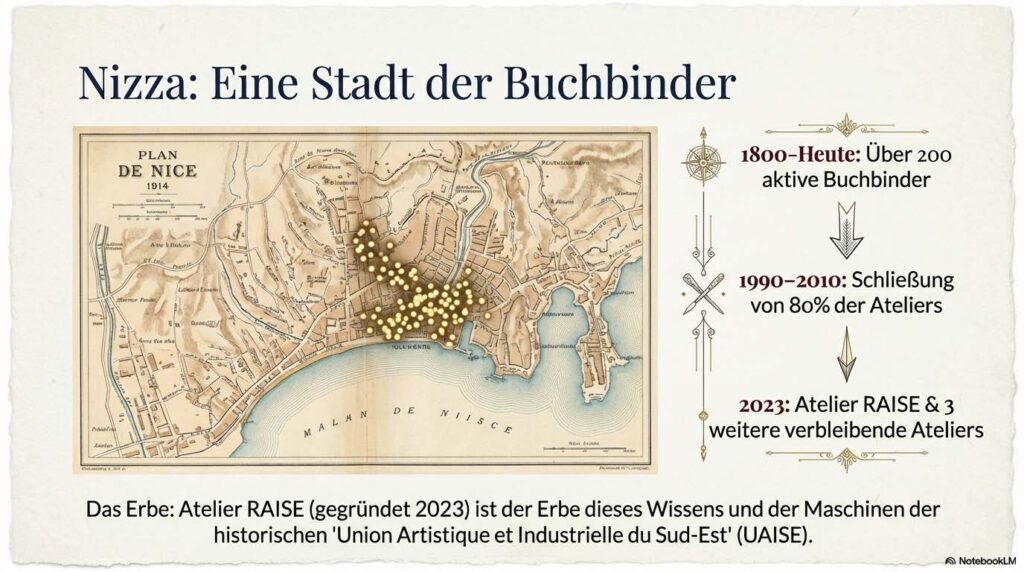
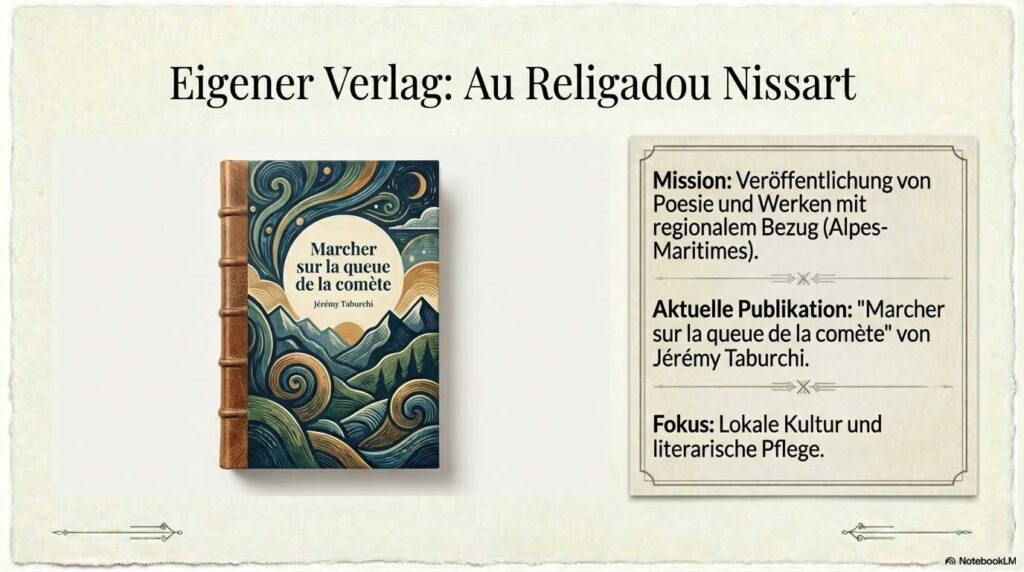
Das Atelier RAISE in Nizza, geführt von dem Experten Vincent Bottasso-Daideri, widmet sich der professionellen Buchbinderei und der Restaurierung historischer sowie moderner Werke. Die Quellen beschreiben ein breites Spektrum an Dienstleistungen, das von handwerklichen Fachkursen bis hin zur Gestaltung luxuriöser Künstlereditionen und humorvoller Kunstprojekte wie dem „Pass des Rosa Katzen-Landes“ reicht. Bottasso-Daideri ist zudem in der regionalen Kulturszene tief verwurzelt, unter anderem als Generalsekretär der Freunde des Kunstmuseums von Nizza und durch Kooperationen mit lokalen Künstlern wie Gérard Serée. Historische Rückblicke beleuchten die lange Tradition des Buchbinderhandwerks in der Region, während technische Erklärungen Einblicke in anspruchsvolle Verfahren wie die Vergoldung oder die Mosaik-Bindung geben. Das Atelier versteht sich somit als ein Zentrum für die Bewahrung des schriftlichen Kulturerbes und die Förderung zeitgenössischer Buchkunst.
by Klaus Kampe
-
Buchbesprechung “Deutsche Exilanten”
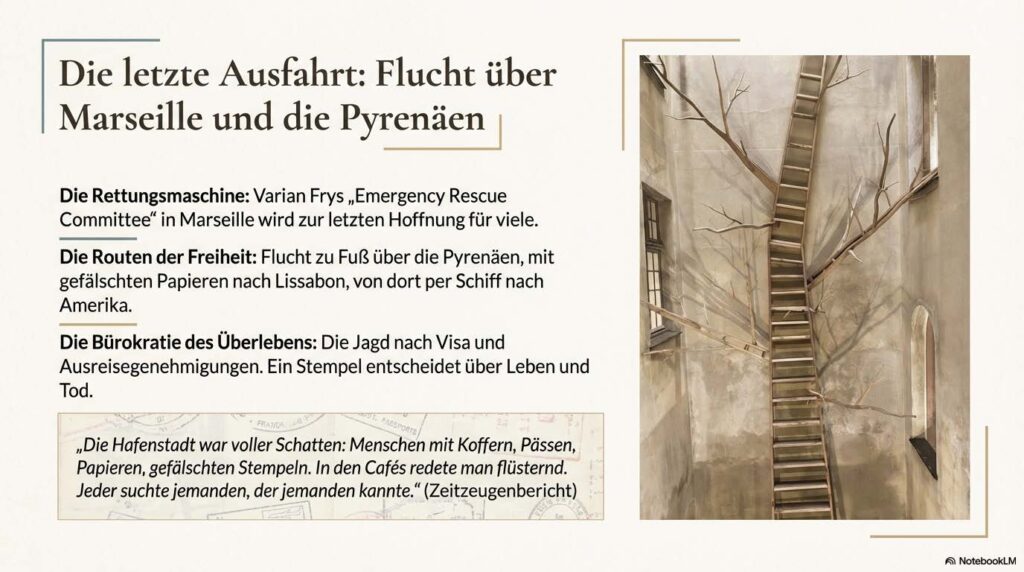
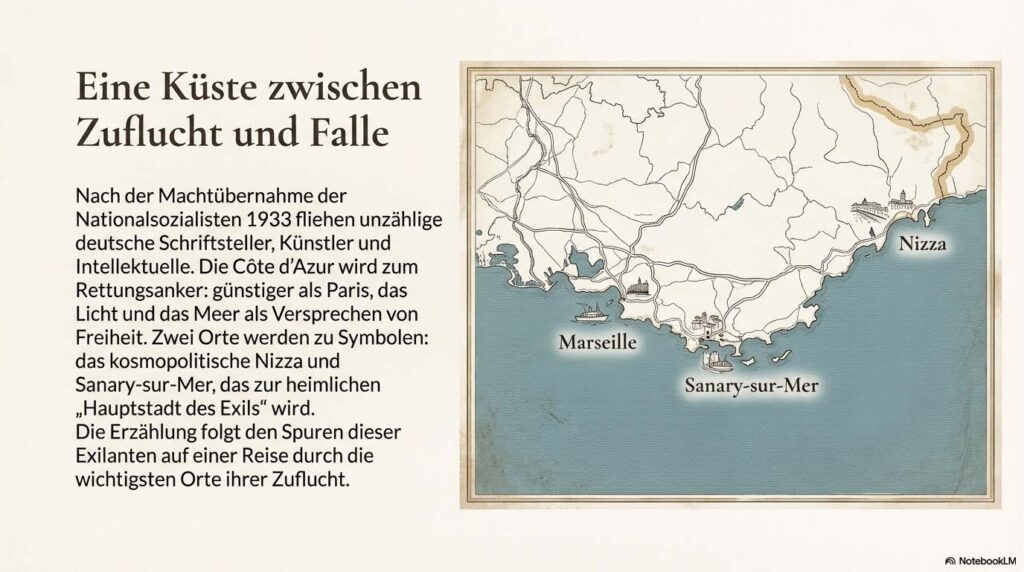
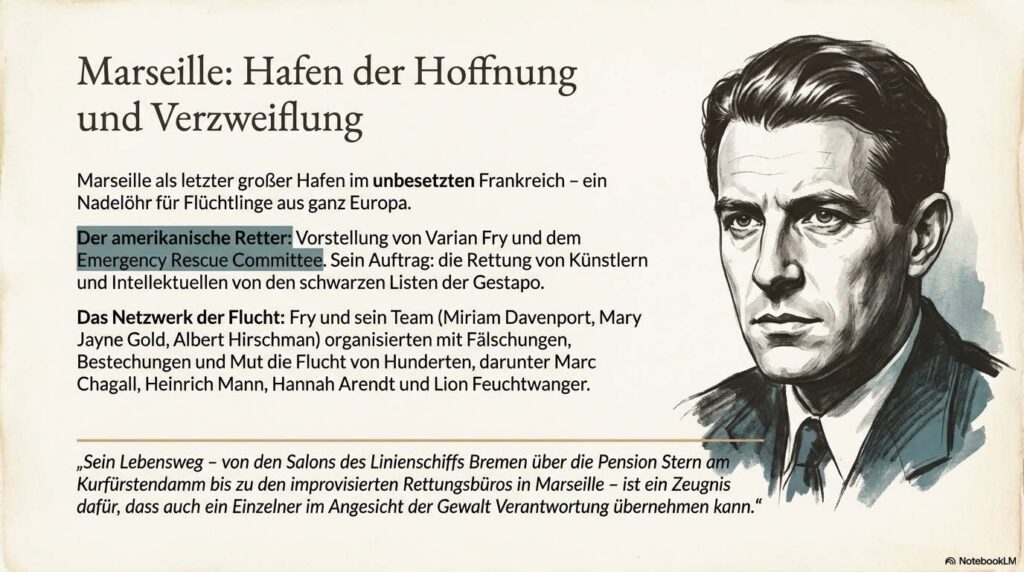
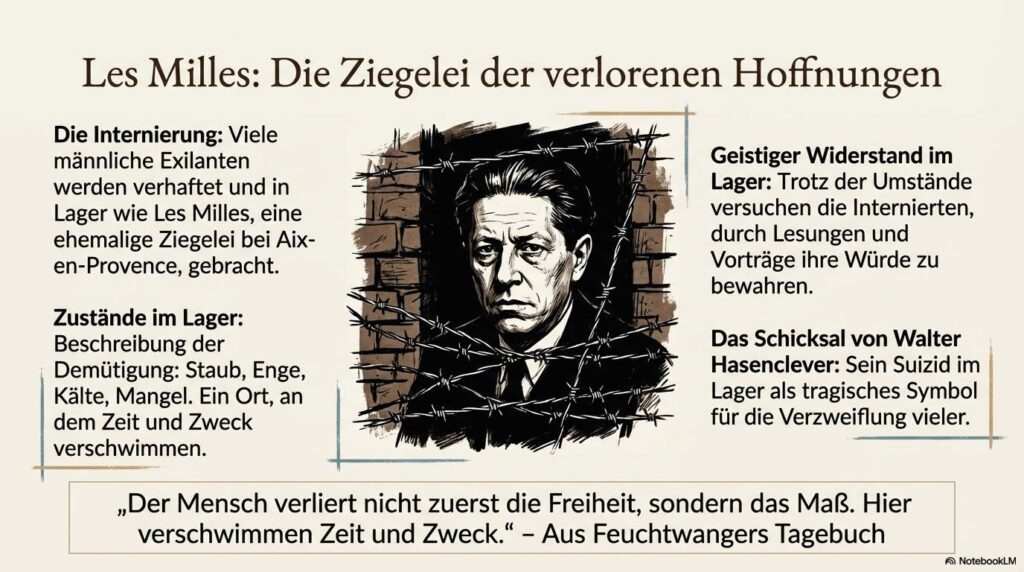
Podcast von Arcoplexus zum Buch “Deutsche Exilanten an der Côte d’Azur” von Klaus Kampe. Das Werk dokumentiert das bewegte Leben deutscher Exilanten an der Côte d’Azur während der 1930er Jahre. Im Fokus stehen Zufluchtsorte wie Sanary-sur-Mer und Nizza, wo bedeutende Intellektuelle wie Thomas Mann, Lion Feuchtwanger und Hannah Arendt versuchten, ihre kulturelle Identität gegen das NS-Regime zu verteidigen. Die Texte beleuchten zudem die mutigen Rettungsaktionen von Varian Fry in Marseille sowie die künstlerische Arbeit des Fotografen Walter Bondy. Neben literarischen Analysen und historischen Fakten fließen persönliche Anekdoten und fiktive Dialoge ein, die das Spannungsfeld zwischen mediterraner Idylle und existenzieller Bedrohung spürbar machen. Letztlich dient das Buch als Hommage an die schöpferische Kraft einer Generation, die trotz Verfolgung und Internierung an Humanismus und Freiheit festhielt. Es verbindet dabei die historische Spurensuche mit dem kollektiven Gedächtnis einer verlorenen Welt. Zum Buch:

by Klaus Kampe
-
Èze Village – History, topography, and cultural transformation of a Mediterranean mountain village
Èze Village towers above the sparkling ribbon of the Mediterranean Sea like a silent witness to a complex past. Perched on a steep rocky outcrop on the French Riviera, the village uniquely combines traces of early Ligurian cultures, medieval power struggles, modern fortification policies, and the cultural trends of the Belle Époque. Its development is a prime example of the transformation of Mediterranean settlements from strategic strongholds to symbolic cultural landscapes.
1. The beginnings: Ligurian settlements and Roman spheres of influence
The earliest traces of human presence in the Èze area can be attributed to the Celto-Ligurian tribes who settled in the region around what is now Mont Bastide. The choice of location was motivated by both defensive and economic considerations: the extremely steep topography offered protection from attackers, while the proximity to the sea facilitated trade.
With Roman expansion in Provence, the entire coastal region was integrated into a systematic administrative and transportation system. Although Èze itself was not at the center of Roman urbanity, continuous settlement established itself along the coast, particularly in Èze-sur-Mer. The Roman presence also left behind agricultural techniques such as terraced farming and olive cultivation, which shaped the landscape until modern times.
Èze Village – Cactus Garden 2. Medieval consolidation: between Provence and Savoy
From the High Middle Ages onwards, Èze developed into a fortified village, which was ideal for military purposes due to its location at an altitude of 430 meters. From then on, its history was marked by territorial conflicts: Èze initially belonged to the County of Provence.
From the 14th century onwards, it fell under the rule of the House of Savoy. The conflict between Savoy and France in the 17th century led to multiple changes in strategy and ultimately to its integration into the Kingdom of France.
The medieval streets – now home to artists’ studios and boutiques – were originally designed for defensive purposes. The village functioned as a stone labyrinth intended to confuse attackers. The central fortress, the citadel of Èze, was repeatedly expanded, but fell victim to Louis XIV’s strategic order of destruction in 1706. Today’s platform with the “Jardin Exotique” is a relic of this military past.
3. Modern infrastructure: Fort Révère as part of national defense systems
In the 19th century, Èze once again became the focus of French military planning due to its geographical location. Fort Révère, located in the hinterland above the village, was built after 1870 as part of the so-called Séré de Rivières system – a network of modern fortifications of European significance, created in response to the Franco-Prussian War.
Fort Révère is characterized by: a polygonal layout with casemates, embrasures in all directions, massive walls made of stone and concrete, devices for communication with neighboring coastal and mountain forts.
Although Fort Révère was never involved in combat, it played a role in monitoring the coast and securing the Italian-French border. Today, as a restored monument, it offers one of the most impressive panoramic views of the Riviera and symbolizes an era of European rearmament that changed fundamentally with the First World War.
4. Château Balsan – Riviera romance and sophisticated
The advent of Riviera tourism in the 19th century marked the beginning of a new era for Èze. Château Balsan played a special role in this development. Industrialist Émile Balsan, who came from an influential textile family, acquired the estate and transformed it into a sophisticated retreat.
The château is remarkable for cultural and historical reasons: It was a frequent meeting place for the Parisian and international elite. Coco Chanel, who was closely associated with Émile Balsan in her early life, spent long periods here. It was in Èze that she made the transition from the world of aristocracy and bohemianism to her calling as a designer.
The subsequent conversion of the building into the exclusive Château de la Chèvre d’Or hotel marked another turning point: the Riviera became a luxury destination, while the historic buildings of Èze were integrated into tourist and cultural contexts.

5. Continuity and renewal: From an agricultural society to a cultural landscape
Until the early 20th century, Èze was still heavily agricultural: olive groves, vineyards, terraced farming, and sheep breeding dominated life. It was only with the expansion of modern transport infrastructure—roads, railways along the coast, and later the Corniche Routes—that the village underwent structural change.
The significant combination of historic buildings, an exceptional location, and romantic aesthetics led to Èze becoming a fixture for: artists and writers, botanists (especially because of the exotic garden), historians, and tourists from all over the world.
Today, Èze combines the preservation of its medieval identity with a mixture of arts and crafts, luxury hotels and natural landscape typical of the Côte d’Azur.
6. Concluding remarks
Èze Village is a prime example of the transformative power of historical sites. Its history encompasses: Ligurian origins, medieval power struggles, French and Savoyard territorial politics, modern fortification systems, the sophisticated culture of the Belle Époque and modern cultural tourism.
The Château Balsan and Fort Révère serve as striking anchor points: one embodies the aesthetic and social appeal of the Riviera, the other the strategic importance of the region in an era of geopolitical uncertainty.
Èze is thus not only a picturesque mountain village, but also a living archive of European history—a place where political, cultural, and landscape developments overlap in an extraordinary way.