A visit to Villa Kérylos on the French Riviera is like traveling back in time to the world of the ancient Greeks—but through the eyes of two passionate scholars of the early 20th century.

The visit—atmosphere and impressions
Upon entering the villa, you are greeted by a light-filled courtyard (peristyle) whose marble columns and water basins are immediately reminiscent of the architecture of classical Greek residences. The rooms are richly decorated with frescoes, mosaics, ornate furniture, and everyday objects—many of which were specially crafted based on ancient models, giving visitors the feeling of being in a living archaeology project.
From the open balcony, the view extends across the Mediterranean Sea to the Saint-Jean-Cap-Ferrat peninsula—a deliberate part of the concept: as in the homes of the ancient Greeks, the sea should always be present.
The owner: Théodore Reinach (1860–1928)
Théodore Reinach was a French scholar, historian, archaeologist, and politician.
He came from the famous Reinach family of bankers and artists, which belonged to France’s intellectual elite.
Reinach was deeply in love with Greek culture and philology. For him, Villa Kérylos was a life project—not as a replica, but as a creative reconstruction of a luxurious residence from the Greek Classical period (2nd–1st century BC).
He used the villa both as a vacation home and as a place of study and representation.

The architect: Emmanuel Pontremoli (1865–1956)
The architect Emmanuel Pontremoli was a graduate of the École des Beaux-Arts and later its director. He won the prestigious Prix de Rome in 1890 and spent years in Greece and the eastern Mediterranean.
These travels made him a specialist in Hellenistic architecture, which made him the ideal partner for Reinach’s vision. Pontremoli’s approach was extraordinary: he used modern building materials (concrete, iron), but designed each room according to ancient models, and integrated artisans, sculptors, and furniture designers who created new works specifically for the house based on archaeological models.
Historical background – Construction of the villa
- Construction period: 1902–1908
- Style: Hellenistic, inspired by the houses on Delos
- Goal: An “ideal Greek house” – not a copy, but an authentic reinterpretation
- Name: Kérylos means “tern,” a symbol of good luck in Greek mythology
After Reinach’s death in 1928, his family bequeathed the villa to the French Institute, which still manages it today.

Why it’s worth a visit
A tour of Villa Kérylos allows visitors to:
- immerse themselves in the ancient world,
- understand the interplay between science, art, and architecture around 1900,
- and gain insight into the visions of two extraordinary personalities:
a Hellenistic scholar and an architect influenced by Orientalism.
You leave the villa with the impression that you have visited not so much a museum as an ideal Greek house that – for a moment – is filled with life again.

A day at Villa Kérylos
The morning over Beaulieu-sur-Mer is still young as you walk along the narrow coastal road. The sea glistens in a milky blue, and the first rays of sunshine cast a silvery shimmer on the water’s surface. In the distance, you can see the simple, light silhouette of Villa Kérylos – a house that looks as if it has been blown straight from the spirit of antiquity to the coast of the Côte d’Azur.
Even the path leading there has something solemn about it. The bay lies calm, as if holding its breath, as you approach the entrance portal. As you cross the threshold, time suddenly seems to slow down.
In the first courtyard, a feeling of clarity envelops you. The sky above you is like a ceiling painting of pure color, and in the center murmurs a small water basin—the heartbeat of the house. The marble columns cast long shadows that fall across the antique-style mosaics. You feel the noise of the world quietly closing behind you and something else beginning: a silent conversation between you and the spirit of the past.
You wander through the rooms and notice the care that Théodore Reinach and Emmanuel Pontremoli have lavished on every detail. The Andron – once a place for conversations and banquets – welcomes you with cool walls decorated with mythological scenes. You imagine Reinach receiving guests here, scholars and artists immersed in passionate discussions about Greece, while outside the waves crash against the rocks.
In the bedroom, your gaze lingers on a golden border that shimmers in the sunlight. You feel as if this is less a room than a thought, artfully materialized. The bed is designed according to ancient models – simple yet sublime. You wonder if Reinach ever felt here that he was living in two worlds at once: the modern Riviera and ancient Greece.
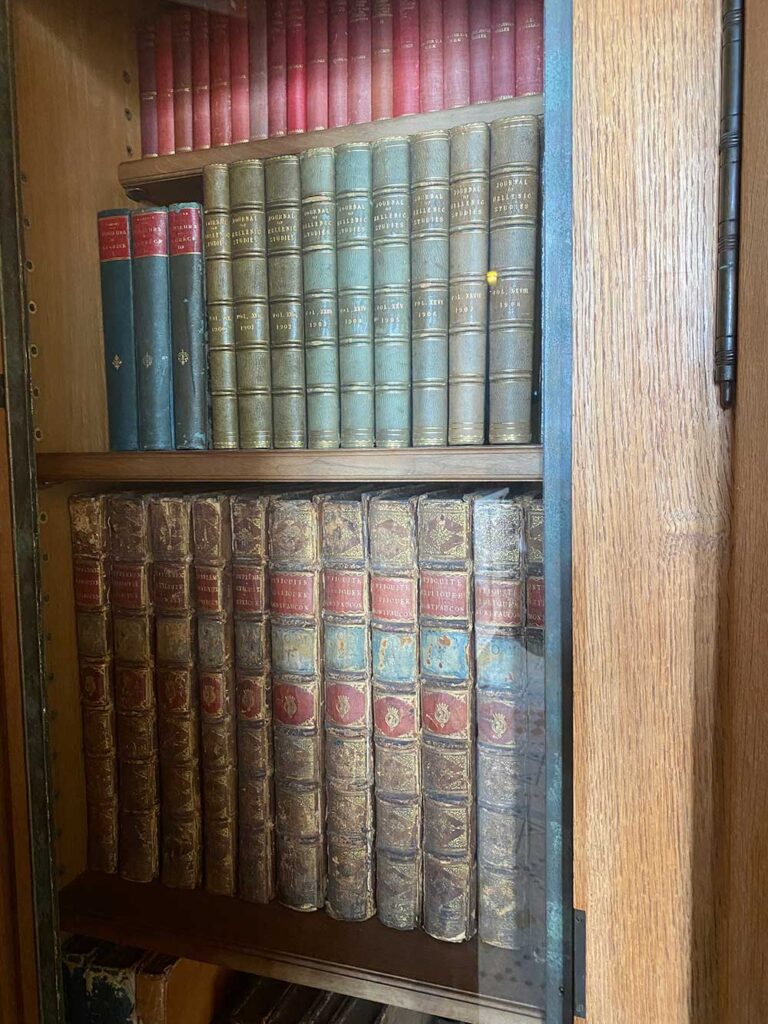
The library smells of old wood and a hint of the sea. The shelves—delicately crafted—stand as silent witnesses to his studies. Perhaps it was here that he immersed himself in his books while Pontremoli further refined the lines and proportions of the villa in his mind. Two men, united by a vision that came to fruition in these rooms: the dream of a house that does not copy the past, but embodies it.
When you finally reach the balcony, the view opens up to a Mediterranean panorama that seems almost unreal in its beauty. The sea lies like a calm cloth before you, and on the Saint-Jean-Cap-Ferrat peninsula, the villas glitter like scattered gems. A gentle breeze brushes your cheek, carrying the scent of salt and pine trees. You lean against the railing, and for a moment, the boundary between now and then seems to blur.
Perhaps this is the moment when you truly understand the villa: it is not a museum, but a conversation—between cultures, centuries, people. An ideal built with modern materials and an antique soul. A place that carries the longing not only to preserve beauty, but to live it.
When you leave the villa later and look back once more, it seems to float between the rocks and the sea. Elegant, timeless, a little mysterious. And you know that a part of you remains there, somewhere between the marble columns and the gentle splashing of the fountain, where antiquity came back to life for a moment.