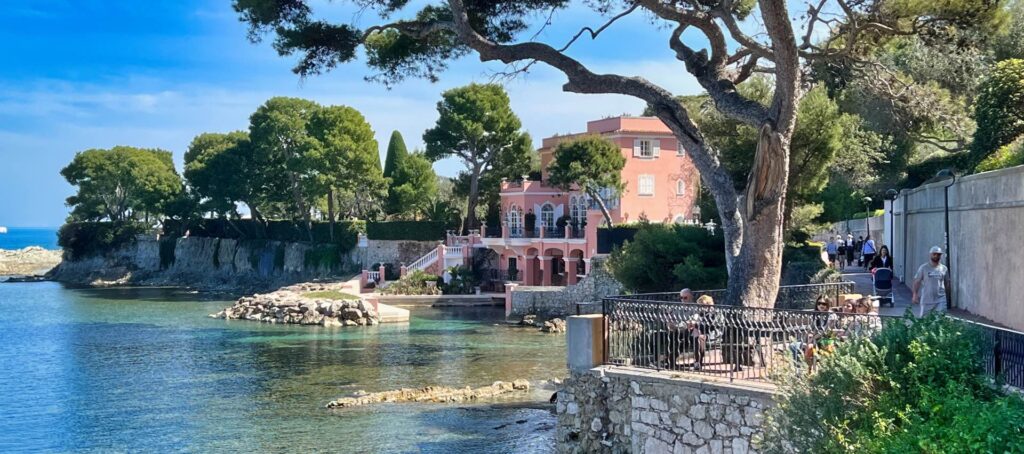
On the prestigious French Riviera, on the Saint-Jean-Cap-Ferrat peninsula, stands one of the most famous villa estates on the Côte d’Azur: the pink villa, now called La Fleur du Cap. This property is a fascinating example of late 19th-century luxury architecture, which over time has been home to a remarkable series of prominent residents and has become a setting for the social and cultural history of the Riviera.
Architecture and construction history
The villa was built in 1880 by Albert Bounin, the son of a Sardinian arms dealer and olive oil merchant from Nice. Bounin acquired several plots of land on the quiet headland of Cap Ferrat and had a picturesque estate built there, which he initially called L’Isoletta and which had a small private harbor. From the outset, the building captivated visitors with its location directly on the sea and its striking pink façade, which would later give it its name.
Later, his son Paul took over the estate, added an extra floor, and renamed the villa Lo Scoglietto (“the little rock”). During these early years, the house remained largely hidden from public view, but it soon became a notable destination for wealthy travelers on the Riviera.
Prominent residents in front of Niven
During the first decades of the 20th century, the villa changed owners and tenants several times:
- In 1920, the Duchess of Marlborough, Consuelo Vanderbilt, one of the most prominent society figures of her time, lived there for a while.
- In the 1950s, the villa was occupied by King Leopold III of Belgium shortly before his abdication.
- The silent film and early sound film star Charlie Chaplin spent several weeks at the estate.
This series of famous guests shows how strongly the Riviera had become a refuge for aristocrats, movie stars, and wealthy travelers since the early 20th century—a trend that also had a strong influence on the image of the villa.
David Niven and the Riviera Era
Perhaps the most famous resident of the pink villa was British actor David Niven (1910–1983). Niven bought the villa in the late 1950s/early 1960s and made it his long-term home.
David Niven was one of the most charming and versatile actors of his generation. A Hollywood star, author, and former officer, he was considered an elegant gentleman with British charm. Niven was closely connected to the international celebrity scene on the Riviera: he was friends with Princess Grace Kelly and Prince Rainier of Monaco and was one of the well-known personalities who shaped the lifestyle of the Côte d’Azur in those years.
During this time, the pink villa was not only a private residence, but also a place for social gatherings. Niven also played a cinematic role as part of the estate: a scene from his film “Trail of the Pink Panther” (1982) was shot here — an ironic reference to the villa with its striking color and celebrity connections.
After his death in 1983, the small square in front of the villa was named Place David Niven — a lasting testament to the actor’s influence on local culture and the collective memory of Saint-Jean-Cap-Ferrat.
NAfterlife and restoration
Over the following decades, the property changed hands several times; since 1999, it has belonged to the parents of New Zealand billionaires Christopher and Richard Chandler, who had it extensively restored. Today, the villa is called La Fleur du Cap and is larger and better maintained than ever before — a monument to the glamorous era of the Riviera.
Conclusion
The pink villa in Cap Ferrat uniquely embodies the history of the Côte d’Azur: it is an expression of luxurious 19th-century architecture, a reflection of an aristocratic and cinematic society, and at the same time a place where the lives of prominent personalities such as David Niven have materialized. Its bright color and spectacular location above the sea make it a symbol of glamour, elegance, and the cultural appeal of the French Riviera to this day.