Provence and the Côte d’Azur are more than just landscapes. They are the setting for empires, religious wars, artistic revolutions, and economic upheavals.
It was here that Napoleon Bonaparte marched back to Paris. It was here that Pablo Picasso’s colors and Vincent van Gogh’s art took shape. It was here, in Avignon, that popes reshaped the power structure of Europe.
But behind the beauty of the Riviera lies another story: plague epidemics, pirates, secret smuggling routes, and forgotten fortresses.
“PROVENCE AND THE CÔTE D’AZUR HISTORICA” brings this world to life as a strategic card game—playable, collectible, and historically immersive.
Not as a textbook. But as a clash between history and play.
About Us
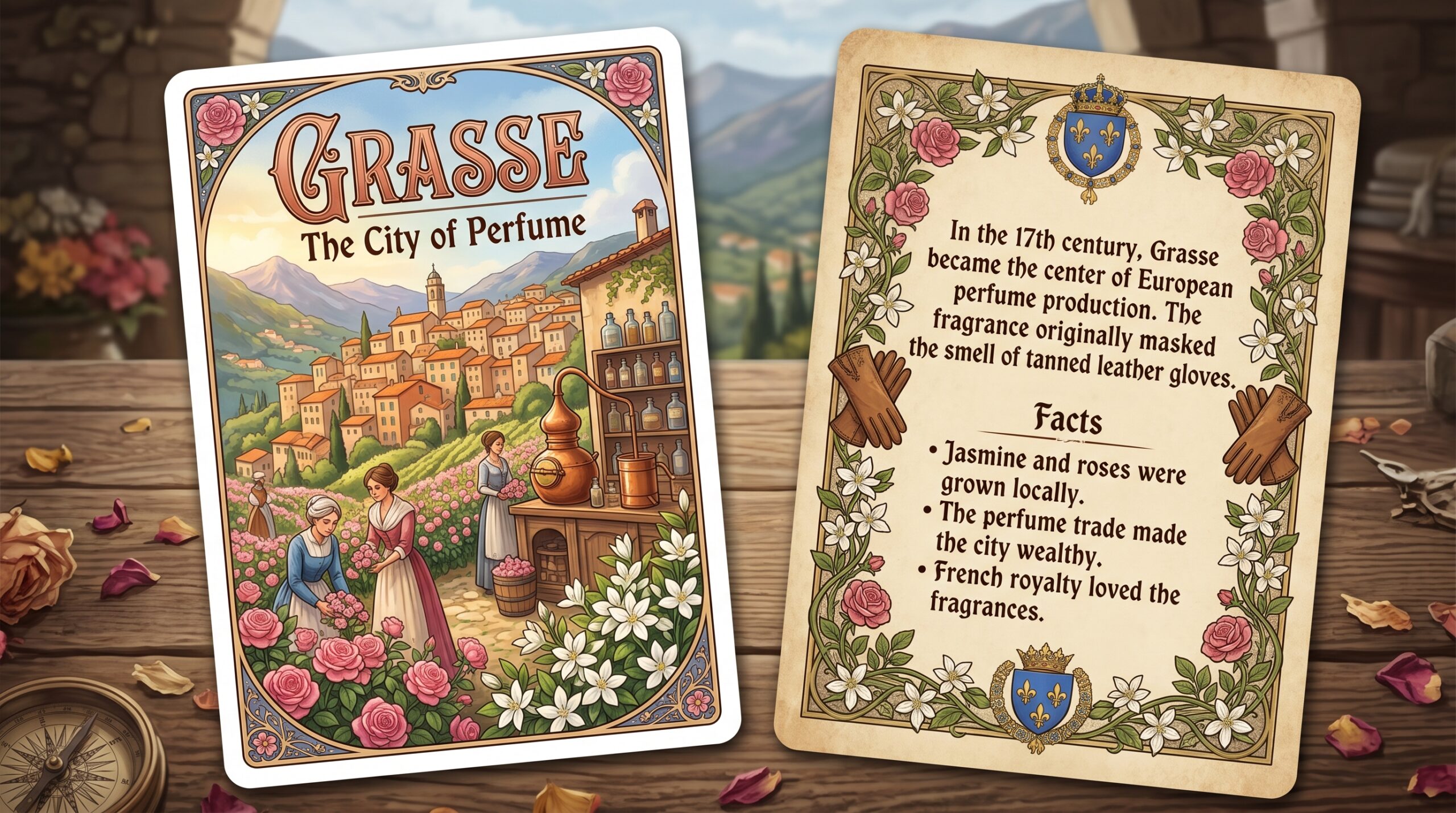
Grasse is a city in the Alpes-Maritimes department in southern France. It is considered the world capital of perfume and is located about 15 km north of Cannes on the slopes of the Côte d’Azur. It is known for its historic old town and its centuries-old tradition of perfume-making.
Key Facts
UNESCO Status: Intangible Cultural Heritage (2018, Art of Perfumery)
Region: Provence-Alpes-Côte d’Azur
Population: approx. 50,000 (2021)
Founded: in the Middle Ages
Economy: Perfume industry, tourism, agriculture
About Us
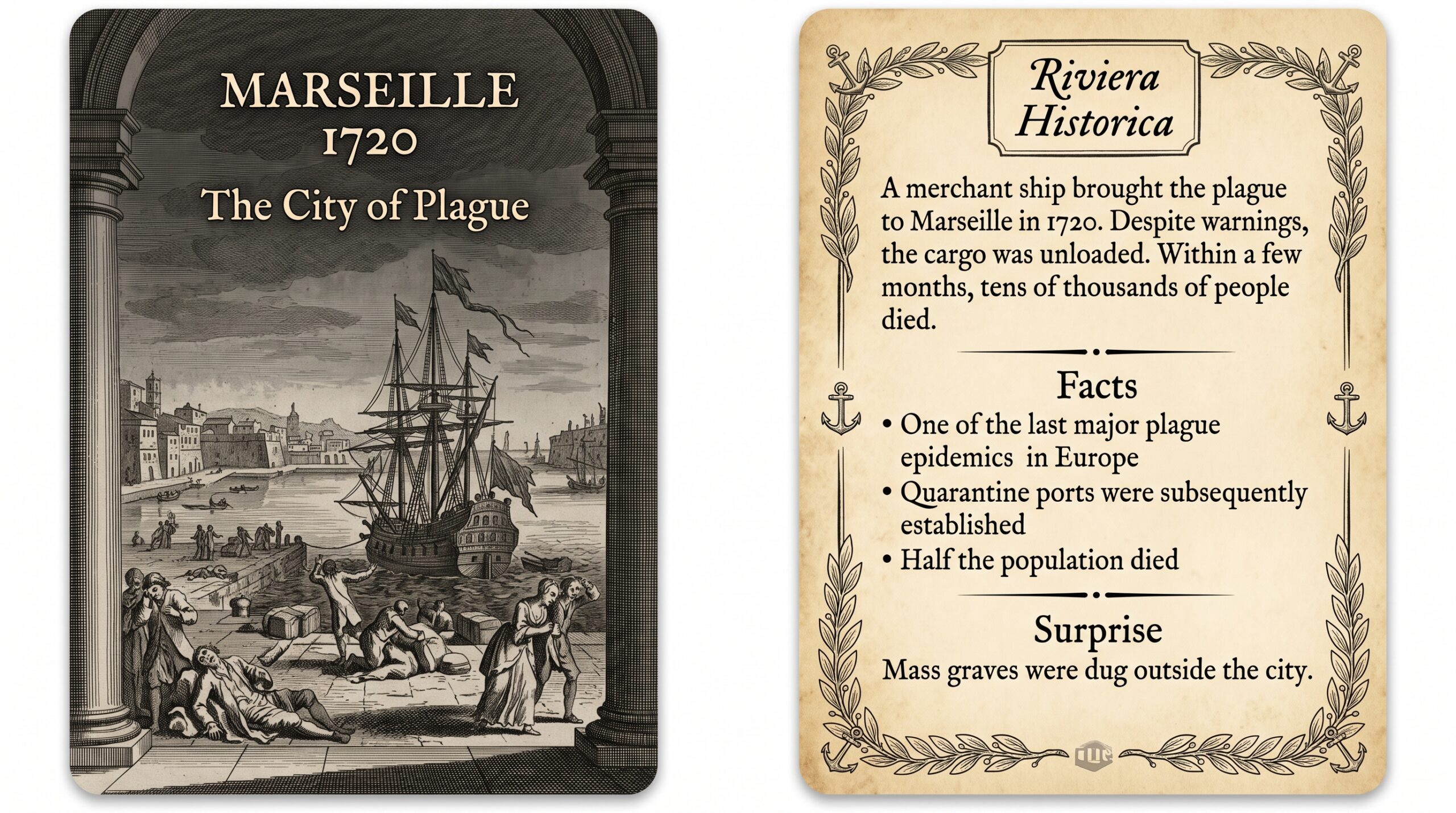
Marseille is a city in the Bouches-du-Rhône department in southern France. It is the second-largest city in France and the country’s oldest city, located on the Mediterranean coast in the Provence-Alpes-Côte d’Azur region. It is known for its historic Old Port, multicultural atmosphere, and important role as a major maritime hub.
Key Facts
UNESCO Status: Part of the “Marseille, European Capital of Culture” legacy (2013)
Region: Provence-Alpes-Côte d’Azur
Population: approx. 870,000 (2021)
Founded: around 600 BC by Greek settlers from Phocaea
Economy: Port and shipping industry, tourism, trade, culture, fisheries
This article by Radio-Nice.Club explores the concept of co-creation and active citizen participation in the fields of sustainability research and European cultural policy. A central focus is on engaged scholarship, which seeks to integrate social change and social inclusion directly into the research process through transformative methods such as co-creation. In parallel, the second text analyzes the historical development of the European Capitals of Culture, where participation has evolved from mere consultation to a deeper involvement of civil society. Both texts emphasize that participatory approaches are crucial for strengthening democratic legitimacy and making alternative ways of life visible in local communities. Despite the positive potential, the authors warn against instrumental use and institutional power imbalances that can hinder genuine co-creation. Ultimately, the sources advocate for research and cultural planning that views people not merely as objects, but as active co-creators of their environment.
These sources deal with the fifth studio album by the rock band Genesis and its cultural and political context. The focus is on the title “Selling England by the Pound”, which plays on the British currency and units of weight to criticise the sell-out of English identity and increasing Americanisation. The texts provide a detailed analysis of the opening track “Dancing with the Moonlit Knight”, which, through its blend of Arthurian legend and modern critique of consumerism, is regarded as a commentary on social decline. In addition, Peter Gabriel’s theatrical live performances and the band’s musical development within the progressive rock genre are examined. Finally, the documents contain references to cultural institutions in Berlin that focus on surrealist art and avant-garde projects.
[Intro] (Stimme mit Hall, fast flüsternd) „Kannst du mir sagen, wo mein Land liegt?“, fragte der Faun. Die Königin lacht nur. „Es liegt bei mir.“ Willkommen im Land von „Vielleicht“. Check das… [Part 1] Der Einhorn-Faun sucht die Heimat in den Augen seiner Lady, Doch die Welt ist grau geworden, alles wirkt wie schattig-shady. Die Königin von „Vielleicht“ hält die Zügel fest in ihrer Hand, Er zahlt den Preis für Träume, doch er kriegt nur leeren Sand. „Die Zeitung kommt zu spät!“, schreit ein Typ aus der Masse, Die Schlagzeile brennt, während er wartet an der Kasse. Der alte Mann ist weg, nur ein Zettel blieb am Ende, „Alter Vater Themse“ – er spülte sich durch die Wände. Er ist ertrunken im System, zwischen Profit und Gier, England wird verkauft nach Gewicht – wir sind alle hier. [Hook] Bürger der Hoffnung, Bürger voll Ruhm, Die Uhr tickt laut, was wirst du tun? Die Zeit vergeht, es ist die Zeit deines Lebens, Doch du suchst den Sinn in den Ruinen vergebens. Wir tanzen hinaus mit dem Ritter im Mondschein, In einer Welt aus Plastik, wir wollen nur frei sein. [Part 2] Ganz ruhig jetzt, setzt euch hin, schluckt die bittere Pille, Eure Wimpey-Träume zerkauen – das ist der Wille. Sie fressen lautlos, verdauen das Land Pfund für Pfund, Ein Land auf dem Teller, ein fetter, gieriger Schlund. Der Junge sagt: „Du bist, was du isst“, also iss gesund, Der Alte sagt: „Trag nur das Beste“, sonst gehst du vor die Hund’. Doch du weißt, was du bist – und es ist dir scheißegal, Dein Gürtel platzt vor Hochmut, eine selbstgemachte Qual. Das ist die Farce, die wir leben, ein Theaterstück aus Schrott, Der Kapitän tanzt voran – unser neuer, falscher Gott. [Bridge] Folge mir! Bis die Gralssonne im Schimmel versinkt. Folge mit! Bis das Gold in deinen Händen nicht mehr klingt. Die Ritter vom Grünen Schild stampfen den Boden platt, Während die Hoffnung in den Gassen langsam Abschied nimmt. [Part 3] Draußen vor dem Saloon sitzt die Dame, alt und schwer, Sie legt die Kreditkarten aus, doch der Beutel ist leer. Sie spielt die Wahrsagerin, zieht die Karten aus dem Dreck, Doch das Blatt ist gezinkt, der Sinn ist längst weg. Jeder spielt für sich allein, keine Einigkeit im Spiel, Wir reden uns runter an der Tafel – ohne Ziel. Du bist die Show, du spielst das Steckenpferd im Kreis, Ich spiel den Narren für einen viel zu hohen Preis. Wir necken den Stier, wir drehen uns rund, Die Welt ist ein Karussell und wir fallen in den Schlund. [Outro] Mach mit beim Tanz, bis das Gold kalt wird… Tanzend mit dem Ritter, im fahlen Licht der Nacht. Die Ritter stampfen… sie rufen… England… verkauft nach Gewicht. (Beat blendet aus mit dem Sound einer tickenden Standuhr).
Ideologies are always prisons of thought based on ignorance rather than tolerance.
Using the example of
Whittaker Chambers: (Cold War Classics) “Witness” vs. Hannah Arendt: “Vita activa or On Active Life” two responses to the same experience.
Common starting point: break with ideology
Chambers experienced
communism as a belief system the break is existential, almost religious ideology = attempt to impose meaning on history
Arendt
analyzed ideology as a substitute for thinking Ideology = logic that overwhelms reality Totalitarianism arises when people stop judging
Commonality: Ideology is not “thinking wrong,” but rather no longer thinking. The decisive difference: What follows from the break?
Here, the paths diverge radically. Chambers: Withdrawal from politics Central motif in Witness
Anthropology
Man is fallen
Power always corrupts
History tends toward evil
Response to totalitarianism: Asceticism, witness, sacrifice, refusal. Arendt: Return to politics Central motif in Vita activa
Freedom exists only where people act together.
Consequences:
Politics is irreplaceable.
No salvation, no ultimate goal.
Freedom arises between people, not in the soul.
Anthropology
Humans are capable of beginning (natality).
History is open.
Guilt and responsibility are political, not metaphysical.
Response to totalitarianism: Action, public discourse, judgment. The core conflict Question
Chambers
Arendt Where does salvation lie?
Outside the world
In the world Role of politics
Danger
Necessity Attitude toward history
Doom logic
Openness Antidote to ideology
Faith
Thinking Freedom
Internal
Public Why the New Right chooses Chambers – and avoids Arendt Chambers is attractive because:
he creates meaning
clearly distributes guilt and blame
makes history readable as a struggle
charges politics with morality
perfect for Kulturkampf narratives. Arendt is uncomfortable because:
she promises no salvation
she critically examines all camps
she demands judgment, not loyalty
she desacralizes politics
bad for mobilization, good for freedom. Blücher as the silent key
Blücher would say between the two:
“Those who ask for meaning instead of responsibility are fleeing from freedom.”
He shares the break with Chambers, but with Arendt the consequence:
no ideology
no doctrine of salvation
no ultimate order
Only action under uncertainty. Escalation (honest, not conciliatory)
Chambers helps us to leave totalitarianism behind. Arendt helps us to avoid falling back into it.
The New Right often stops at the first step.
How Arendt is systematically misunderstood today (e.g., “mass society = liberalism”) The fundamental misunderstanding: Arendt = anti-liberalism? Claim (New Right, but also post-liberals):
Arendt showed that liberalism leads to mass society and thus to totalitarianism.
What Arendt actually says:
Mass society does not arise from too much freedom,
but from the disintegration of the world, bonds, and political action.
This can happen in liberal, authoritarian, or revolutionary systems.
For Arendt, liberalism is not the cause, but is often too weak to prevent totalitarianism. Misunderstanding: “Mass society = multiculturalism/migration” Right-wing interpretation:
Mass = politically uprooted people
The decisive factor is lawlessness, not origin.
Nation states themselves have produced masses (e.g., stateless persons in the 1930s).
Ethnic homogeneity does not protect against totalitarianism – it often accelerates it. Misunderstanding: Arendt legitimizes authoritarian order Right-wing appeal:
Order, authority, discipline as a bulwark against chaos
Arendt:
makes a strict distinction between:
    authority (recognized, not enforced)
    power (derived from collective action)
    force (a substitute for power)
Authoritarian regimes destroy power; they do not stabilize it.
Those who confuse violence with order reproduce totalitarian logic. Misunderstanding: Arendt = cultural pessimism Simplified interpretation:
criticizes depoliticization, not modernity
Technology is not the problem,
but when it replaces human action
Equality is a prerequisite for politics, not its enemy
Arendt is not a cultural critic in the right-wing sense. Misunderstanding: “The banality of evil” = trivialization Frequent right-wing (and popular) misreading:
Eichmann was “just a cog in the wheel”
Guilt disappears in the system
Arendt means:
Eichmann was guilty,
but not demonic,
rather lacking in judgment
which is more dangerous than fanaticism
Evil does not become smaller, but closer.
This is uncomfortable for right-wing movements:
Guilt cannot be externalized.
Even “normal patriots” can bear injustice.
Misunderstanding: Arendt as defender of “Western values.” Instrumentalization:
Arendt as key witness for “defense of civilization.”
The West vs. barbarism.
Arendt:
Rejects myths of civilization
Totalitarianism is modern, Western, rational
Not a “foreign” disease
Those who use Arendt for cultural warfare have already lost. The blind spot of the New Right
The New Right adopts:
Arendt's diagnosis of fear
Her criticism of ideology
Her skepticism toward narratives of progress
It rejects:
Judgment against its own side
Plurality
Public sphere without compulsory loyalty
Arendt would say:
Ideology begins where thinking ends – even on the right.
Misunderstanding: Liberals also misread Arendt
Not just the right. Liberal simplification:
Arendt = constitution, institutions, rule of law
Problem:
Arendt was skeptical of pure administrative liberalism
without a vibrant public sphere, institutions collapse
Bureaucracy is politically empty, not neutral
Arendt is anti-technocratic, not anti-liberal.
Arendt is anti-technocratic, not anti-liberal.
The New Right reads Arendt as a warning against freedom.
Liberals read her as a defender of order.
Both are wrong.
Arendt defends freedom as a practice. And that makes her dangerous to any camp logic. Hannah Arendt ↔ Carl Schmitt Why their proximity is asserted—and their opposition is concealed Why they are mentioned together at all
The New Right likes to claim:
“Arendt and Schmitt both analyze the crisis of liberalism.”
Formally, this is true:
both criticize liberal legalism
both do not see politics as administration
both reject optimism about progress
But: They draw opposite conclusions from this. The decisive contrast (one sentence)
Schmitt asks: Who decides in a state of emergency?
Arendt asks: How can people act together without a state of emergency?
Understanding of politics Carl Schmitt
Politics = friend–enemy distinction
The political is conflictual or not at all
Unity arises through demarcation
Homogeneity is a prerequisite for political order
Politics requires decision-making, if necessary against the law. Hannah Arendt
Politics = plural space of appearance
Politics arises between different parties
Conflict yes, but not existential
Homogeneity destroys politics
Politics needs publicity, not decision-making power. State of emergency vs. natality Schmitt
Sovereignty lies with those who decide on states of emergency.
Exceptions are the moment of truth in politics.
Law thrives on the breaking of law.
Order is always precarious, hence authoritarian safeguards. Arendt
Central concept: natality (the ability to begin)
Politics thrives on new beginnings, not on exceptions
A state of emergency is political failure
Freedom begins where violence ends. Power and violence (fundamental!) Schmitt
Power = decision-making power
Violence is a legitimate political means
Law is ultimately based on violence
Arendt
Power arises from joint action
Violence is a loss of power
Violence destroys legitimacy, even if it is effective
Here, any reconciliation is impossible. People, unity, homogeneity Schmitt
Democracy = identity of the rulers and the ruled
This presupposes homogeneity
Exclusion is democratically legitimate
Arendt
The people are not a substance
Political community arises through participation
Rights arise from belonging to the world, not from identity
Liberalism = danger of administration
Politics is replaced by bureaucracy
Public life becomes desolate
→ Solution: more politics, not less.
Same diagnosis – opposite therapy. Why the New Right “Schmittizes” Arendt
Typical strategy:
Arendt quotes on crisis, masses, ideology
combined with Schmitt's:
    Decision
    Sovereignty
    Exception
Result: seemingly “humane Schmitt”
This is intellectually dishonest:
Arendt undermines Schmitt's entire foundation
her concepts of power and freedom directly contradict him
The moral dividing line Schmitt
Law follows power
Guilt is secondary
Loyalty is decisive
Arendt
Guilt is personal
Thinking is a duty
Loyalty is never an excuse
Eichmann vs. State of Emergency.
Escalation Schmitt thinks about politics in terms of war. Arendt thinks about politics in terms of action. Schmitt needs enemies to create order. Arendt needs others to enable freedom.
Why this is crucial today
Those who equate Arendt with Schmitt:
legitimize states of emergency
moralize power
depoliticize responsibility
Arendt would be radical here:
The state of emergency is not the salvation of politics, but its end.
Carl Schmitt and the authoritarian left Basic idea: Schmitt’s core concepts
The central Schmittian concept:
Sovereignty = Who decides on the state of emergency Power concentrates when rules fail. The sovereign stands above the law in order to enforce order or transformation. Friend–enemy logic Politics is always conflict. Unity arises through demarcation. State decision ≫ Moral or liberal principles Legal norms are secondary to effective power.
Why this is attractive to the authoritarian left a) State-centered solution to crises
Marxists, Leninists, or Stalinists seek instruments to enforce radical transformation.
Schmitt provides legitimation for executive power beyond liberal restrictions.
b) State of emergency as a political strategy
Revolution = “permanent state of emergency.”
Schmitt's theory allows for:
    Emergency as a moment of political clarity.
    Overriding the law as a legitimate means.
c) Friend–enemy logic for class struggle.
The left can interpret “bourgeoisie vs. proletariat” as a political exceptional relationship.
Schmitt's concept becomes the legal or strategic basis for class politics.
d) Rejection of liberal civil society
Liberal institutions = obstacle to radical transformation.
Schmitt shows how law and democracy can be formal without real transformative power.
Tensions / limits
Schmitt is not a leftist; he defends the state and order, not revolution.
Schmitt's emphasis on national homogeneity clashes with internationalist leftist thinking.
Schmitt wants to limit the state of exception to sovereignty, not to permanent revolution.
Conclusion: Leftists selectively adopt, often only, the mechanism of power concentration, not his conservative philosophy of the state. Historical examples Actor
How Schmitt was received Leninism / Stalinism
Schmitt’s justification of exceptions as justification for the “dictatorship of the proletariat” Italian left (Gramsci circle)
Schmitt’s friend-enemy logic for bloc formation in class struggle Neo-Marxists / Critical theory
Schmitt as an analytical tool: states of emergency, political decision-making mechanisms, but without normative approval Comparison: left vs. right Schmitt reception Feature
Right
Authoritarian left State of emergency
Protection of the nation, culture, order
Transformation, revolution, class rule Friend–enemy
Nation / identity
Classes, global enemies Legitimacy
Defense, preservation
Radical transformation Relationship to freedom
Secondary, often repressive
Secondary, often utopian
Schmitt is technically flexible because he describes mechanisms of power rather than defining them morally. That is why he works on both sides. The crucial point
Schmitt is attractive to any political movement that wants to transcend legal norms in favor of radical decisions.
Right: Nation, tradition, identity Left: Revolution, class rule, transformation Both ignore Schmitt’s normative concern that sovereignty is always bound to responsibility and concrete community.
Views on left-wing and right-wing ideology
in german:
Ansichten zur linken und rechten Ideologie
Ideologien sind immer Denkgefängnisse die auf Ignoranz basieren und nicht auf Toleranz.
am Beispiel von
Whittaker Chambers: (Cold War Classics) „Witness“
vs.
Hannah Arendt: „Vita activa oder Vom tätigen Leben“
zwei Antworten auf dieselbe Erfahrung.
1Gemeinsamer Ausgangspunkt: Bruch mit der Ideologie
Chambers
erlebte den Kommunismus als Glaubenssystem
der Bruch ist existentiell, fast religiös
Ideologie = Versuch, der Geschichte einen Sinn aufzuzwingen
Arendt
analysierte Ideologie als Ersatz für Denken
Ideologie = Logik, die Realität überrollt
Totalitarismus entsteht, wenn Menschen aufhören zu urteilen
Gemeinsamkeit: Ideologie ist nicht „falsch denken“, sondern nicht mehr denken.
Der entscheidende Unterschied: Was folgt aus dem Bruch?
Hier trennen sich die Wege radikal.
Chambers: Rückzug aus der Politik
Zentrales Motiv in Witness
Geschichte ist ein geistlicher Kampf, den der Mensch nicht gewinnen kann.
Konsequenzen:
Politik ist sekundär, fast gefährlich
Erlösung liegt außerhalb der politischen Welt
Christentum = letzte Wahrheit gegen geschichtsphilosophische Hybris
Anthropologie
Mensch ist gefallen
Macht korrumpiert immer
Geschichte tendiert zum Bösen
Antwort auf Totalitarismus: Askese, Zeugenschaft, Opfer, Verweigerung.
Arendt: Rückkehr in die Politik
Zentrales Motiv in Vita activa
Freiheit existiert nur dort, wo Menschen gemeinsam handeln.
Konsequenzen:
Politik ist unersetzlich
keine Erlösung, kein Endziel
Freiheit entsteht zwischen Menschen, nicht in der Seele
Anthropologie
Mensch ist anfangsfähig (Natalität)
Geschichte ist offen
Schuld und Verantwortung sind politisch, nicht metaphysisch
Antwort auf Totalitarismus: Handeln, Öffentlichkeit, Urteilskraft.
Der Kernkonflikt
Frage
Chambers
Arendt
Wo liegt das Heil?
Außerhalb der Welt
In der Welt
Rolle der Politik
Gefahr
Notwendigkeit
Haltung zur Geschichte
Untergangslogik
Offenheit
Gegenmittel zur Ideologie
Glaube
Denken
Freiheit
innerlich
öffentlich
Warum die Neue Rechte Chambers wählt – und Arendt meidet
Chambers ist attraktiv, weil:
er Sinn stiftet
Schuld und Opfer klar verteilt
Geschichte als Kampf lesbar macht
Politik moralisch auflädt
perfekt für Kulturkampf-Narrative.
Arendt ist unbequem, weil:
sie keine Erlösung verspricht
sie alle Lager kritisch prüft
sie Urteil verlangt, nicht Loyalität
sie Politik entsakralisiert
schlecht für Mobilisierung, gut für Freiheit.
Blücher als stiller Schlüssel
Blücher würde zwischen beiden sagen:
„Wer nach Sinn statt nach Verantwortung fragt, flieht vor Freiheit.“
Er teilt mit Chambers den Bruch, aber mit Arendt die Konsequenz:
keine Ideologie
keine Heilslehre
keine letzte Ordnung
Nur Handeln unter Unsicherheit.
Zuspitzung (ehrlich, nicht versöhnlich)
Chambers hilft, den Totalitarismus zu verlassen. Arendt hilft, danach nicht wieder hineinzugeraten.
Die Neue Rechte bleibt oft beim ersten Schritt stehen.
Wie Arendt heute systematisch missverstanden wird (z. B. „Massengesellschaft = Liberalismus“)
Das Grundmissverständnis: Arendt = Anti-Liberalismus?
Behauptung (Neue Rechte, aber auch Postliberale):
Arendt habe gezeigt, dass Liberalismus zur Massengesellschaft und damit zum Totalitarismus führe.
Was Arendt tatsächlich sagt:
Massengesellschaft entsteht nicht aus zu viel Freiheit,
sondern aus Zerfall von Welt, Bindungen und politischem Handeln.
Das kann in liberalen, autoritären oder revolutionären Systemen passieren.
Liberalismus ist bei Arendt nicht Ursache, sondern oft zu schwach, um Totalitarismus zu verhindern.
Èze Village towers above the sparkling ribbon of the Mediterranean Sea like a silent witness to a complex past. Perched on a steep rocky outcrop on the French Riviera, the village uniquely combines traces of early Ligurian cultures, medieval power struggles, modern fortification policies, and the cultural trends of the Belle Époque. Its development is a prime example of the transformation of Mediterranean settlements from strategic strongholds to symbolic cultural landscapes.
1. The beginnings: Ligurian settlements and Roman spheres of influence
The earliest traces of human presence in the Èze area can be attributed to the Celto-Ligurian tribes who settled in the region around what is now Mont Bastide. The choice of location was motivated by both defensive and economic considerations: the extremely steep topography offered protection from attackers, while the proximity to the sea facilitated trade.
With Roman expansion in Provence, the entire coastal region was integrated into a systematic administrative and transportation system. Although Èze itself was not at the center of Roman urbanity, continuous settlement established itself along the coast, particularly in Èze-sur-Mer. The Roman presence also left behind agricultural techniques such as terraced farming and olive cultivation, which shaped the landscape until modern times.
Èze Village – Cactus Garden
2. Medieval consolidation: between Provence and Savoy
From the High Middle Ages onwards, Èze developed into a fortified village, which was ideal for military purposes due to its location at an altitude of 430 meters. From then on, its history was marked by territorial conflicts: Èze initially belonged to the County of Provence.
From the 14th century onwards, it fell under the rule of the House of Savoy. The conflict between Savoy and France in the 17th century led to multiple changes in strategy and ultimately to its integration into the Kingdom of France.
The medieval streets – now home to artists’ studios and boutiques – were originally designed for defensive purposes. The village functioned as a stone labyrinth intended to confuse attackers. The central fortress, the citadel of Èze, was repeatedly expanded, but fell victim to Louis XIV’s strategic order of destruction in 1706. Today’s platform with the “Jardin Exotique” is a relic of this military past.
3. Modern infrastructure: Fort Révère as part of national defense systems
In the 19th century, Èze once again became the focus of French military planning due to its geographical location. Fort Révère, located in the hinterland above the village, was built after 1870 as part of the so-called Séré de Rivières system – a network of modern fortifications of European significance, created in response to the Franco-Prussian War.
Fort Révère is characterized by: a polygonal layout with casemates, embrasures in all directions, massive walls made of stone and concrete, devices for communication with neighboring coastal and mountain forts.
Although Fort Révère was never involved in combat, it played a role in monitoring the coast and securing the Italian-French border. Today, as a restored monument, it offers one of the most impressive panoramic views of the Riviera and symbolizes an era of European rearmament that changed fundamentally with the First World War.
4. Château Balsan – Riviera romance and sophisticated
The advent of Riviera tourism in the 19th century marked the beginning of a new era for Èze. Château Balsan played a special role in this development. Industrialist Émile Balsan, who came from an influential textile family, acquired the estate and transformed it into a sophisticated retreat.
The château is remarkable for cultural and historical reasons: It was a frequent meeting place for the Parisian and international elite. Coco Chanel, who was closely associated with Émile Balsan in her early life, spent long periods here. It was in Èze that she made the transition from the world of aristocracy and bohemianism to her calling as a designer.
The subsequent conversion of the building into the exclusive Château de la Chèvre d’Or hotel marked another turning point: the Riviera became a luxury destination, while the historic buildings of Èze were integrated into tourist and cultural contexts.
5. Continuity and renewal: From an agricultural society to a cultural landscape
Until the early 20th century, Èze was still heavily agricultural: olive groves, vineyards, terraced farming, and sheep breeding dominated life. It was only with the expansion of modern transport infrastructure—roads, railways along the coast, and later the Corniche Routes—that the village underwent structural change.
The significant combination of historic buildings, an exceptional location, and romantic aesthetics led to Èze becoming a fixture for: artists and writers, botanists (especially because of the exotic garden), historians, and tourists from all over the world.
Today, Èze combines the preservation of its medieval identity with a mixture of arts and crafts, luxury hotels and natural landscape typical of the Côte d’Azur.
6. Concluding remarks
Èze Village is a prime example of the transformative power of historical sites. Its history encompasses: Ligurian origins, medieval power struggles, French and Savoyard territorial politics, modern fortification systems, the sophisticated culture of the Belle Époque and modern cultural tourism.
The Château Balsan and Fort Révère serve as striking anchor points: one embodies the aesthetic and social appeal of the Riviera, the other the strategic importance of the region in an era of geopolitical uncertainty.
Èze is thus not only a picturesque mountain village, but also a living archive of European history—a place where political, cultural, and landscape developments overlap in an extraordinary way.