Between Nice and Monaco, the village of Èze rises like a defiant prayer in stone. Anyone climbing the steep path today can perhaps still sense the breath of centuries past—the crunch of boots on limestone, the distant thunder of cannons, the whispering of loyalties that changed with the wind like the flags on the battlements.
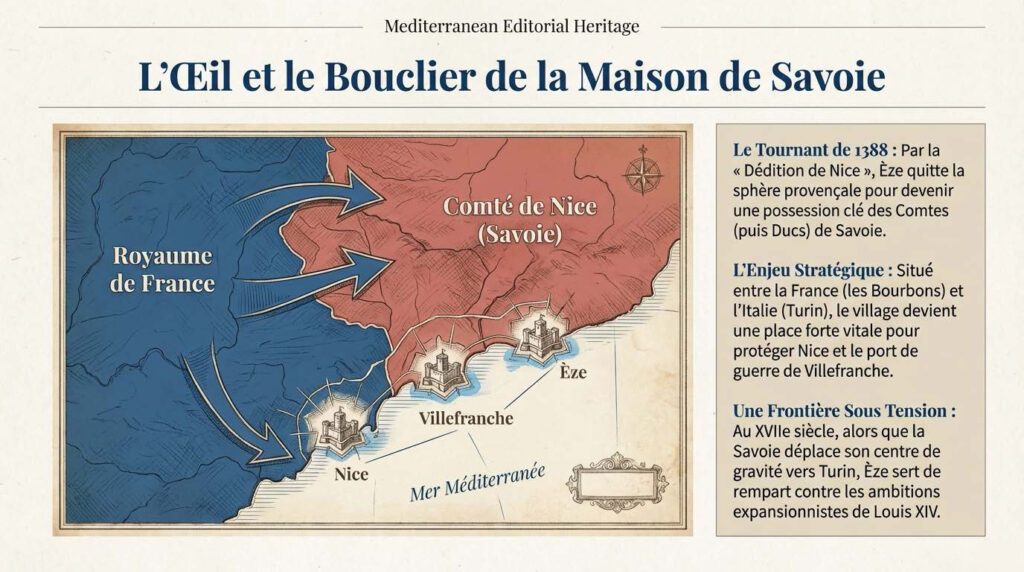
In the 14th and 15th centuries, this rocky nest belonged to the Duchy of Savoy, that idiosyncratic power between the Alps and the sea, which was neither entirely Italian nor entirely French, but a border kingdom – tough, ambitious, distrustful. Savoy knew the value of heights. Whoever held the mountains held the roads. And whoever held the roads controlled trade, customs duties, rumors – and destiny.
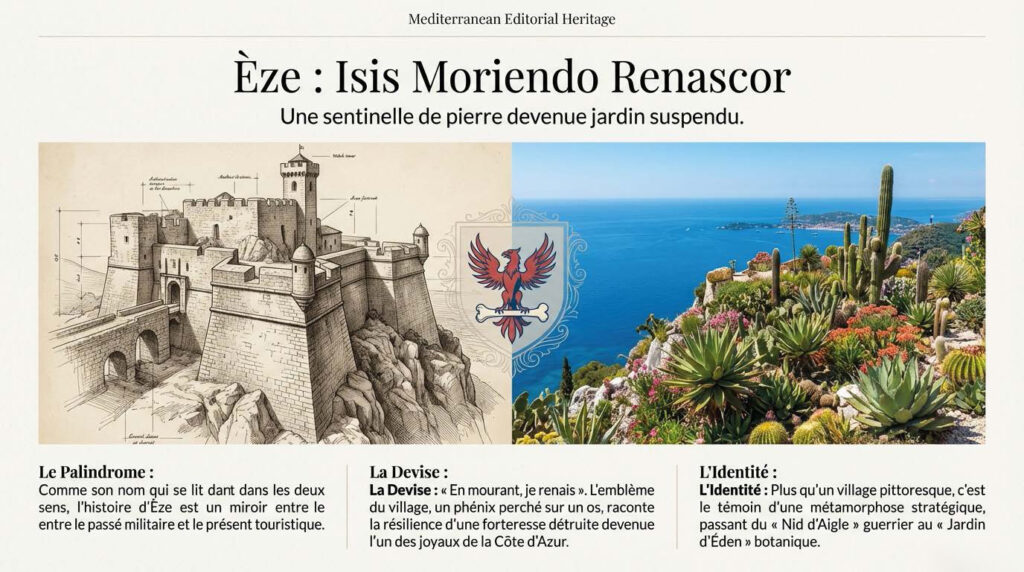
Èze was not a pretty village for painters and flâneurs, but a guard post. Fortification – Savoy’s systematic policy of fortification – turned the rock into a bastion. Rings of walls snaked around the summit like stone serpents; narrow gates, built so that no assault could easily break them, forced attackers into tight angles. A keep rose above the roofs, watchful like a stone eye over the Mediterranean. The houses themselves were part of the defense: densely built, with hardly any gaps, narrow alleys that resembled embrasures rather than streets. Those who fought here fought step by step.
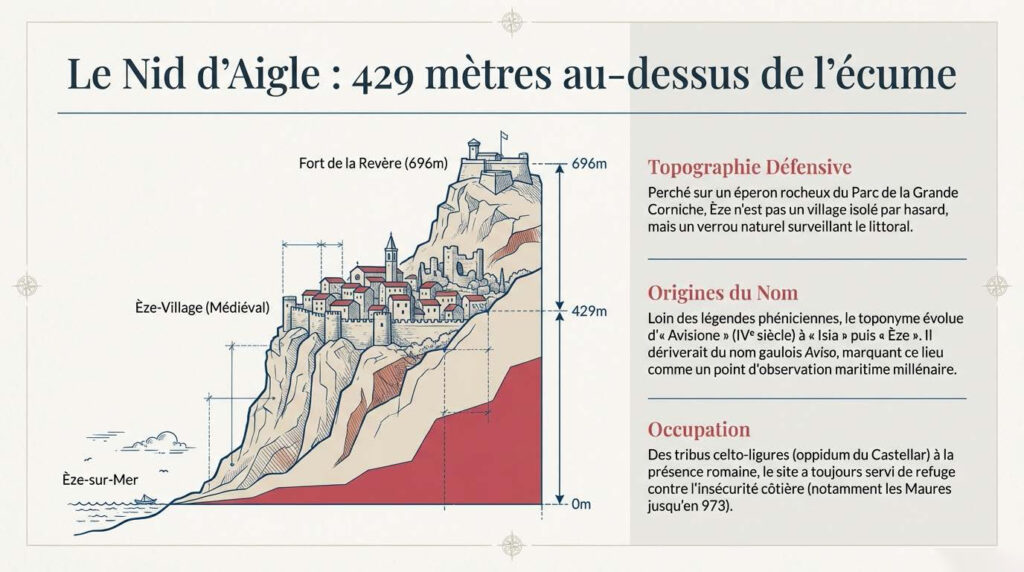
Savoy fortified not out of vanity, but out of necessity. The coast was contested. The Counts of Provence looked covetously upon the strategic heights. Later, the French crown pressed in, and from the east, the influence of the Italian powers grew. Èze was a border post in a game whose rules were constantly changing.
The fighting rarely took the form of large, decisive battles. It came in the form of dawn raids, sieges that lasted for weeks, and betrayals behind half-open gates. According to chronicles from the region, a Savoyard garrison once held out for months while enemy troops cut off the water supply. They lived on supplies, salted fish, and whatever the cisterns yielded. Thirst was the invisible besieger.
But Savoy knew how to hold its ground. The dukes – from Amadeus to their successors – invested in stone rather than splendor. While cathedrals grew elsewhere, bastions grew here. The walls of Èze were reinforced, towers raised, embrasures adapted to the new art of gunpowder. With the advent of artillery, the rock also changed: the ramparts had to be lower, thicker, and more resistant. War wrote its technical evolution into the limestone.
And yet the village was more than just a garrison. Between the alarm calls, everyday life revolved around olive oil, fishing, and pious processions. The people knew that they were living on a threshold. Their identity was not a fixed banner, but a fabric of dialects, alliances, and survival strategies. Sometimes they spoke of the Savoyard lord with loyalty, sometimes with cautious distance. For power, they had learned, is never final in border regions.
In the 16th century, when the great European conflicts reached the coast, Èze once again became a pawn. Tensions between Savoy and France escalated, and the region around Nice was fought over several times. The walls of Èze saw banners change, heard commands in different languages. Each party promised protection; each demanded loyalty.
It is said that after a particularly fierce battle, parts of the fortifications were severely damaged. But even in ruins, the place remained a symbol. The rock itself was the real fortress – ancient, unyielding, indifferent to the changing rulers. Savoy may have ruled, France may have pressed, but the stone outlasted them all.
When you walk through Èze today, between galleries and gardens, you can only see fragments of that defensibility. But in the narrowness of the alleys, in the abrupt drop of the cliffs, in the view down to the wide sea, that old logic still remains: whoever stands up here has gained time.
And perhaps that is the real story of Savoy in Èze—not triumph or defeat, but the steadfast holding of a rock against the turmoil of the world.
in Deutsch:
Zwischen Nizza und Monaco erhebt sich, wie ein trotziges Gebet aus Stein, das Dorf Èze. Wer heute den steilen Pfad hinaufsteigt, ahnt vielleicht noch den Atem der Jahrhunderte – das Knirschen von Stiefeln auf Kalk, das ferne Donnern von Geschützen, das Flüstern von Loyalitäten, die im Wind wechselten wie die Fahnen auf den Zinnen.
Im 14. und 15. Jahrhundert gehörte dieses felsige Nest zur Herzogtum Savoyen, jener eigenwilligen Macht zwischen Alpen und Meer, die weder ganz italienisch noch ganz französisch war, sondern ein Grenzreich – zäh, ehrgeizig, misstrauisch. Savoyen wusste um den Wert von Höhen. Wer die Berge hielt, hielt die Wege. Und wer die Wege hielt, kontrollierte den Handel, die Zölle, die Gerüchte – und das Schicksal.
Èze war kein schmuckes Dorf für Maler und Flaneure, sondern eine Wache. Die Fortesierung – jene systematische Befestigungspolitik Savoyens – machte aus dem Felsen eine Bastion. Mauerringe schlangen sich um den Gipfel wie steinerne Schlangen; schmale Tore, so gebaut, dass kein Sturmangriff sie leicht brechen konnte, zwangen Angreifer in enge Winkel. Ein Donjon erhob sich über die Dächer, wachsam wie ein steinernes Auge über dem Mittelmeer. Die Häuser selbst waren Teil der Verteidigung: dicht gebaut, kaum Zwischenräume, schmale Gassen, die eher Scharten als Straßen glichen. Wer hier kämpfte, kämpfte Schritt um Schritt.
Savoyen befestigte nicht aus Eitelkeit, sondern aus Not. Die Küste war umkämpft. Die Grafen von Provence blickten mit Begehrlichkeit auf die strategischen Höhen. Später drängte die französische Krone, und von Osten her wuchs der Einfluss der italienischen Mächte. Èze war Grenzposten in einem Spiel, dessen Regeln sich ständig änderten.
Die Kämpfe kamen selten als große, entscheidende Schlacht. Sie kamen als Überfälle im Morgengrauen, als Belagerungen, die Wochen dauerten, als Verrat hinter halb geöffneten Toren. Einmal – so berichten Chroniken aus der Region – soll eine savoyische Garnison monatelang ausgeharrt haben, während feindliche Truppen die Wasserzufuhr kappten. Man lebte von Vorräten, von gesalzenem Fisch, von dem, was die Zisternen hergaben. Der Durst war der unsichtbare Belagerer.
Doch Savoyen verstand es, seine Höhen zu halten. Die Herzöge – von Amadeus bis zu ihren Nachfolgern – investierten in Stein statt in Pracht. Während anderswo Kathedralen wuchsen, wuchsen hier Bastionen. Die Mauern von Èze wurden verstärkt, Türme erhöht, Schießscharten an die neue Kunst des Pulvers angepasst. Mit dem Aufkommen der Artillerie veränderte sich auch der Fels: niedriger, dicker, widerstandsfähiger mussten die Wälle sein. Der Krieg schrieb seine technische Evolution in den Kalkstein.
Und doch war das Dorf mehr als Garnison. Zwischen den Alarmrufen lebte ein Alltag aus Olivenöl, Fischfang und frommen Prozessionen. Die Menschen wussten, dass sie auf einer Schwelle lebten. Ihre Identität war kein festes Banner, sondern ein Gewebe aus Dialekten, Bündnissen, Überlebensstrategien. Mal sprach man vom savoyischen Herrn mit Loyalität, mal mit vorsichtiger Distanz. Denn Macht, das hatte man gelernt, ist in Grenzregionen nie endgültig.
Im 16. Jahrhundert, als die großen europäischen Konflikte die Küste erreichten, wurde Èze erneut zum Spielball. Die Spannungen zwischen Savoyen und Frankreich eskalierten, und die Region um Nizza wurde mehrfach umkämpft. Die Mauern von Èze sahen Banner wechseln, hörten Befehle in verschiedenen Zungen. Jede Partei versprach Schutz; jede forderte Treue.
Es heißt, dass nach einem besonders heftigen Gefecht Teile der Befestigung schwer beschädigt wurden. Doch selbst in Trümmern blieb der Ort Symbol. Der Fels selbst war die eigentliche Festung – uralt, unbeugsam, gleichgültig gegenüber den wechselnden Herren. Savoyen mochte herrschen, Frankreich mochte drängen, doch der Stein überdauerte sie alle.
Wenn man heute durch Èze geht, zwischen Galerien und Gärten, sieht man nur noch Fragmente jener Wehrhaftigkeit. Doch in der Enge der Gassen, im abrupten Abbruch der Klippen, im Blick hinunter auf das weite Meer liegt noch immer jene alte Logik: Wer hier oben steht, hat Zeit gewonnen.
Und vielleicht ist das die eigentliche Geschichte Savoyens in Èze – nicht Triumph oder Niederlage, sondern das beharrliche Halten eines Felsens gegen die Unruhe der Welt.
by Klaus Kampe
