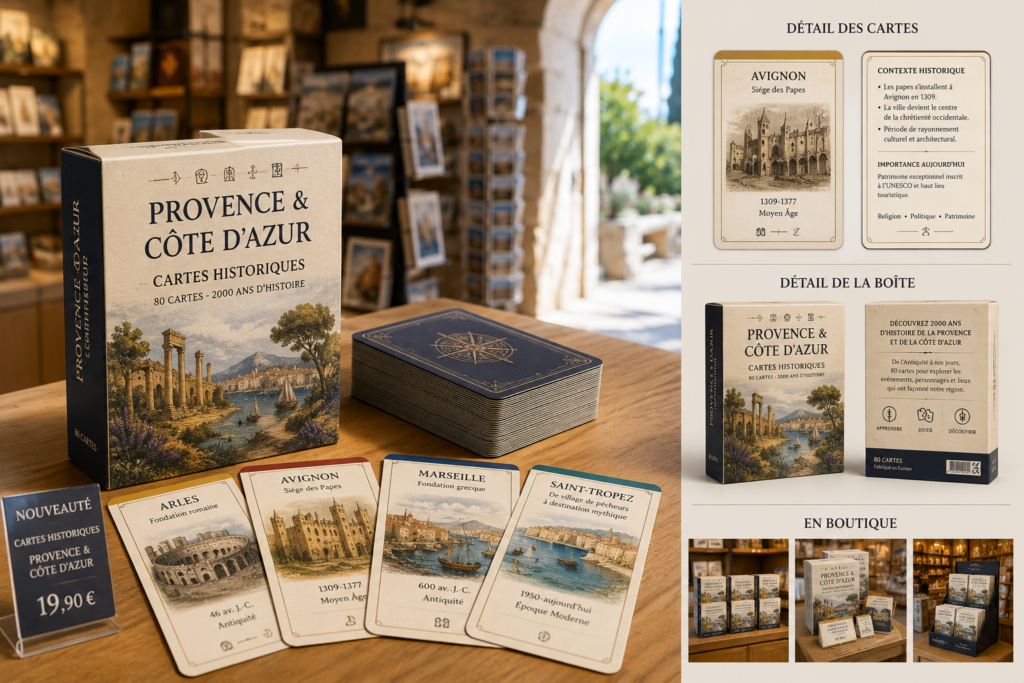
About the cards
Provence and the Côte d’Azur are more than just landscapes. They are the setting for empires, religious wars, artistic revolutions, and economic upheavals.
It was here that Napoleon Bonaparte marched back to Paris. It was here that Pablo Picasso’s colors and Vincent van Gogh’s art took shape. It was here, in Avignon, that popes reshaped the power structure of Europe.
But behind the beauty of the Riviera lies another story:
plague epidemics, pirates, secret smuggling routes, and forgotten fortresses.
“PROVENCE AND THE CÔTE D’AZUR HISTORICA” brings this world to life as a strategic card game—playable, collectible, and historically immersive.
Not as a textbook.
But as a clash between history and play.
About Us
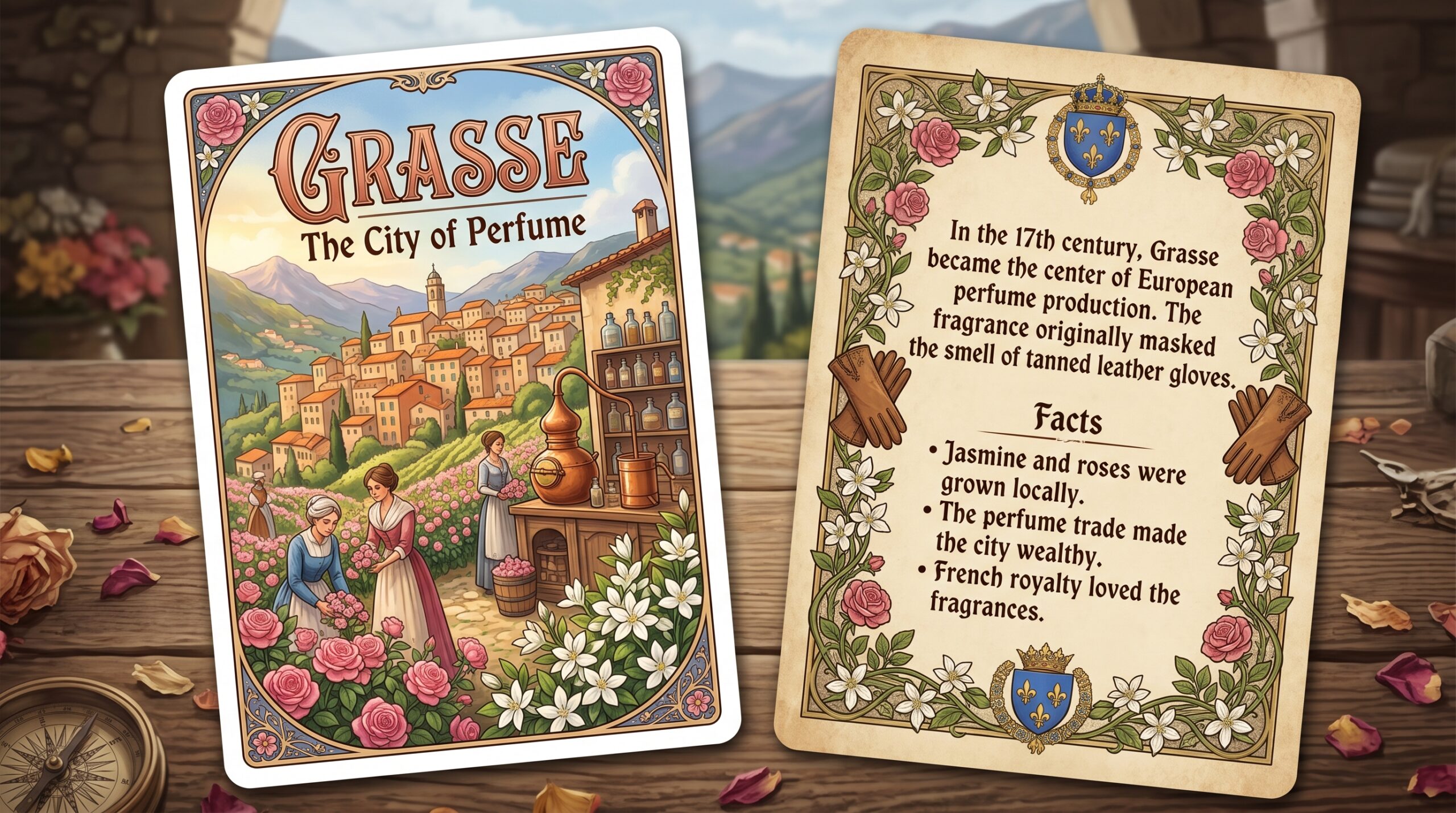
Grasse is a city in the Alpes-Maritimes department in southern France. It is considered the world capital of perfume and is located about 15 km north of Cannes on the slopes of the Côte d’Azur. It is known for its historic old town and its centuries-old tradition of perfume-making.
Key Facts
UNESCO Status: Intangible Cultural Heritage (2018, Art of Perfumery)
Region: Provence-Alpes-Côte d’Azur
Population: approx. 50,000 (2021)
Founded: in the Middle Ages
Economy: Perfume industry, tourism, agriculture
About Us
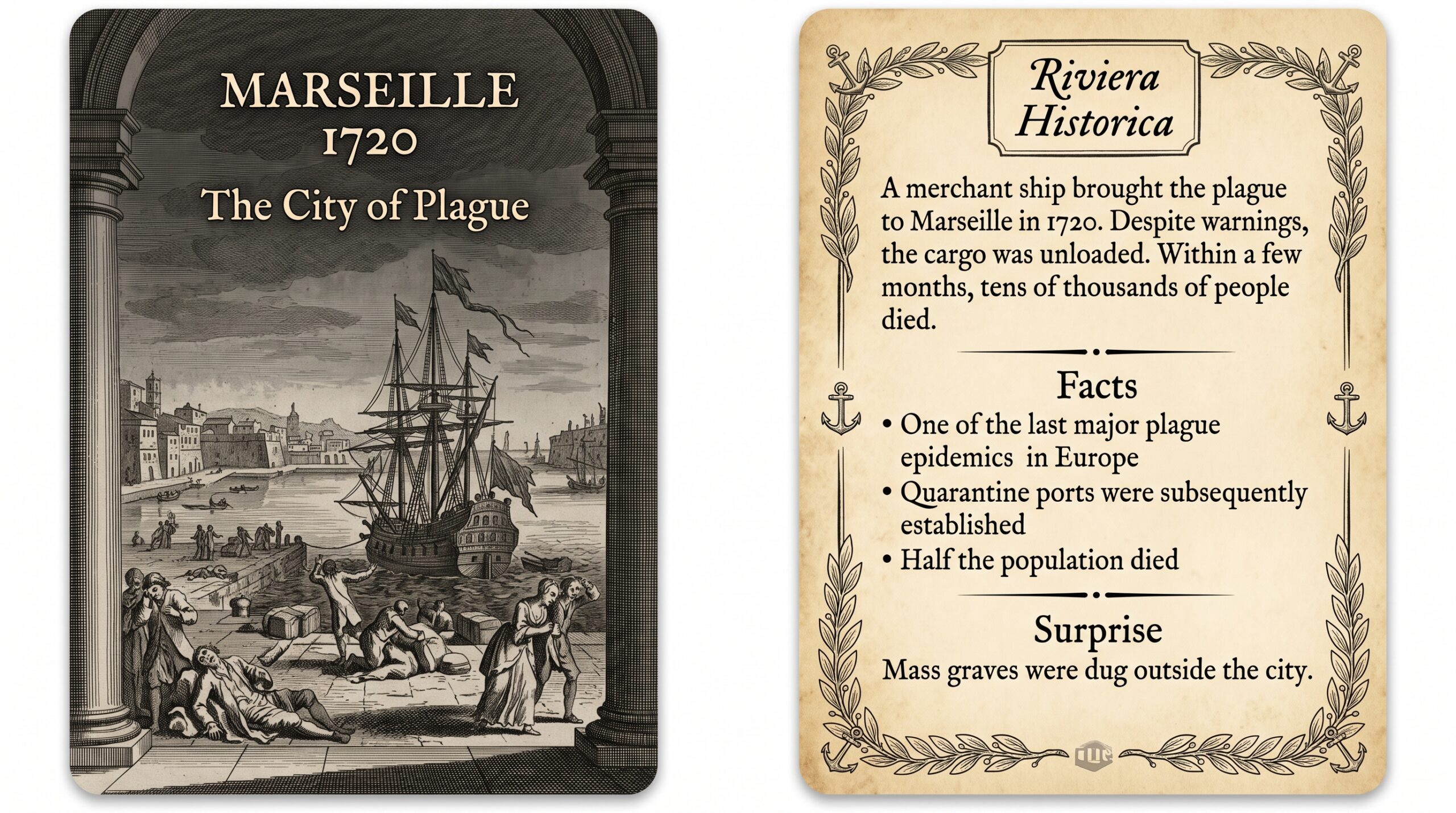
Marseille is a city in the Bouches-du-Rhône department in southern France. It is the second-largest city in France and the country’s oldest city, located on the Mediterranean coast in the Provence-Alpes-Côte d’Azur region. It is known for its historic Old Port, multicultural atmosphere, and important role as a major maritime hub.
Key Facts
UNESCO Status: Part of the “Marseille, European Capital of Culture” legacy (2013)
Region: Provence-Alpes-Côte d’Azur
Population: approx. 870,000 (2021)
Founded: around 600 BC by Greek settlers from Phocaea
Economy: Port and shipping industry, tourism, trade, culture, fisheries
Got questions?
Feel free to reach out.
Kartenset: „Geschichte der Provence – 2000 Jahre im Süden Frankreichs“
Kategorie 1: Antike / Römerzeit (1–10)
- Gründung von Massalia (heutiges Marseille) durch Griechen (ca. 600 v. Chr.)
- Ausbau von Aquädukten in der Region Provence
- Bau des römischen Amphitheaters in Arles
- Gründung von Nemausus (heutiges Nîmes)
- Via Aurelia – römische Handelsstraße entlang der Küste
- Römische Weinproduktion in der Provence
- Triumphbogen von Orange
- Integration der Region in die römische Provinz Gallia Narbonensis
- Entwicklung von römischen Thermen in Aix
- Christianisierung der Städte im 4. Jahrhundert
Kategorie 2: Mittelalter (11–20)
- Gründung des Herzogtums Provence
- Bau der Festung von Les Baux-de-Provence
- Papsttum in Avignon (1309–1377)
- Bau des Papstpalasts in Avignon
- Pestepidemien im 14. Jahrhundert
- Handelsmacht Marseille im Mittelalter
- Kreuzzüge und Beteiligung provenzalischer Ritter
- Entwicklung romanischer Kirchenarchitektur
- Konflikte zwischen Provence und französischer Krone
- Aufstieg der Grafen von Provence
Kategorie 3: Renaissance & Frühe Neuzeit (21–30)
- Integration der Provence in das Königreich Frankreich (1481)
- Entwicklung von Aix als Verwaltungssitz
- Bau repräsentativer Stadtpaläste in Aix-en-Provence
- Seiden- und Textilhandel in Marseille
- Einfluss italienischer Renaissance auf Architektur
- Ausbau der Hafenwirtschaft
- Religionskriege in Südfrankreich
- Künstlerische Blüte in Aix
- Entwicklung lokaler Märkte (marchés provençaux)
- Einführung moderner Steuerverwaltung
Kategorie 4: Französische Revolution (31–40)
- Revolutionäre Unruhen in Marseille
- Bildung von lokalen Jakobiner-Clubs
- Abschaffung der Feudalrechte in der Provence
- Umbenennung von Kirchen und öffentlichen Plätzen
- Beteiligung provenzalischer Truppen an Revolutionskriegen
- Widerstand royalistischer Gruppen
- Hinrichtungen während der Terrorphase
- Neue Verwaltungsstruktur (Départements)
- Aufstieg der Nationalgarde in Südfrankreich
- Marseille als Zentrum revolutionärer Lieder („La Marseillaise“)
Kategorie 5: 19. Jahrhundert / Industrialisierung (41–50)
- Ausbau des Hafens von Marseille
- Eisenbahnverbindung Paris–Marseille
- Industrialisierung der Küstenregion
- Wachstum der Weinwirtschaft
- Urbanisierung von Aix und Marseille
- Kolonialhandel über Marseille
- Entwicklung der Lavendelindustrie
- Hafenarbeit und Migration
- Bau moderner Boulevards
- Erste touristische Reisen an die Côte d’Azur
Kategorie 6: Kunst & Kultur (51–60)
- Paul Cézanne in Aix-en-Provence
- Vincent van Gogh in Arles
- Entwicklung der provenzalischen Malerei
- Gründung von Kunstakademien in der Region
- Einfluss des Lichts der Provence auf Impressionismus
- Literatur von Frédéric Mistral (Provenzalische Sprache)
- Opern- und Theaterkultur in Marseille
- Entstehung lokaler Volksfeste
- Entwicklung der Lavendel-Ikonografie
- Künstlerkolonien in Südfrankreich
Kategorie 7: 20. Jahrhundert & Kriegszeit (61–70)
- Marseille im Ersten Weltkrieg als Hafen für Truppen
- Widerstand in der Provence im Zweiten Weltkrieg
- Besetzung Südfrankreichs durch Deutschland (1942)
- Résistance in den Alpen und Provence
- Befreiung von Marseille 1944
- Wiederaufbau nach dem Krieg
- Migration aus Nordafrika nach Marseille
- Wirtschaftlicher Aufschwung der Nachkriegszeit
- Entwicklung des Tourismus an der Côte d’Azur
- Filmindustrie in Cannes und Umgebung
Kategorie 8: Moderne Provence & Côte d’Azur (71–80)
- Entwicklung von Cannes als Filmstadt
- Internationalisierung von Marseille als Hafenmetropole
- Tourismusboom an der Riviera
- Gründung des Filmfestivals von Cannes
- Ausbau der Autobahnen und Flughäfen
- Schutz von Naturparks (Calanques)
- Luxustourismus in der Côte d’Azur
- Integration europäischer Kulturprojekte
- Wein- und Kulinarik-Tourismus
- Moderne Identität der Provence als Kultur- und Reiseziel